“The failure to see direct experience as the irreducible wellspring of knowledge is precisely the Blind Spot”
This might be the first book to be burned by scientists and lovers of empiricism, famous for not burning books, because of how heretical it’s claims, uh, claim to be. Count me in this shocked group.
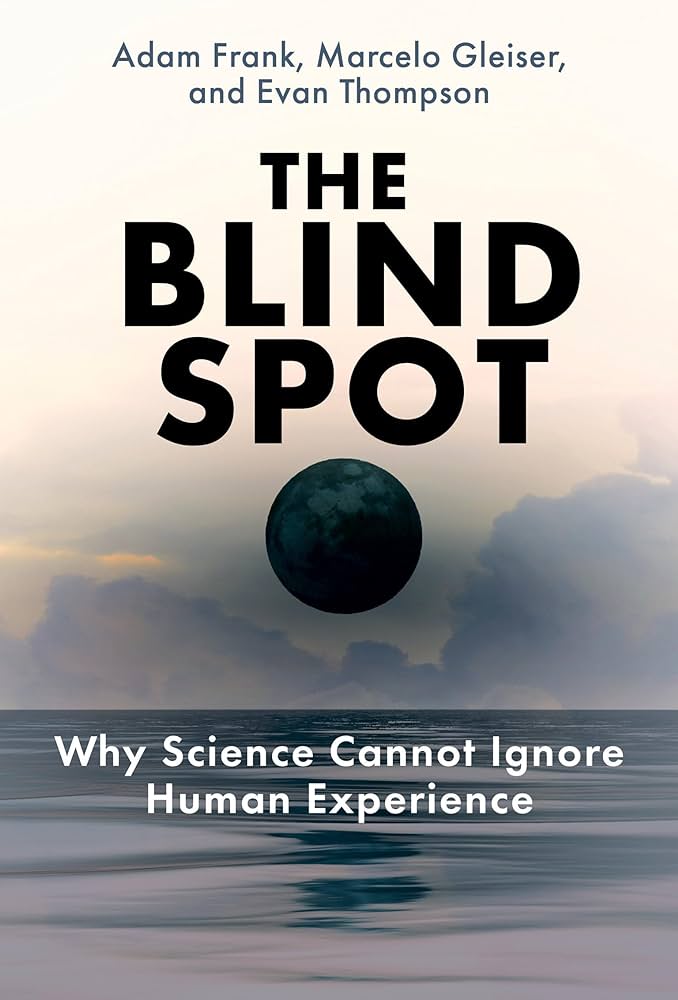
With years advocating for scientific methods, working as an educator in the Denver Museum of Nature and Science, and believing in the power of objective/critical thinking handed down from Plato and Socrates, I felt like a naughty dilettante as I read through the author’s explanation that empirical science has both expanded, and drastically curtailed, human flourishing.
How can that be?
Well – it’s a simple irrefutable truth – there is no objective view from nowhere.
It’s tempting to think that science gives us a God’s-eye view of reality, an observational window into the innermost workings of the universe itself, but thinking there is such a view absent of subjective, direct experience is not only misleading, it’s impossible.
The book claims that the “blind spot” of scientism has resulted in a sharp neglect and discrediting of human experience; and this neglect has had drastic effects.
To define the perils of the blind spot, we have to define where it came from, how it developed, and what a possible eyes-wide-open alternative blending of rationalism with reason might look like in the future.
SOCRATES & PLATO WERE DICKS
The book starts with a portrayal of the birth of the blind spot, with Socrates and Plato, the original philosophical wedges in between the real world humans experience and something else called “reality.”
As a longtime fan of philosophy, platonic solids, and the socratic method, it’s shocking to hear that Socrates and Plato, the founders of the philosophical and scientific traditions, were kinda dicks. And the reason for it was their belief in “logic”
Nietchze referred to Plato and Socrates as the world’s first “degenerates” – why?
The answer is their development of something now called FORMALISM and REDUCTIONISM – which mean, respectively, that the world is made up of many forms, and can be fully, logically explained and understood by breaking down, or reducing anything into composite parts. This is the birth of “the blind spot”.
Plato/Socrates believed in an abstract “more real” reality, which Nietzsche found to be self-defeating. Nietzsche argued against the concrete existence of abstracts, and urged us to embrace the material world more fully.
Socrates hated the irrationality of music, thought poetry was banal and writers of it should be excommunicated. He once said that if you translate poetry into prose, you can see poets aren’t saying much. So send them to an island? Ouch.
The main takeaway is they kicked off this “other than” relationship between objective reality and the subjective experience of it. Seen through the left brain/right brain lens of Ian McGilchrist, Socrates and Plato were heavily into left brain thinking, breaking everything down into parts, calculating, machine-like, not embodied, but empirical.
This grew into the modern philosophical and scientific belief that the primary level of reality is the measurable, objectifiable, quantifiable WHAT of existence, and the ineffable, subjective, and qualitative HOW we experience existence through, is a secondary phenomena, and to some, an illusion all together.
THE SCIENCE IS COMING
The book then leaps into the Enlightenment, and all the science that kicked off during this time. The establishment of empirical, testable, methods helped jump start massively great things. But again, this entrenched the Blind Spot into the Western world even more.
A causality of empiricism is the thinking that primary processes (atoms/cells/forces) are concrete reality, and secondary phenomena (feeling/experience) is window dressing. When the blind spot really digs in, is when something called surreptitious substitution happens, when we replace our experienced world for the empirical one.
“In the development of the modern scientific worldview, the abstract and idealized representation of nature in mathematical physics is covertly substituted for the concrete real world, the world we perceive. The perceptual world is demoted to the status of mere subjective appearance, while the universe of mathematical physics is promoted to the status of objective reality. Thus according to this way of thinking, temperature or the average kinetic energy of atoms or molecules is what’s objectively real, but the feelings of hot and cold are mere subjective appearances.”
Galileo’s frictionless plane, Newton’s absolute time, the Bohr model of the atom with a dense nucleus surrounded by electrons in quantized orbits, and evolutionary-biological models of totally isolated populations – these are idealized representations that came from and exist in the minds of scientists. They are not concrete realities in the natural world we live in.
“The predictive models of physics work mostly inside walls – the walls of a lab, a particle detector, a large thermos, a battery casing. In other words, the models work in places what we can control and shield from outside influences and where we can precisely arrange the conditions to fit the models.”
This is where I struggled a bit – it isn’t that these models of scientific thinking are MADE UP, but that they were created by the subjective understanding and experiencing of things by these scientists, and then replicated in tightly controlled, easily measurable, laboratory workshops – but in the real world, these things are in such a dynamic and complicated web of systems, the lab findings rarely match up with life, so rather than cop to that reality, we break off into more abstractions.
“A loaded and unnecessary metaphysical assumption about what the world is like outside the range of our ability to construct and test predictive models. The assumption is that how things behave in tightly controlled and manufactured environments should be our guide to how things behave in uncontrolled and unfabricated settings.”
So, the TL;DR is:
Real: objectivity, planes, atoms, genes, math, statistics
Illusion: subjectivity, experience, reality, life, existence
This is our modern approach to the world, and it’s messing us up….because it seeks to remove us (the understanders) from understanding.
Here’s where the Blind Spot hits our modern problems and touches on our fervor with consciousness in AI. We are trying to measure consciousness in humans, to then map it onto AI, but we cannot do this without using our consciousness or our subjective experience.
“There is no way to step outside of consciousness and measure it against something else. Everything we investigate, including consciousness and it’s relation to the brain, resides within the horizon of consciousness.”
THE ANSWER
The way forward is to accept that through an over-reliance on science and measurability, we have been substituting our ability to map out our experiences of the world, for the world itself. We have to develop a world-view that views life as a huge, dynamic, non-linear, insanely complex network that can be reduced to parts to understand functions, but these small patches of clarity cannot be bubbled up to explain the entire web.
“We’re authors of the scientific narrative, and we’re characters within it. As authors, we create science. As characters in the narrative we’re a miniscule part of the immense cosmos. This is how we must portray ourselves as creators of the scientific narrative. There is no way to take ourselves out of the story and tell it from a God’s-eye perspective. Instead of saying that science is a means for rising above the great, strange mystery of being human, a better story is that science takes us deeper into that mystery, revealing new ways to experience it, delight in it, and most of all value it. By leaving behind the Blind Spot, we can properly understand the crucial importance of objectivity as a means for public knowledge without transforming it into a dubious ontology.”
PICK UP THE BOOK – https://a.co/d/6edWUje
 POSMarketing