A Data-Driven Reflection on Ogilvy’s Wisdom
David Ogilvy famously observed, “Consumers don’t think how they feel. They don’t say what they think, and they don’t do what they say.” This axiom expresses his belief, and a common observation in marketing, that we should not place undue reliance on what consumers claim to believe or want.
And so, the industry seemingly understood Ogilvy’s quote as a call to ignore customers, and gather cold hard data on them to look at, and finally really understand, what they actually do, want, think, feel.
Fast forward several decades, and the marketing industry has undergone a seismic shift. The rise of data-driven strategies has enabled a relentless pursuit of quantitative efficiency, often at the expense of qualitative effectiveness.
But what happens when the very data we rely on is, to put it bluntly, a rats’ nest of inaccuracies, mislabels, and outdated assumptions?
The Myth of Precision in Data-Driven Marketing
When I downloaded my personal data profiles from major brokers like Experian, Acxiom, and Equifax, what I found was astonishingly inaccurate.
Misaligned geo-coordinates, outdated life events, and inferences that seemed plucked from an alternate reality.
My attempt to question this led to an unexpected scolding on LinkedIn—a dismissal of my concerns with the argument that I didn’t understand how marketing data is “actually used.”
The defense? This data isn’t meant to describe me, the individual, but rather to approximate my membership in broader statistical groupings and cohorts.
Yet, isn’t the promise of targeting and digital advertising to reach the “right person, with the right message, at the right time”?
This promise sounds precise and personal, yet it rests on statistical inferences that are anything but.
Who Am I to the Machines?
As I stared at these PDFs and spreadsheets, I couldn’t help but wonder: Am I this profile? Who constructed this approximation of me, and why does it exist? The experience felt oddly dystopian—a disjointed identity cobbled together by algorithms and sold as a marketable commodity.
It’s less about understanding who I am, and more about creating the appearance that platforms and advertisers can.
The reality is sobering. Much of the infrastructure underlying digital advertising—the vast data exchanges, real-time bidding systems, and audience segmentation—exists to maintain the illusion that every individual is reachable, accounted for, and fully understood. But when I dug a little deeper, I saw what appears to me as a shaky foundation built on probabilistic assumptions, not concrete truths.
The Illusion of “We Have the Meats”
Picture this: data profiles are the “meat” offered by the priests of marketing—packaged, categorized, and sold to advertisers as “we have the soccer moms, we have the high-income millennials, we have the early tech adopters.
These profiles connote meaning and imply precision, but the actual meat of the matter is far less robust. They’re not individuals but statistical abstractions, inferred from a soup of signals and assumptions.
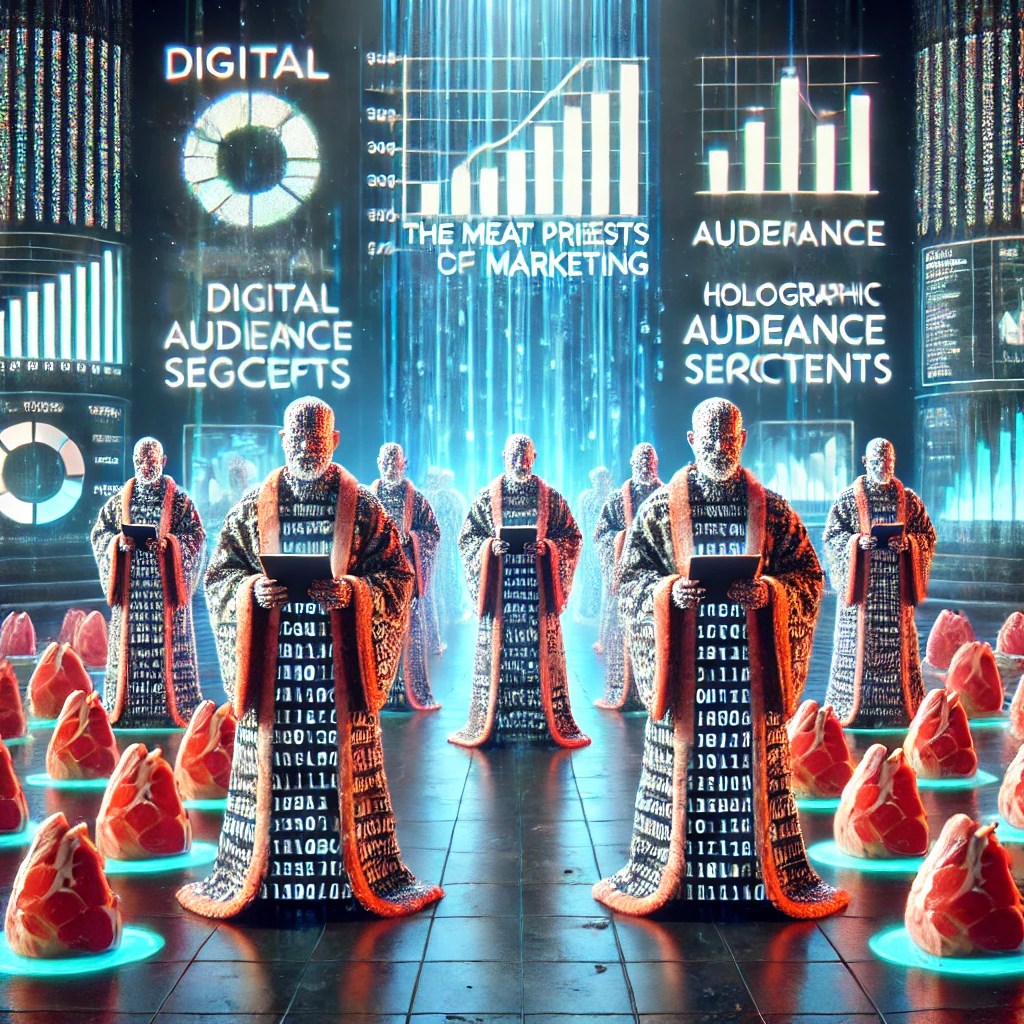
The issue isn’t the existence of these profiles, or their veracity, but their role as drywall filling for the modern marketing ecosystem. Platforms and media destinations prioritize convincing advertisers that they have access to every conceivable audience over creating accurate, ethical, and transparent connections.
What’s sold is the perception of precision, not the reality of it.
All this for….what?
If collecting every single piece of data on every single person on the internet has not yet yielded a bulletproof marketing strategy, a few military-grade pieces of advice on irrefutable tactics, or at the very least a few guiding principles for marketing we all agree on 100%, why do we keep amassing it? 🤔
We should, by now, have something close to the Holy Grail for techno-minded marketers after all the data we gathered and can access, but instead we have, a holy sh*t load of data that very few marketers know what to do with….
Real-Time Data or Watching the Kettle Boil?
Marketers love their dashboards, with data syncing every 15 minutes to provide “real-time” insights. But what exactly are we tracking? Consumer data profiles—altered and updated daily—might offer a snapshot of current behaviors, but they don’t capture the enduring essence of who consumers are.
Any “real-time” dashboard, in most cases, is reflecting echoes of recent marketing efforts, with actions observed today potentially being the residual effects of campaigns from many months prior.
If consumer data profiles can change multiple times in a single day, what actionable insight can we truly derive? Can we trust data that is in constant flux to inform long-term strategies? And if a small shift is detected, how would we even respond at scale without undermining our broader objectives?
Toward a More Thoughtful Use of Data
The answer lies not in abandoning data but in rethinking how we use it. Instead of chasing the illusion of precision, marketers should embrace the messiness of human behavior. This means prioritizing qualitative insights alongside quantitative metrics, acknowledging the limitations of current systems, and striving for a balance between scale and personalization.
Ogilvy’s wisdom is more relevant than ever. Consumers will never be fully captured by what they say, think, or even do. And the marketing industry must recognize that its data-driven tools are not omniscient but merely useful—when wielded thoughtfully.
In the end, it’s not about having the most data but about understanding its context and limitations, using it to build connections that resonate on a human level, not just a statistical one.
 POSMarketing