What a World Without Invisible Influence Could Teach Us About Attention, Trust, and Choice
Imagine a world where social media algorithms suddenly vanished. No invisible sorting. No predictive nudging. No unseen hands rearranging what you see and feel.
Only raw, organic feeds — chronological, popularity-based, and human. Or, maybe that’s what you think social media is anyway….
How We Got Here
Before algorithms dominated social media, platforms like Facebook and Twitter organized content chronologically. The most recent posts appeared first; popularity was visible but peripheral. Discovery was driven by networks of friends, geography, and cultural gravity — not hidden mathematical models seeking to prolong attention.
Today, that landscape is radically different. Modern feeds are precision-designed to sustain engagement by prioritizing:
Controversy: Outrage clings longer than agreement
Novelty: The new outcompetes the familiar
Emotional Intensity: Strong feelings crowd out muted ones
Tribal Identity: “Us versus them” narratives take precedence
This architecture does not reward the best ideas. It rewards the ideas that keep you suspended inside the feed.
Conspiracy theories, hyper-partisan news, surreal micro-trends — they did not thrive accidentally. They were mechanically advantaged.
A World Without the Algorithm
If the hidden engines were silenced overnight, a profound shift would unfold.
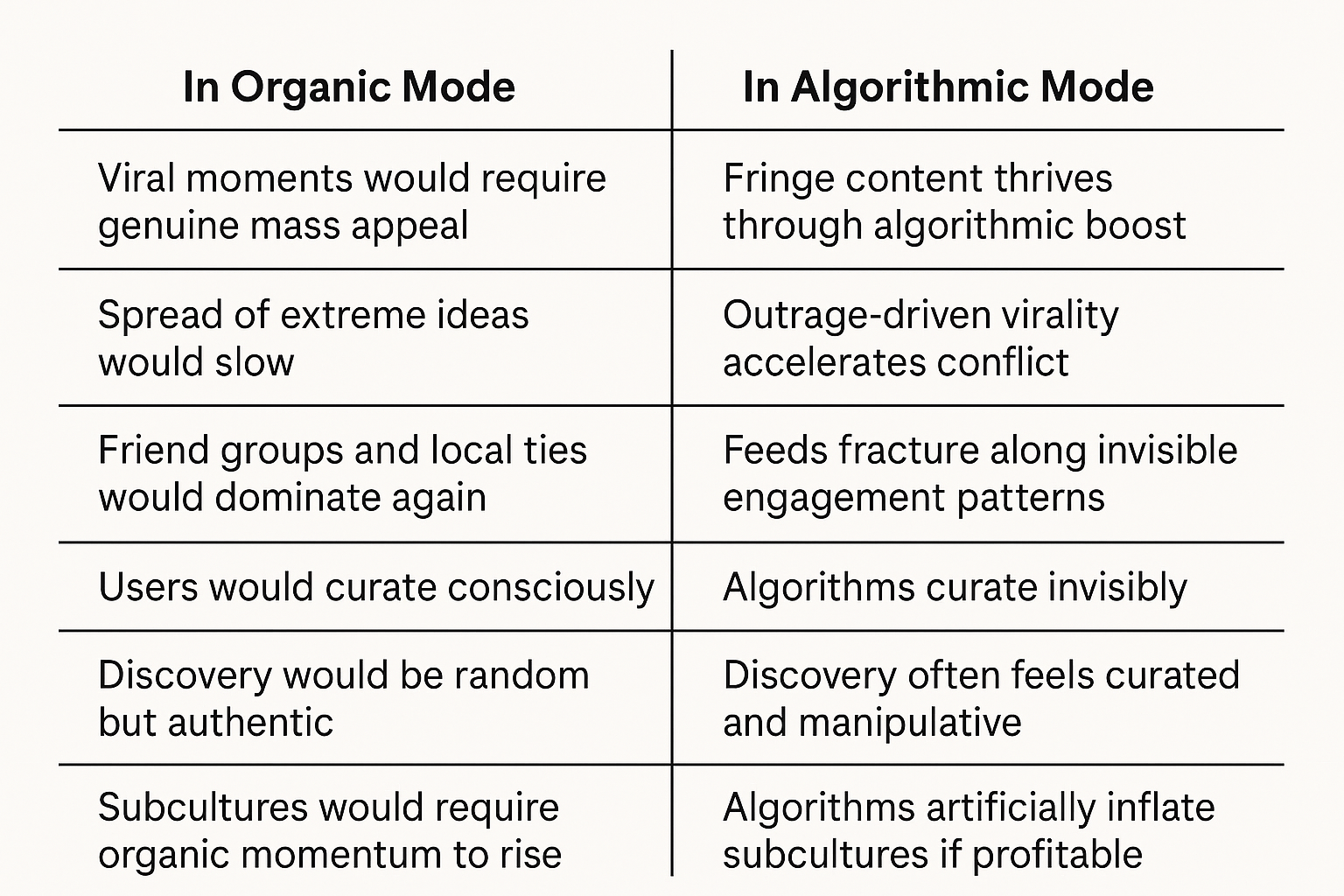
In the short term, social feeds would appear slower, flatter, even mundane. Polarization would ease. Virality would cool. The engineered emotional high would dissipate.
Many brands, media outlets, and influencers, built on the scaffolding of algorithmic leverage, would see traffic collapse.
Longer Reverberations
Over time, deeper cultural transformations would take root:
Localism Resurfaces: Friend groups, neighbors, and geographic cultures regain primacy over abstract ideological factions.
Creativity Rekindles: Untethered from algorithmic incentives, new forms of expression — strange, slow, sublime — would reemerge.
Communities Stabilize: Subcultures would grow without radicalizing feedback loops driving them into extremes.
Visible Curation Demanded: Raw feeds, overwhelming by nature, would spark a hunger for honest, transparent curation tools.
The social fabric would slowly stitch itself back together, not through elimination of disagreement, but through reduction of manufactured emotional flooding.
Why It Matters
Research by organizations like the Alaska Humanities Forum highlights how polarization flourishes through mistrust, fear, and tribal loyalty — exactly the emotional fields algorithmic systems plow and harvest.
In a blackout, disagreement would persist. But the machinery that escalates every friction point into existential battle would falter.
Public life would no longer operate in “war mode” by default.
A Closing Reflection
The true antagonist is not algorithms themselves, but their invisibility, their opacity, their silent shaping of experience without consent.
If users could choose their curation engines — transparent, customizable, aligned to their own aims — the benefits of personalization could survive, without the corrosions of manipulation.
Imagine a future where algorithms are not unseen masters but visible instruments. Some designed for calm. Some for exploration. Some for discovery. Some for depth.
The feed would no longer be a trap disguised as a gift. It would be a tool, chosen freely, and wielded with understanding.
In the real world, right now, we could unplug from social media entirely. But then we’d conglomerate in another way, on another platform, and someone would show up with ways to corral us, and we’d be thankful to be in the barn, for a while, until it started burning, like the last ones.
Here are three things everyday people can start doing right now in light of the algorithm blackout thought experiment:
Reclaim Your Feed
Switch your social media settings to chronological where possible. Mute or unfollow accounts that inflame or exhaust you. Curate consciously — not passively — and treat your feed like a garden, not a slot machine.
Pause Before Sharing
Algorithms reward emotional reactivity. Resist the urge to repost things that provoke immediate anger or outrage. Ask: Do I understand this? Is it helping or harming? Slowing down can stop a toxic loop before it spreads.
Seek Out the Unexpected
Algorithms narrow what you see. Break that pattern by following people outside your usual circles — different geographies, politics, cultures. Genuine discovery rarely happens inside a predictive cage. Invite some randomness back in.
 POSMarketing