An honest look at how blame and shame distort marketing, what happens when teams confuse control with responsibility, and what we can do to change the story line.
If you’ve never been on a marketing team that has operated under:
- panic
- magical thinking
- misleading metrics
- scapegoating
- unrealistic expectations
…then this article isn’t for you.
Similarly, if you’ve never felt the following as a marketer:
- guilt & shame
- imposter syndrome
- perfectionism
- fear of failure
- over-apologizing
- taking accountability for things outside your control (e.g., “We didn’t go viral!”)
…you can close this tab.
And finally, if you’ve never felt like you’ve had a role (even a small one) in the problems in your life and work, you can not only stop reading but take a winning lap.
You’ve won life!
For everyone else, hi, I’m Jake Sanders, and in the past 11 years in this industry, I’ve been blamed for bad sales numbers when the only marketing budget was my salary, I’ve felt ashamed I couldn’t hold a ranking amidst inscrutable Core Updates. I’ve been made to, made myself, and made others feel like absolute dogshit based on poor results for things I thought could, but fundamentally can’t, be controlled.
I have felt this invisible blame and shame. I’ve manufactured it. I’ve handed it out.
If you’ve gotten to this point on the page, that means maybe you have too.
I’m here to rattle the bones of an emotional skeleton in our professional closet – the fact that blame and shame invisibly, palpably, negatively, and in most instances, pointlessly impact marketers. We have to unveil and fix the death shroud of blame and shame, and that work starts by acknowledging it’s real, admitting to and smoothing out some wrinkly truths we navigate daily because of it, and asking ourselves one single question: what can we actually control?
The Psychological Role of Control in Marketing
Let’s be honest, in full technicolor – do you think me, you, or the Joe and Jane marketer out there has any meaningful amount of control over these things, and, be for real:
- Algorithms
- AI
- Competitors
- Economic conditions or stock markets
- Platform decisions
- ‘The buyer’s journey’
- Impression quality
- Consumer attention
- Cultural momentum
- Legal, regulation or compliance
How many event ballrooms, LinkedIn hot takes, whitepapers, webinars, and pay-to-learn schemes have we attended/downloaded/seen promising to help marketers master navigating the above?
Still feels like I’m wrong though, doesn’t it? Deep inside.
I know I bristled while writing the list above. I still feel in my romantic heart that ‘one great ad’ can change the algorithm, a single drop of soul-shaking creativity could flood the market, one military-grade playbook would hack it, with enough money, with enough tech, one silver bullet would shoot my werewolf.
Maybe. You and I know better. Or, we’re getting there.
So, what is in control (ideally) of marketers?
- Strategy
- Creative quality / Distinctiveness
- Positioning
- Distribution/Cadence
- Customer Experience
- Budget Allocations
- Internal culture and discipline
- Measurement frameworks
Again, there are mountains of content and advice on enhancing, optimizing, and improving these controllable aspects of marketing, all fine and good – but if they’re being used with false confidence that they’ll increase control of the uncontrollable, it’s gonna fail.
Sounds like a hater perspective again, doesn’t it? Feels like it to me.
Let’s keep cooking…
The biggest issue, the titanic impact the marketing industry is facing, is a psychological one – not a business problem or a math problem or a strategy/framework problem, but a matter of mental perspective and discernment around CONTROL.
If someone doesn’t know the difference between what they can and can’t control, their mindset, ego, their whole identity pivots around a misconception, which ends up inverting their faith, cognitive functioning, and entire way of thinking.
What we can’t control often masquerades as what’s most measurable.
What we can control looks fuzzy and out of reach by comparison.
Said more simply…
We mistake visibility for control
The things marketers can’t control—impressions, clicks, reach, conversions, algorithmic performance, attribution models—are the things that show up cleanly in dashboards. They’re quantified, refreshed in real time, and framed as levers, so they feel actionable. Measurement creates the illusion of mastery.
Meanwhile, the things marketers can control—strategy quality, creative distinctiveness, positioning clarity, consistency, internal discipline, long-term brand signals—are harder to see, slower to validate, and messier to measure. They don’t update every morning. They require judgment instead of dashboards. So by comparison, they feel vague, subjective, and “out of reach.”
So the inversion happens:
- The measurable looks controllable (but isn’t).
- The controllable looks immeasurable (but is).
Marketers control the inputs—strategy, creativity, consistency, distribution, and brand signals.
They cannot control the closed systems, the probabilities, or the behaviors that ultimately decide outcomes.
But they can engineer them better if they play the right odds.
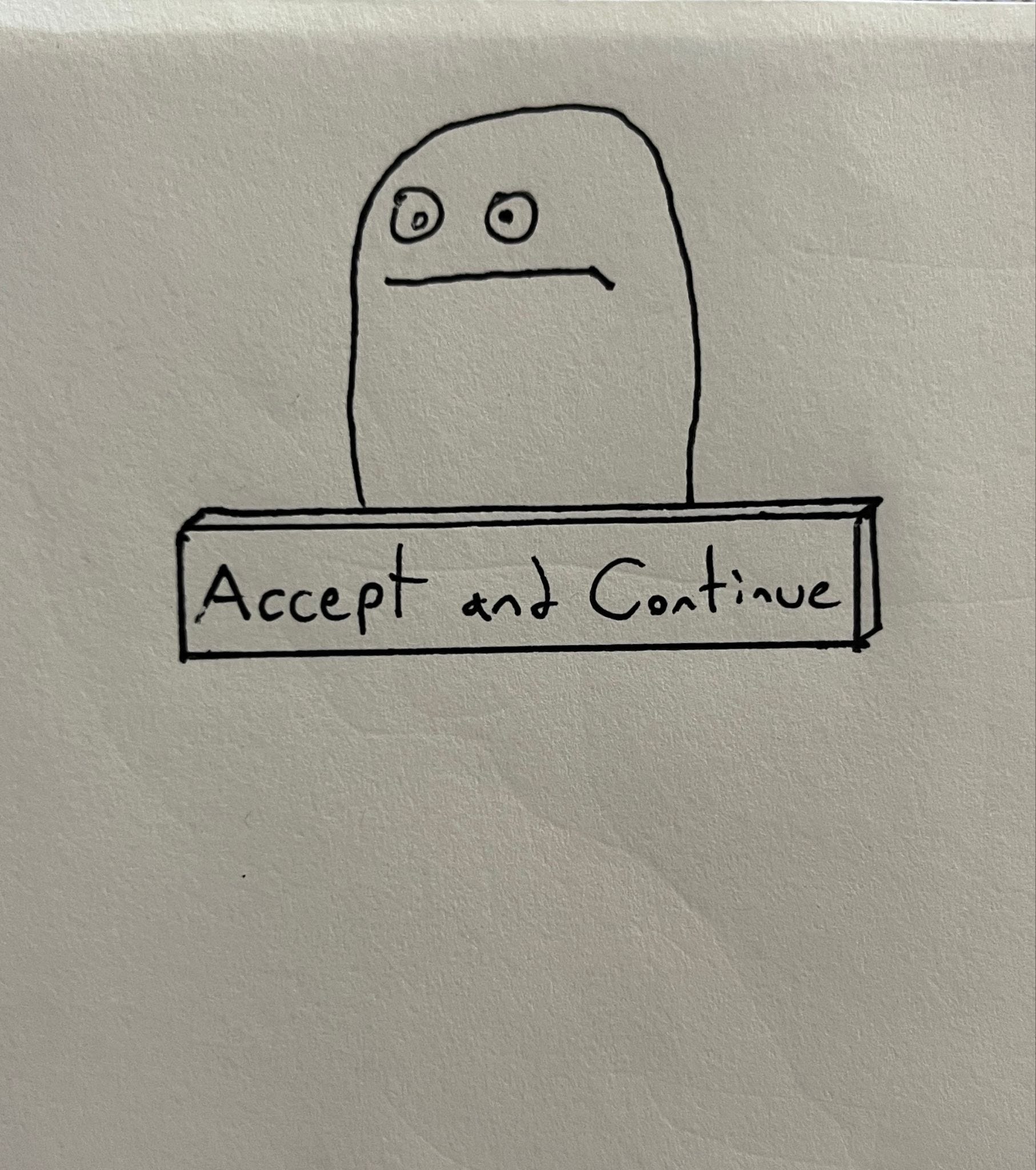
So this first part is critical. You have to be wise and courageous to definitively differentiate and accept what you can control and what you can’t.
Acceptance is NOT Resignation
I’ll say it again – Acceptance is not resignation.
Sit with this one.

Reflect on your feelings – doesn’t the word, “acceptance” bring to mind passivity. It feels weak, right? Feels like you just have to accept it. Right?
But how do you feel when you’re “accepted?” That’s massively different, isn’t it?
Real acceptance isn’t settling or compromising, but recognizing the ‘just-so’ nature of something or someone as a fact. We are loathe to do that, because it connects to CONTROL. Which means, we have a massive problem confusing acceptance and resignation because we are not wise or courageous about control.
Until you fully accept what you can’t control, you’ll never have the power to change anything.
The Impact of Blame & Shame in Marketing
Let’s bring blame and shame onto the stage, and describe briefly how they play out across the controllable and uncontrollable aspects of marketing—where they get misdirected, where they get absorbed unfairly, and where they shouldn’t exist at all because they create no value and distort reality.
Marketers often aim blame outward, at algorithms, platforms, or consumers. “Meta deprioritized us” or “people just don’t get our value prop” becomes a comforting narrative, but algorithms don’t owe you stability and consumers don’t owe you attention. Even predictable issues like programmatic waste or media under-delivery get framed as shocks rather than environmental conditions and strategic/financial limitations the team chose to operate within.
Inside organizations, the blame naturally reverses direction. Marketers absorb pressure for things no one can truly influence: quarterly sales swings, the cultural roulette of creative performance, the inherent and more than natural brokenness of attribution, or the chaos of black-box platform changes. They’re even held to account for problems rooted upstream in product, pricing, and distribution, treated as if communications & promotions alone can guild a lily and magically force the market to behave.
And then there’s the unhelpful emotional layer we slather, get slathered with, and slough off; shamed over creative underperformance when budgets are thin; shamed for not mastering the myriad parts of ad-tech (which are moved around every night by vampires, like in Dark City); guilt around imperfect audience understanding (we can’t understand some of our family members, but we know how consumers think?); or pressure to “optimize” weak strategy into success (the oldest and rankest tale in marketing’s emotional library).
Blame and shame collect wherever marketers, brands, and the business world clings to the illusion of control—pretending uncertainty is certainty, treating probabilistic systems as predictable, or using small levers to mimic mastery over forces they can’t steer. The result is a tangle of inflated expectations, warped accountability, avoidant leadership, burnout, and a culture that rewards performance of confidence instead of actual clarity.
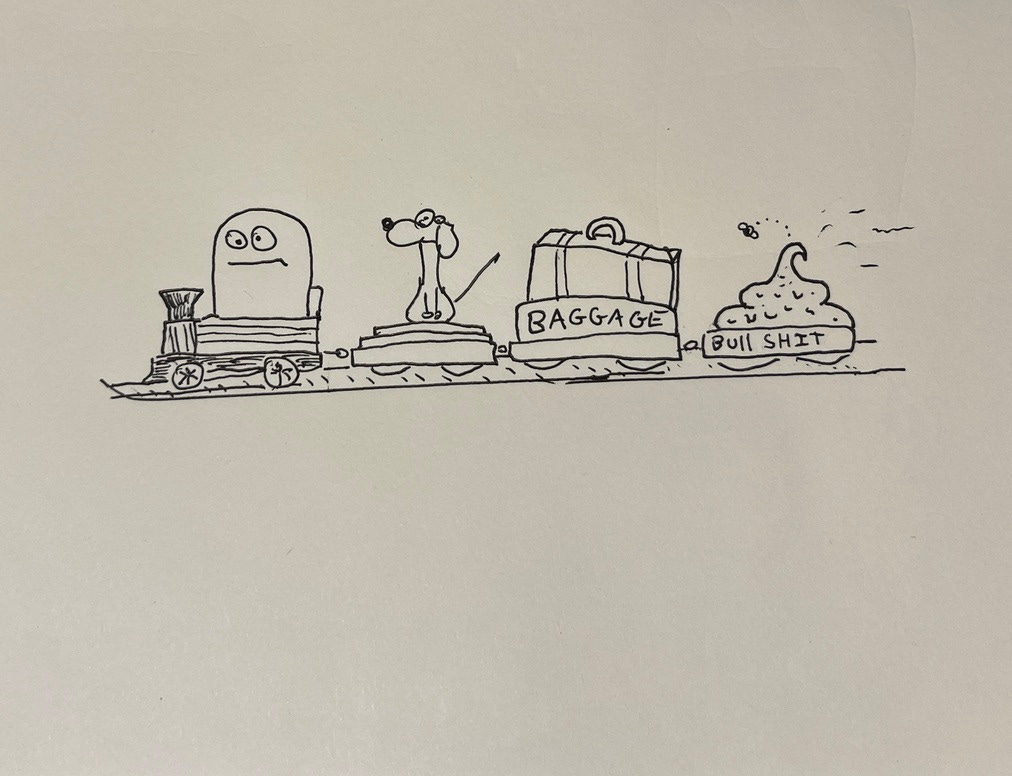
The work gets better the moment the blame & shame train stops and grounded sense replaces senseless flagellation.
How do we knock this unhelpful shit off?
The Myth of Blame-O & Shame The Dog
Double click to interact with video
I created Blame-O and Shame the Dog by accident while exploring the history and mythology around Paul Bunyan. I wrote an article about the research, and it’s worth quoting here for context;
“When Paul Bunyan (a pure content marketing play) was popularized in early 20th century literature by advertising executive WB Laughead, from the Red River Lumber Company, to mythologize and gin up public support for deforestation (particularly of protected Ojibwe lands), they didn’t really focus too much on his history, because the nation was young and without history. Fuzzy references to a before time, murky parentage, a crib 200 feet high, and untamed lands.
So the urge for Bunyan to do his thing and create the country, is not necessarily coming from anywhere, or answering to anything – it’s a clean slate myth, or it’s a myth that cleans the slate by its own steam (hot air).
A modern American myth might require a bit more backstory – but is it because Bunyan lacks precedence that his legend was so impactful? You don’t have to understand much anything else than awe and wonder to have these stories work on you. In fact, ignorance is a great canvas to paint a myth on. This isn’t to say smart people can’t get mythological, or that myths are suited for dumbasses, but the expansion of myth rests on audiences having a fuzzy grasp on facts.
I think it would behoove us to start mining some new myths that work for us, from the bottom up, or we’re gonna keep getting top-down myths that work on us.“
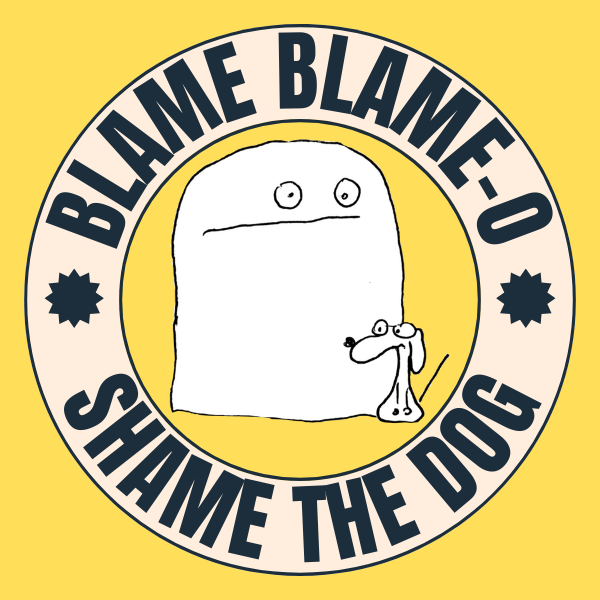
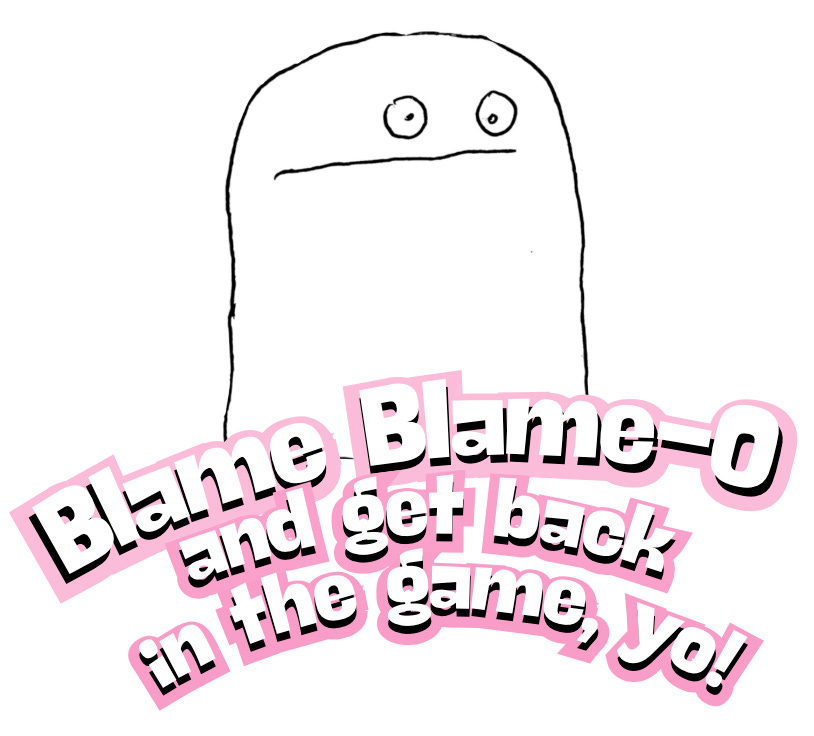
You can learn all about Blame-O and Shame the Dog’s origin story, but their function is to work first as physical manifestation of, then as a mirror of, and finally as a repository for, the dysfunctional behaviors and thinking associated with blame and shame, that has up until now been invisible.
Without a scapegoat for the insanely complicated tapestry of shame and blame that blanket our professional lives and smother our personal ones too, we’ll just keep piling on layers and won’t realize we’re the one’s doing the suffocating.
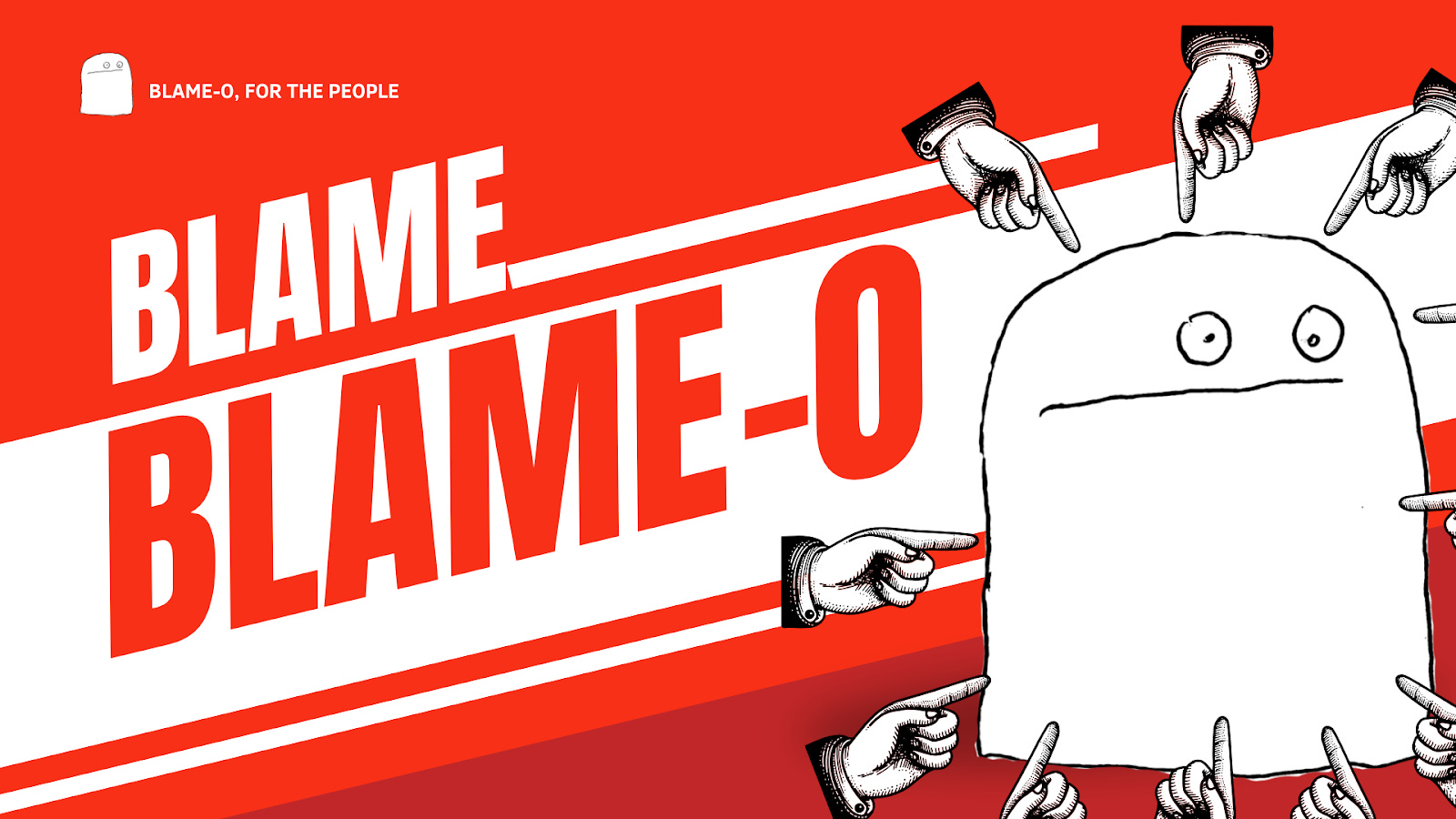
If we can blame Blame-O instead of ourselves or others, we stop using our finger to point and we put it on the pulse of what’s real and in our control.
Blame-O is a mythological symbol of honesty, accountability, clear measurement, evidence-driven and long-term thinking.
Blame-O not only illustrates the uselessness of blame, but identifies and dispels bad assumptions, magical thinking, or unscientific logic.
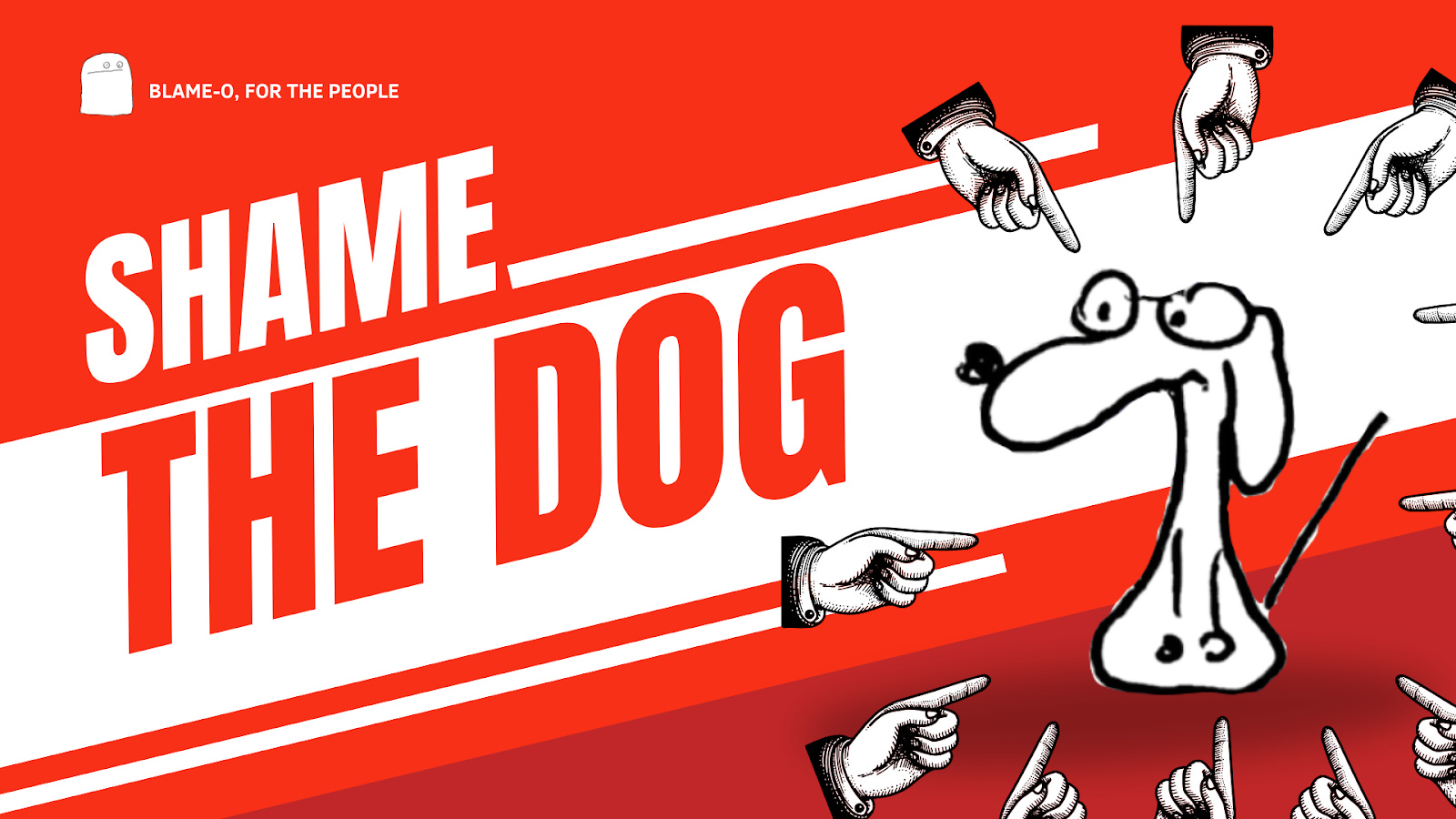
If we can shame Shame the Dog instead of ourselves or others, we start to recognize and prioritize what’s real over what we think we want to feel.
Shame the Dog is a mythological symbol of psychological safety, realistic benchmarks, ethical marketing, self-respect, and standing tall.
Shame the Dog not only illustrates the pointlessness of shame, but helps to identify and eradicate the instances where teams are over-owning things that have nothing to do with fault.
How to Use Blame-O and Shame The Dog
These characters are not the solution to all problems, but a metaphorical mechanism to manifest a mindset for actually doing work and coming up with solutions to solve them more effectively.
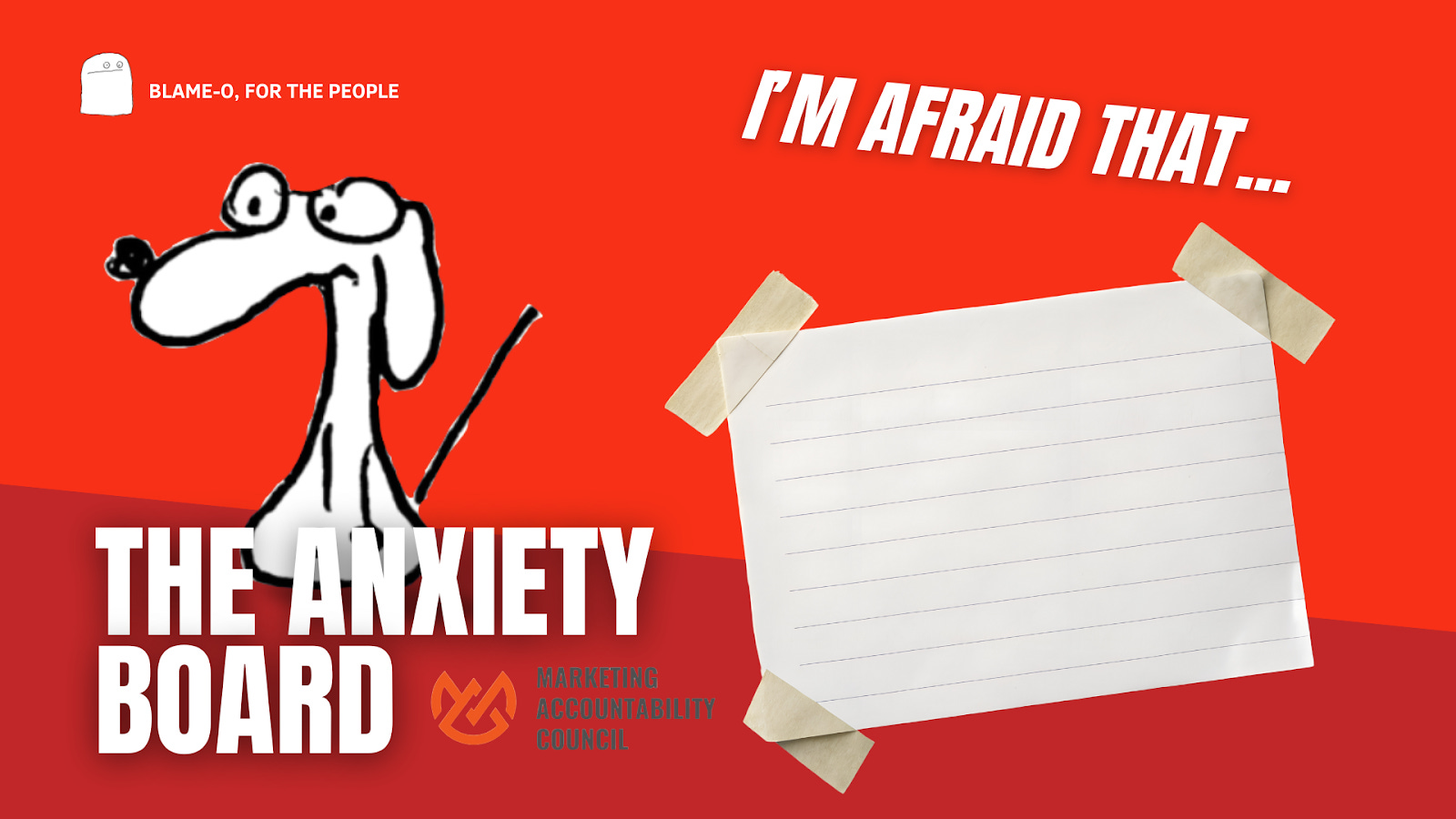
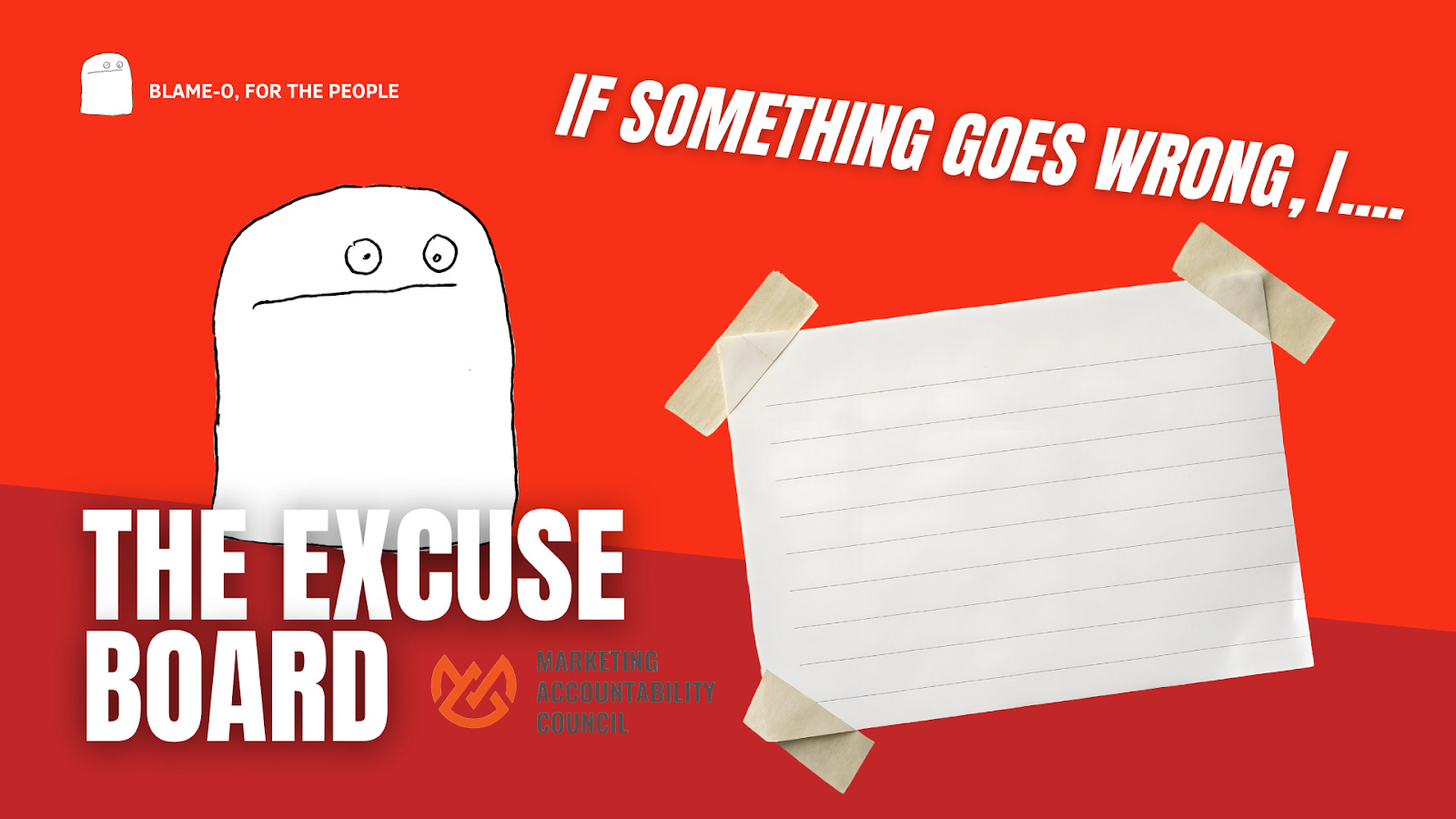
The easiest way to utilize Blame-O and Shame the Dog in marketing is to create two documents; an excuse board, and an anxiety board.
If you can write down all the excuses and anxieties you have around a project or job, and discuss it with your teammates, you instantly establish a transformative place to reflect, commiserate, and properly locate & dispel any shame or blame before it happens, grounding yourself, your team, and everyone on board in science and not self-punishment.
Blame-O and Shame the Dog are teaming up with the Marketing Accountability Council in the new year—expect more cartoons, tools, and training to follow.
Bringing Blame and Shame Home
As I’m trying to finish this and bring it home, I realized, we really need to talk to the people I dismissed at the top. The people who don’t see the blame or feel the shame like we do; we gotta talk to the clients and bosses and leaders that fundamentally believe they can control the uncontrollable, not because they are sociopaths, but simply on account that they’ve never questioned the difference.
How might you bring this up? Tell someone that they might maybe kinda be 100% delusional?
This conversation is difficult because it’s not about tactics but identity and how people understand competence.
Many leaders, ourselves included, learned that being “in control” is what makes them effective, so pointing out limits can feel like questioning their judgment and capabilities, not just their information.
That’s why the goal can’t be to correct or inform them, but to shift the frame. A useful move is to focus on alignment and risk, not blame:
“I want to make sure we’re setting goals we can actually stand behind. Can we separate what we directly control in marketing from the conditions we have to respond to?”
This keeps the conversation collaborative rather than corrective, though I imagine this question alone could get awkward and twisted, so tread in a team spirit kinda way, and lightly.
From there, the goal would be to distinguish between internal levers (strategy, creative, positioning, budget, measurement) and external forces (algorithms, competitors, economic shifts, buyer behavior). The insight lands more cleanly if they’re involved in the sorting themselves.
You can then name consequences without blame: when goals are anchored to controllables, performance compounds, when teams are judged on external forces, results get noisy and frustration rises.
The reframe ideally ends up as: marketing can’t control the environment, but it does control how intelligently and creatively we can respond, which is where real accountability and true advantage live.
Blame and shame thrive wherever we confuse influence with control. With help from Blame-O and Shame the Dog, we tame that confusion and take back the power—inside teams, across organizations, and within ourselves.
The work gets lighter, clearer, and better the moment we stop punishing people for perceived realities, and start holding ourselves accountable for how we behave in this one.
 POSMarketing