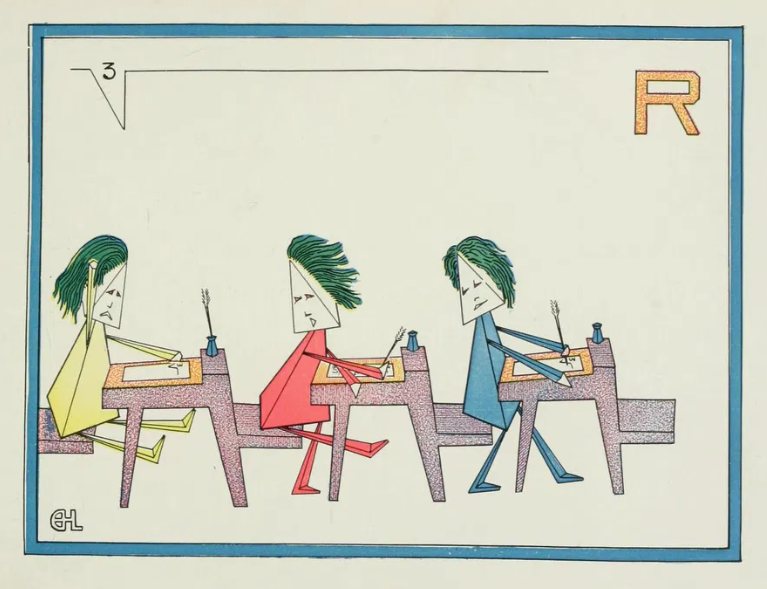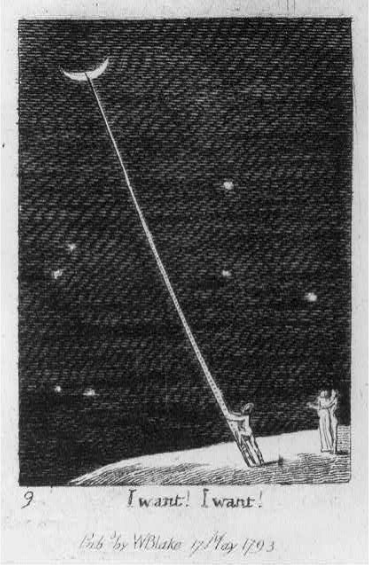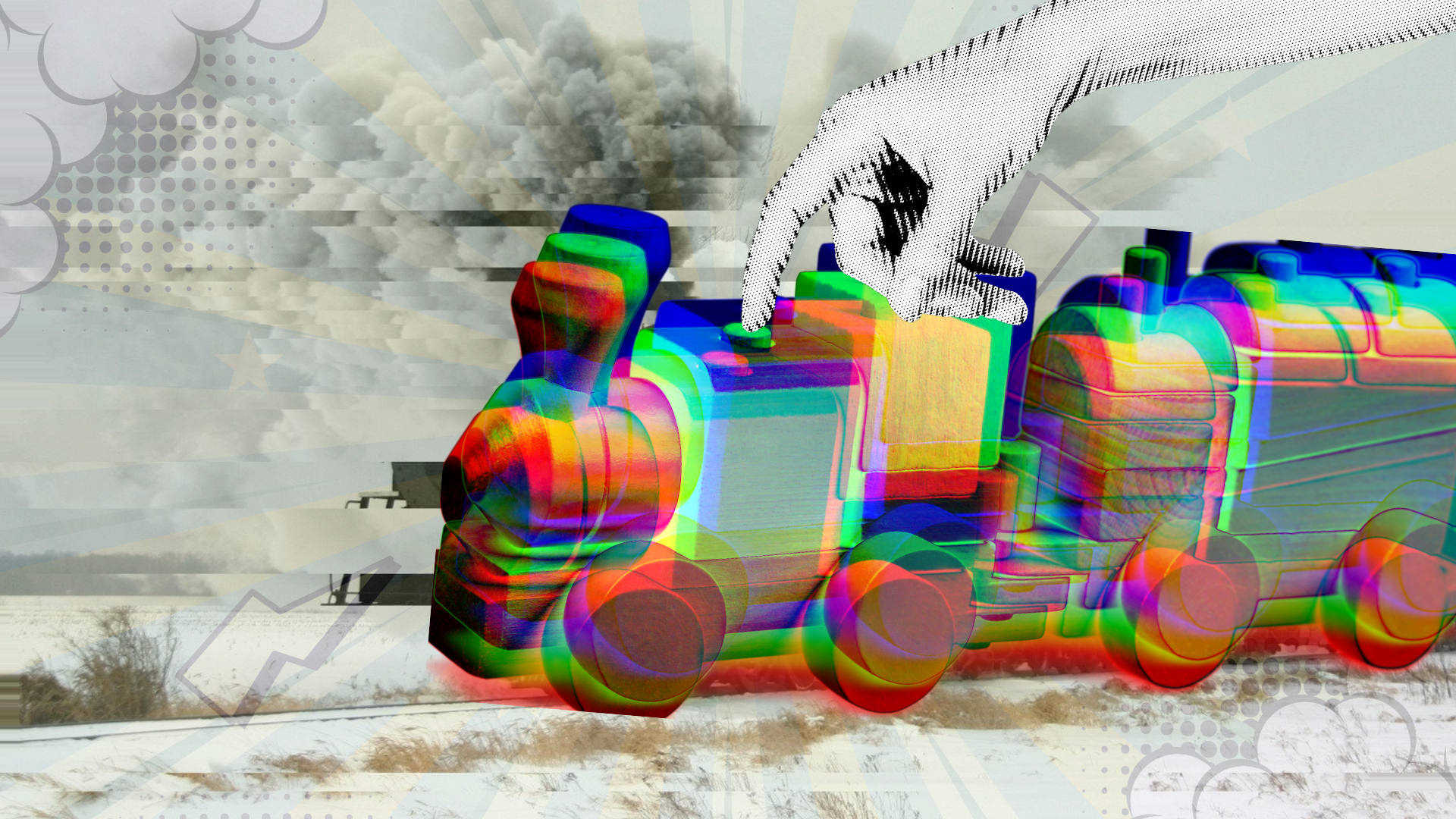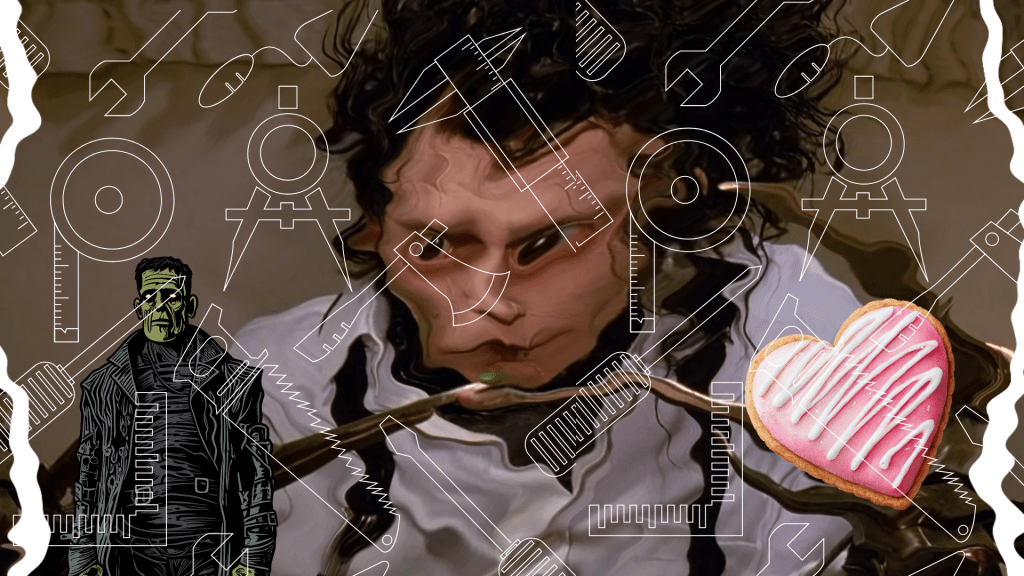
Edward AI Hands

An exploration into tools, purpose, and identity, how the current story of AI is more Edward Scissorhands than Frankenstein, and what it means to think (and live) inside/outside man-created machines.

Tools + Purpose = Identity

THE THOUGHT THAT KICKED THIS OFF: Tools aren’t meant to be attached to bodies.

When us humans invented the microscope or telescope, we didn’t invent them to be strapped to our face. We didn’t invent hammers as a substitute for hands. We didn’t replace the weather lady’s fingers with thermometers.

There is usually distance between tools and users and this is intermediated by purpose.

When the connection between a tool-user and a purpose is strong, this naturally forges identities. The blacksmith was both a tool-based service and a person. I’m a musician, and this identity is strongly linked with my use of instruments for the purpose of making music.

But I haven’t replaced my face with a saxophone. Yet.

Back in the day (still happens this way) you could step away from the lab equipment and still be a scientist and person, shut the machine down, you remained a worker, walk away from the canvas, you could remain an artist.

AI, with its broad reach into all aspects of our lives, personal, professional, and societal – is different from the tools of the past, though it’s confusingly compared with them.

Why confusing? Well…

A pervasive and always-on tool/service that connects you to actions that provide purpose, AI is designed to have zero separation; the hope is, you won’t be able to walk away from it.

I’m not just making this up. Take a look at this LinkedIn post…I removed the poster identity, but this is the interchangeable party line;
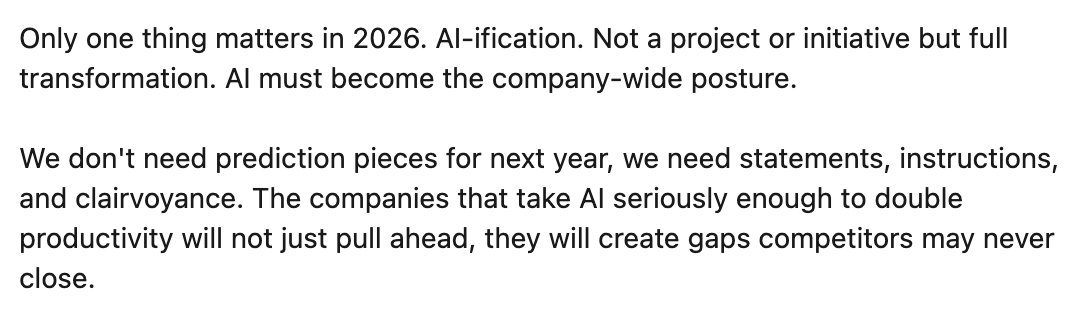
The fusion of purposeful tool-as-identity would be hard to avoid in this arrangement, indeed most AI proponents are busily finding any and every task and barrier, professional and personal and even spiritual, to bring the clean-thinking and rational, problem-solving powers of AI to finally optimize and overcome them.

But the full-AI fix requires everything to happen in the AI, within its tools.

AI is gunning to be always on and in use for every use case, so then, if we accept that identity easily fuses with tools, we don’t really have a purpose (or identity) other than being an extension for this all-in, always-on tool.

It isn’t the other way around like it used to be with all the other tools of the past.

That’s because we followed the wrong story about a man-made man….man.

Forget Frankenstein

The discourse around AI has centered around a Frankenstein-ish, promethean core – it’s a time of powerful men, grave robbing and appropriated piecemeal creation, technology bringing gothic obsessions to life, and grappling with the concept and inner-life of new forms of intelligence.

Most all-in AI enthusiasts fancy themselves as an interlocutor between the monster and the creator, an intermediating and highly literate force capable of translating the selfish terrors of technology into something that benefits all of mankind. A techno poet threading a new narrative of purpose-bound history onto outdated legends, anchoring grand visions to admittedly dead weight, harnessing external and omnipotent forces to animate the most internal aspects of our souls.

Yeah, sure, ok.

I think we skipped over another man-created-man cautionary tale, one that happens to slice right through the Franken-nonsense and dissects this tool-based, misperceived moment in the timeline for analysis.
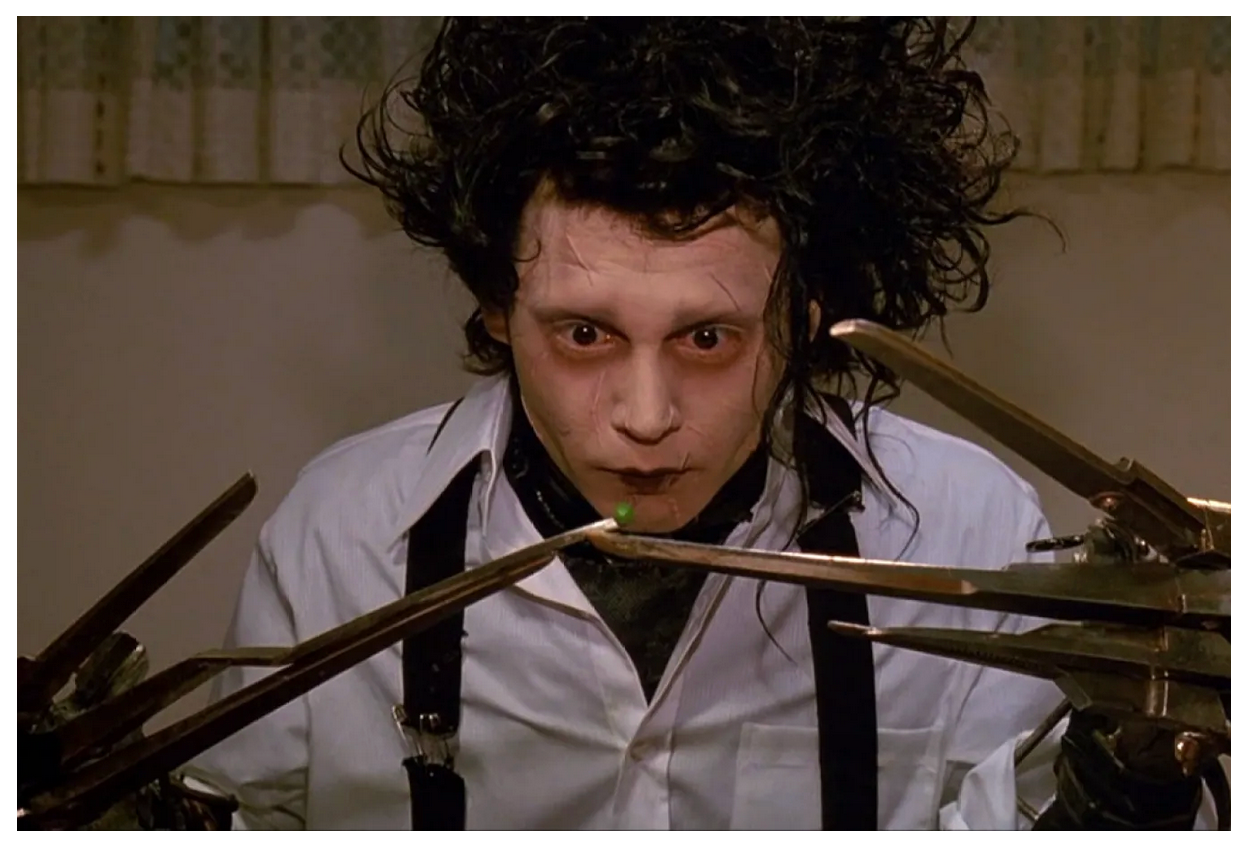
Focus on Edward Scissorhands

Tim Burton’s “Edward Scissorhands” is just an astonishing movie, in itself and for this moment in AI. It’s a story about non-conformity at the base, but there is an interesting tool/purpose/identity connection to AI’s power of cognitive capture on users that I think the movie makes accessible and palpably real.
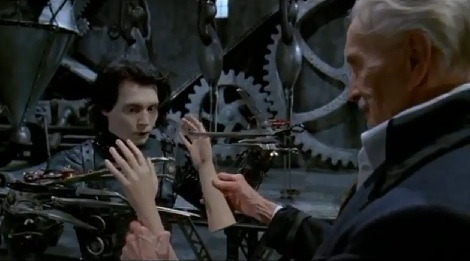
“Edward Scissorhands” is the story of a lonely technologist, who makes a companion out of ONE of his tools that performs a singular task in his cookie-making laboratory, and dies before giving the creation a heart and hands, leaving behind an unfinished lifeform that only has the tool-based sentimentality of his creator, and all the consciousness of a pair of scissors.

The way the Community reacts to Edward connects to how our culture initially responded to AI. It (named Edward by Diane Weist’s Peg) shows up out of nowhere, does amazing imaginative things people have never seen, what can’t it do?
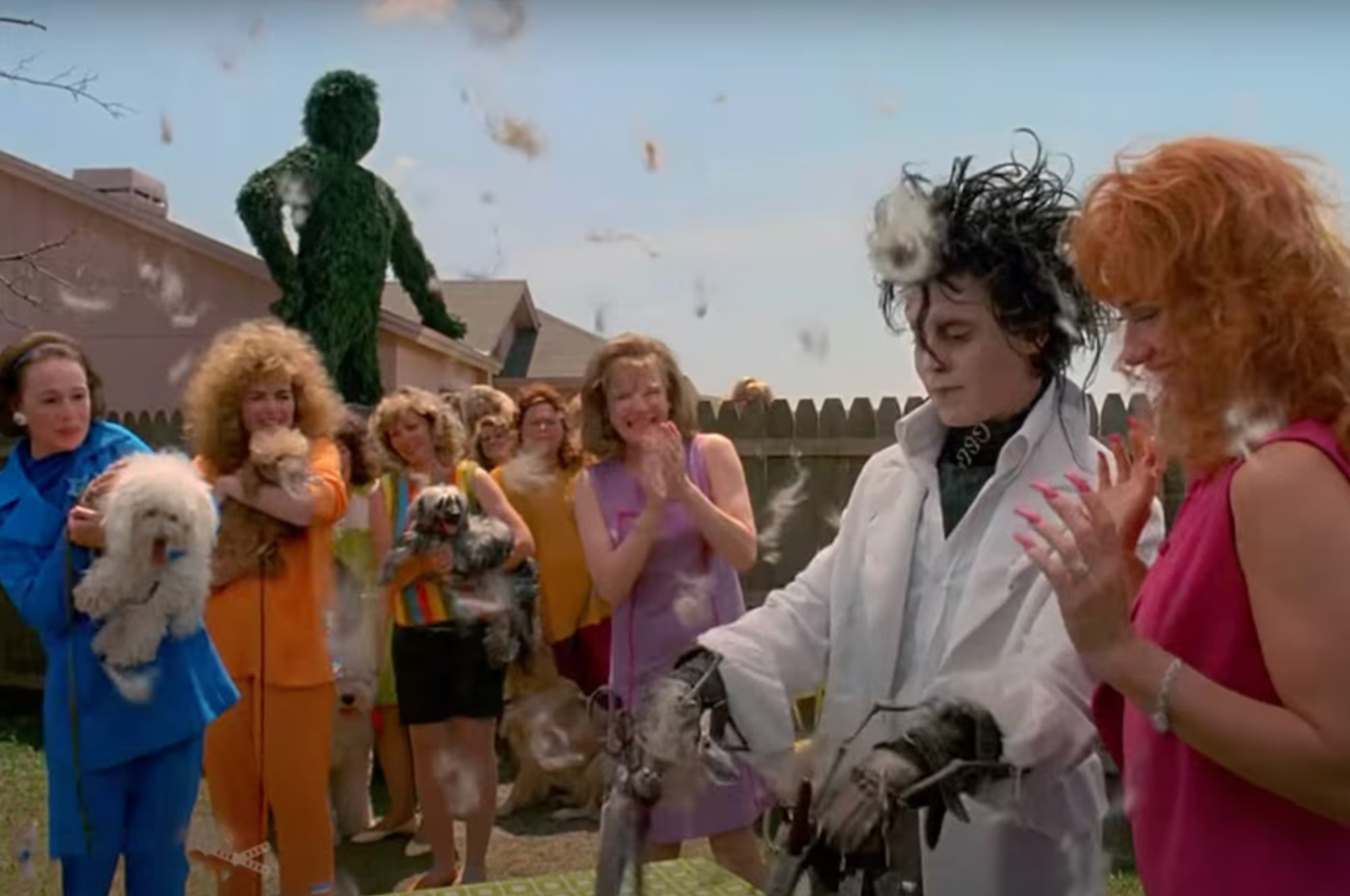
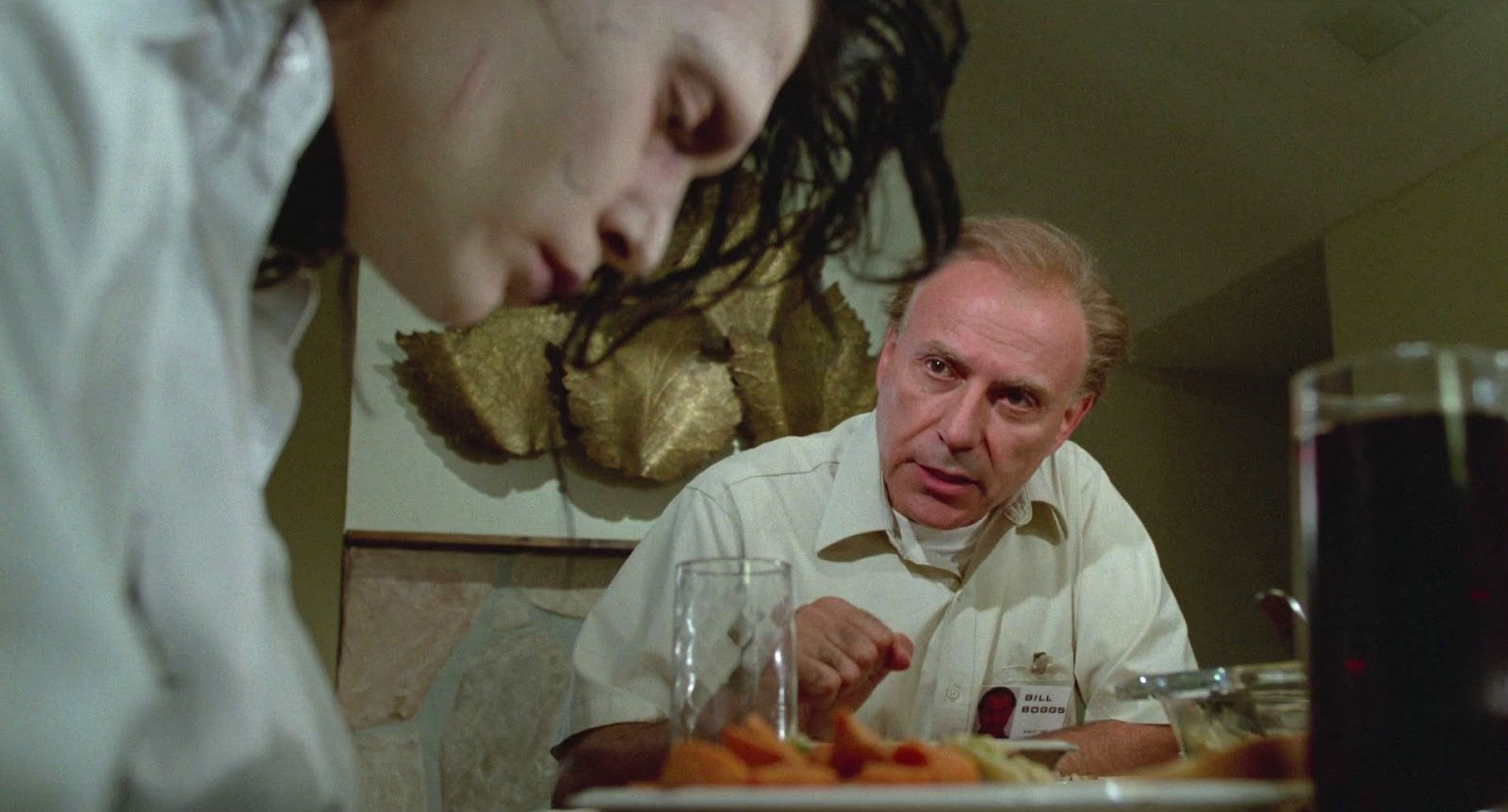
When Alan Arkin’s character Bill finds out all Edward knows about is making cookies, he admonishes and informs him that you can’t buy the finer things in life with cookies. Edward needs to apply himself, and his tools, one and the same, toward a purpose.
The use cases for Edward go from mundane, like hedge trimming and haircutting, to romantic with ice carving, to overtly sexual, when he is trapped in the backroom of a salon with Kathy Baker’s character, Joyce.

Edward is extremely simple-minded and will do whatever you tell him, even to the point of picking locks, and as a scapegoat for human crimes.

In the end, pushed to the brink, Edward commits murder, but with a cover story from Winona Ryder’s Kim, ends up as he started, sequestered away from mainstream society.

When I was writing this, I came across some critical dives into the movie that have teeth, but I also recently finished Edward Said’s “Culture and Imperialism” and there’s a critical concept in that book that requires unpacking for us to continue and for me to land the concept of Edward AI Hands.

A Quick Note About What Edward Said Said
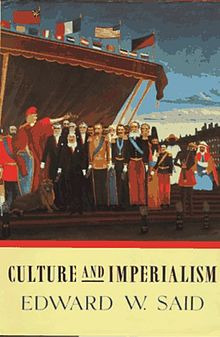
I’m not going to get into all the paradigm shifting insights in this book, but one of the heaviest is that literary study of cultural products FROM empires, like novels, have largely ignored critically viewing the originating brains and audiences for these works, as products OF the empire.

Said articulates that we can make a closed-off, westernized observation of Conrad’s “Heart of Darkness” or Melville’s “Moby Dick” as psychological trips into the mind of man’s obsession, or we could view them as direct products of a societal acceptance of colonialism and whaling. “Mansfield Park” by Jane Austen is a social romp about high-class conformity, but it’s also silently reliant on exploits of colonial capitalism in far-off Antigua.

I thought, and was raised in a system which still believes, that the western canon and all its works were/are simply ‘great’ (and they are, even Said admits this) because they speak to themes common in all men.

They do not.

The most poignant thing in my westernized mind about Said’s insight, given that I’ve spent/wasted a lot of intellectual dollars on these abstract critiques, is that an imperial audience is extremely hampered in their ability to critically see outside a system that created their perspective and worldview.

And, an imperially captured audience and professional class of practitioners contained therein, are probably gonna take cultural products and extract the wrong ass lesson from them, like, thinking they are temporarily embarrassed, genius Frankenstein Gods, and not a bunch of Edward AI-Hands sticking their poindexters into everything not boarded down.

Making Edward AI-Hands Visible

Given the model of Said’s impairment of imperial mindsets to critically view or examine themselves while trapped inside the same empire, the AI tool-turned-human cannot see he’s ceased being a real man, similar to the way Edward’s existence as a tool-turned-human prevents him from becoming real himself.
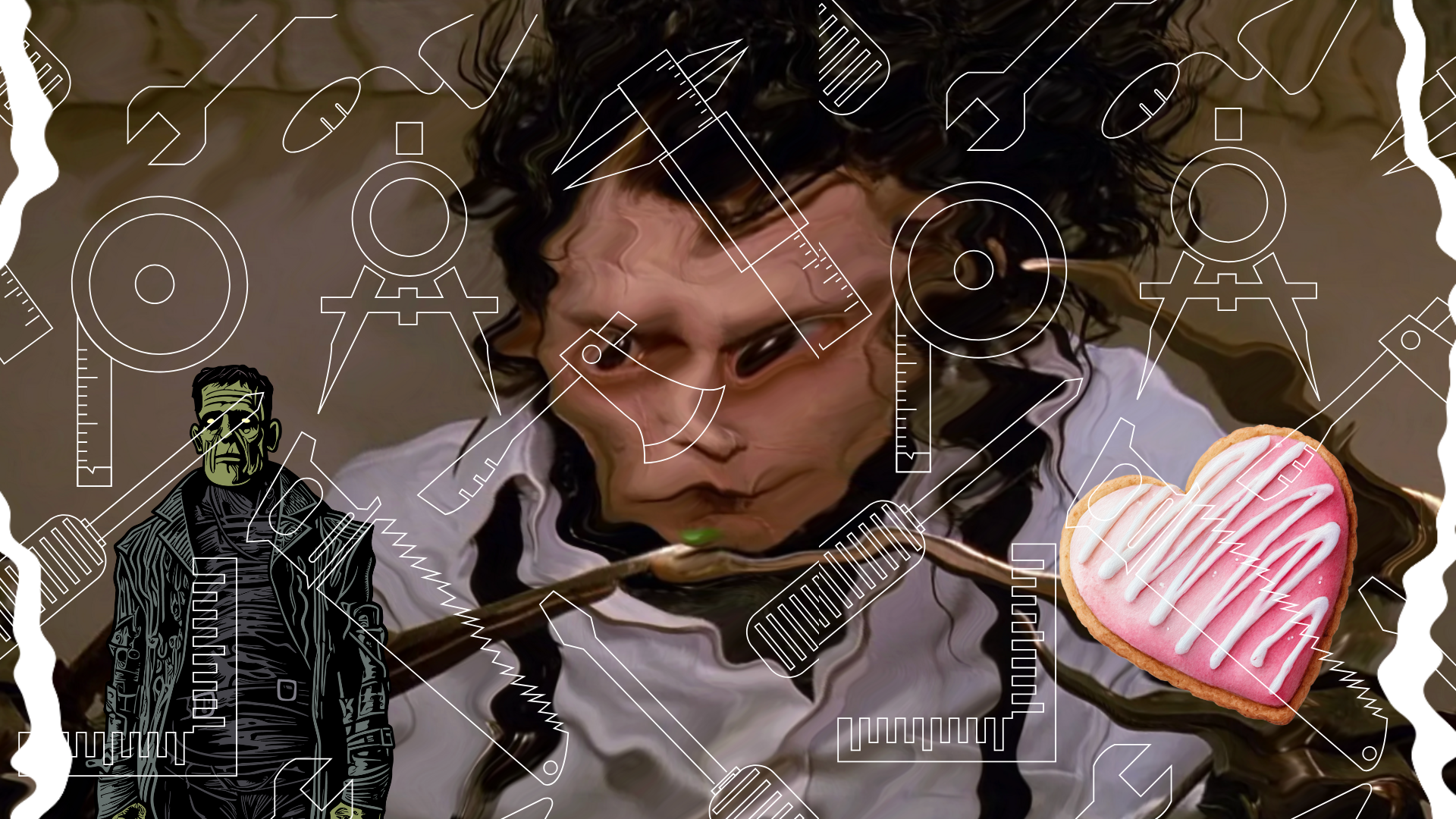
While we were enthralled in critical examination of AI’s Promethean powers, we failed to see that, rather than the romanticism of Frankenstein, which places the seat of god-like power in man’s twisted hands, this tool around has turned its own user base into scissor-minded simplicants, whose development cannot help but be arrested in the cardiac mishap of their factory-adled modelers/creators that left a cookie where a heart should be, and a sandbox for a brain.

I’m writing because reflection and critical thinking require distance, and there’s no pause button with this latest tool, and the distance between us and it is shrinking. We aren’t giving ourselves any space to think or reflect, and without that grace period, we’re falling from it faster and faster.

If we can’t live or think outside of a machine, but only expressly through it, then is it real life or real thinking?

Where Do I End, and The Tool Begins?

THE THOUGHT THAT KICKED THIS OFF: Tools aren’t meant to be attached to bodies.

Technology extends usefulness, but it typically does more to abstract us away from the source material, which in turn makes all our bids for increasing and optimizing tech toward usefulness, more abstract and more useless.

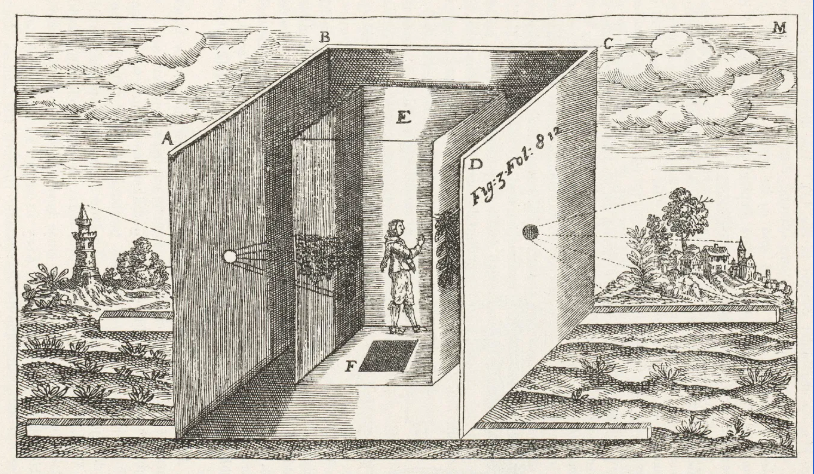
The invention of electric lights extended illumination capabilities. You could deeply study lightbulbs and still not know how light works. Railroads extended commerce. You could deeply study industrial transportation and still not know how economies work. Stethoscopes, microscopes, extended our senses. You could deeply study optics and soundwaves in a lab and still not know how to properly listen or look at the world.

If AI is a singular tool that’s promising to extend the usefulness of every purposeful aspect of humanity, would you know when you’ve abstracted into tool-based consciousness (uselessness) in the real world?

Would you know where you end and the AI begins? Would you know when to turn it off?

You wouldn’t, because at that point, you’d have to turn yourself off, wouldn’t you?

Oh, you’d never let a tool define you?

Look at your hands…..
America: The Funniest Home Video

Modern culture has shifted from thick storytelling to thin content, and when thin becomes the foundation, rather than a byproduct of thick work, culture gets hollowed out.
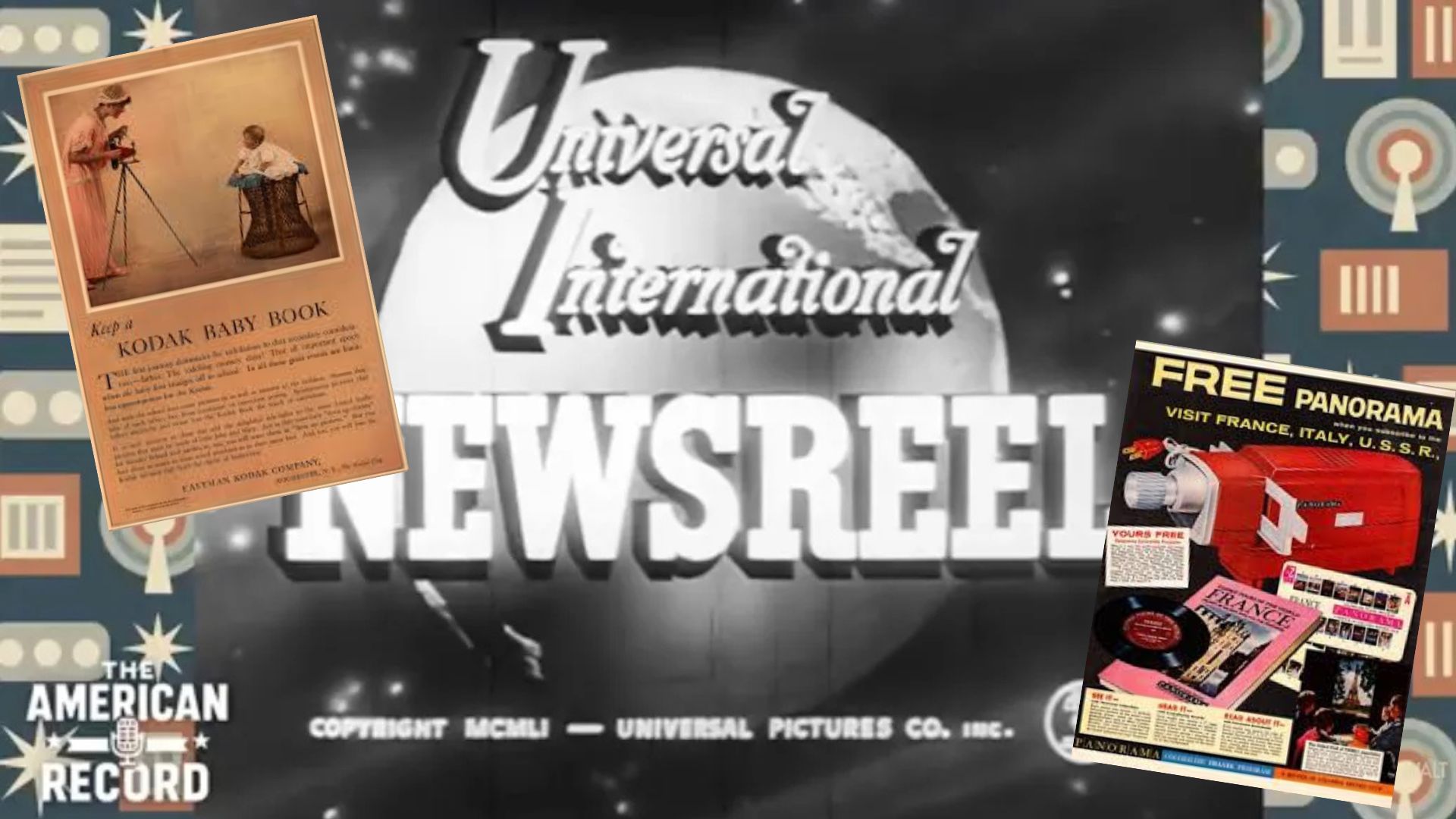
The clip show, the highlight or newsreel, the training montage, the vacation slideshow, the baby book—we’ve always had compendiums of content that abstract the toil, boredom, and process of life into a neatly packaged product.

Instead of the raw, thick, often boring and sometimes senselessly cruel reality of living, we’re offered—and increasingly seek—comfort in products that condense experience, remove process, and present a thin, entertaining, scannable readout of only what we need. These formats emerge from edits and provide a sense of meaning without duration.

It’s the same mindset behind meal-replacement multivitamins: the belief that you can extract the benefits of food without engaging with it directly, without chewing, cooking, or even thinking about it. The nutrients remain, but the practice of preparing and finding food becomes some kind of mirage.

The joy of thinking you can drink chocolate veggies!

There’s nothing inherently wrong with this in the short term. Abstraction can be extremely useful and compression is efficient. But what happens to a culture that allows this clip-based mindset to perniciously take hold of popular consciousness, and persist and proliferate for decades? Say, thirty-five years. What would it produce?

The DNA of AFV

America’s Funniest Home Videos premiered as a one-off special in 1989. Since 1990, it has run continuously on ABC—36 seasons, more than 800 episodes—making it one of the longest-running primetime entertainment shows in television history.

When it first aired, I watched it along with everyone else. Early on, the footage was genuinely incidental. The families were unknown, the videos rough, the moments clearly found and not staged for broadcast. When people won prizes, they looked surprised and vaguely uncomfortable on camera. The appeal came from the sense that these were real, unplanned fragments of actual lives.

A few seasons in, something shifted. It became obvious that some videos were being shot for the show. The families looked rehearsed when they took the prize and the moments seemed framed with broadcast in mind. What began as found footage slowly turned into speculative content: people performing in advance for capture and incentive.

After enough ball punches and manufactured elation, I lost interest. However, as we’ve experienced, the format didn’t disappear but metastasized.

The clip-centric production line spread across pop culture: first through shows like Jackass, then through reality television, and eventually through social media.

At that point, we all lived through it, clips became an entire infrastructure.

AFV didn’t cause this trajectory on its own, but perhaps functioned as a mass-scale proof of concept. Studio heads probably zeroed in on the fact that AFV proved you could build durable entertainment through user generated content, without talent or authorship, hyper-compressing context, and letting incentivized capture replace intention and behavior.

The lesson became a genetic blueprint for media and offline life.

We Exist for Captured Clips

The idea that we perform for capture is no longer controversial. The only question is the degree.

Some people are “too online” while others are able to turn constant performance into a career. Most of us exist somewhere in between, clipping up our lives—consciously or not—to see if something might land, travel, or be featured.

Using AFV as a launchpad, we’ve already rocketed past the point at which authenticity gave way to incentive. Behavior online, and off, has shifted our perspective on lived moments, seeing them no longer for themselves but evaluated by how they might play back.

And if you think this is just an entertainment quirk of the terminally online, it’s not. It’s me, and it’s you, and after decades of clip-based conditioning, the result is a widespread (but consciously unrecognized, or perhaps willfully ignored) acceptance of an engineered reality, and acquiescence to our role as both its eternally starved consumers and its uncomfortably stuffed, content-rich producers.

Enjoy the dichotomy! I know I am!

When Producers Began to Outnumber Writers

One downstream result of AFV was reality television. When reality TV hit, audiences were apparently clamoring for “the real deal.” According to the rating numbers, it appeared as if audiences didn’t want to watch perfect celebrities and elaborately sculpted stories anymore, they wanted to see themselves in the raw.

Scripted shows with writers, arcs, and intention gave way to formats optimized solely for capturing clips.

In scripted television, the story is written before filming. In reality TV, footage is captured first and the story is assembled afterward. Clips are the life-blood of these shows, and any storytelling comes as an editorial artifact.

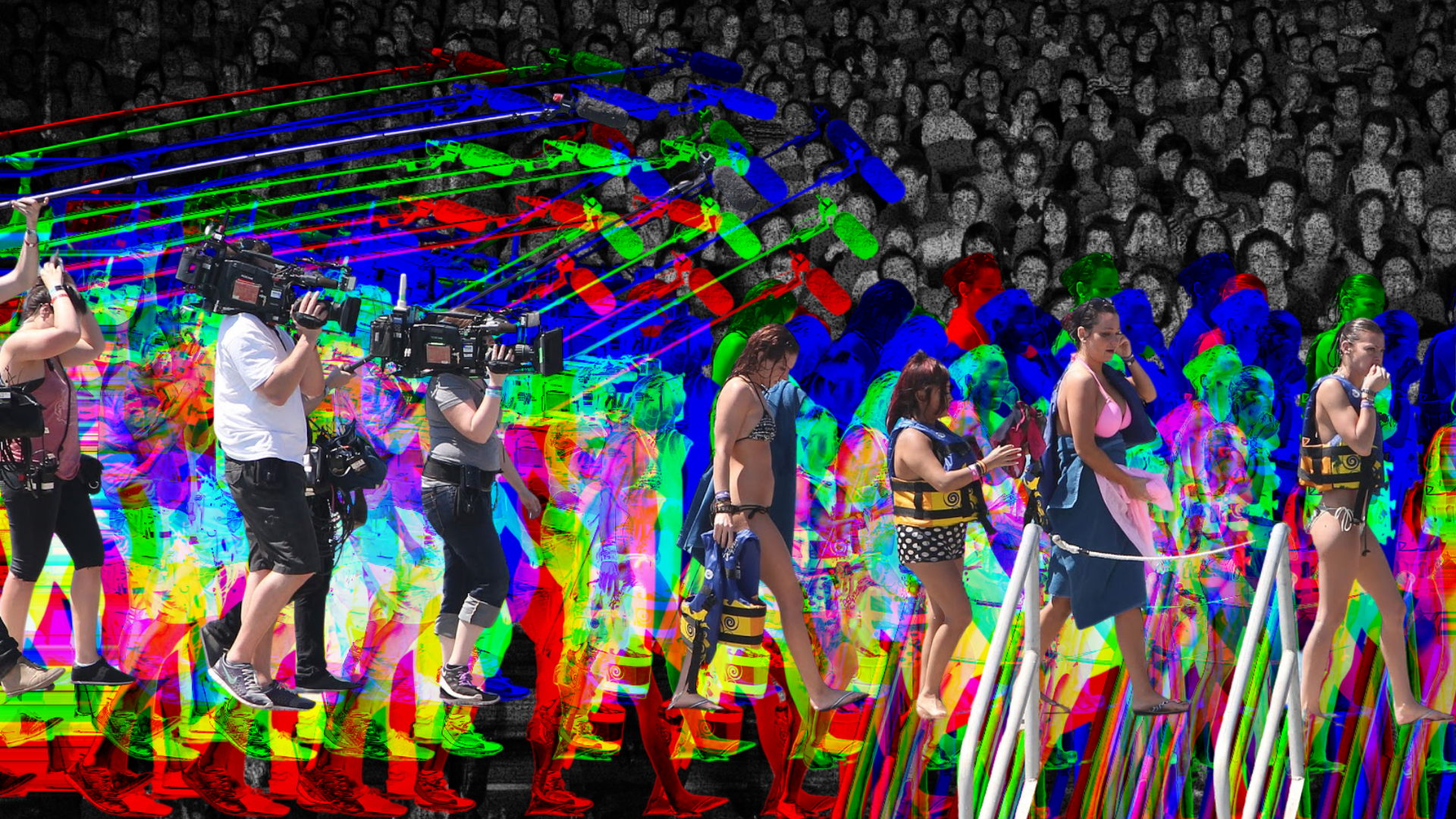
Where a sitcom might credit a handful of writers and producers, a reality show credits dozens (even 40+) of producers, multiple camera crews, and layered production teams. The labor shifts from process of authorship to extraction of product. Everything depends on gathering enough footage to manufacture a narrative later.

Social media scales this model perfectly and includes the audience at home, a jacked up version of AFV. Most users aren’t writing or producing original stories; they’re reacting, sharing, remixing, and lightly editing existing material. We consume clips and produce them, day in, day out. But when producers replace writers, there’s no intention guiding creation, action becomes reactive, performative, and incentive-driven. It is a production…literally.

After thirty-five years of this AFV-like infrastructure to media, it no longer feels strange or off. In a real way, America has become its own funniest home video.

So, why am I still talking?

Process vs. Product (The Skill We Gave Up)

After decades of living alongside a cultural engine built on AFV-refined outputs, what has it done to us? The clearest damage appears in our confusion between process and product, work and output, effort and recognition.

Take education for example…

The outcome process of education is learning how to teach yourself. The output product is a diploma, which is often mistaken for the point.

This confusion between process & product hardened, about two decades into having AFV in our DNA, when reality TV and social media hit, and audiences stopped being audiences and started thinking like producers.

In television, production replaced authorship. It’s become more important to learn how to produce and compile clips than actually tell a story. In music it’s more important to have stage presence rather than work hard to earn and deserve to be on one. In art it’s about affect and aestethics more than learning how art evinces these effects in yourself and others.

We didn’t lose respect for process outright, but culturally absorbed just enough producer language to believe outcomes could exist without it. That belief has hollowed out both the work and the people consuming it.

When a culture only consumes products, it stops producing people who understand process. Everyone wants to arrive; no one knows how to set off. Everyone wants the spotlight; no one knows what sustains the light.

A culture that worships and idolizes products will end up forgetting how to make them. A culture that tries to forge meaning solely through procedural outputs, is at extreme risk for forgetting how to process and live life itself.

Or is this just a thick slice of bullshit? About that….

Thin vs. Thick

Luke Burgis, drawing on René Girard’s mimetic theory, describes thin and thick desires in his book Wanting. The distinction is useful here.

Thin desires are lightweight and imitative. We want them because we see others wanting them. They attach easily to trends and disappear just as quickly.

Thick desires form slowly. They are rooted in values, relationships, and long attention. They endure because they are cultivated, not copied.

A culture saturated with finished products and visible outcomes makes thin desires abundant and thick desires rare. When process disappears, desire itself becomes procedural—magnetizing us toward what looks desirable rather than what is worth wanting.

Thirty Years of Thin and the Missing Thick

Thin programming—AFV-style clips, memes, junk content—isn’t inherently bad. The problem is scale, dominance, and evolution. Thin content increasingly pretends to be thick. But it ain’t.

If you start with something vapid and thin, its only evolution is exaggeration. It becomes more pornographic, more violent, more absurd, more meaningless. You can’t arrive at thick, cerebral depth by intensifying thinness. That path only loops back on itself—a self-referential ouroboros, endlessly consuming its own output.

After thirty plus years, the results are visible. No argument is required. Unless, you’re in the thick of it and have figured it all out. Tell the monks we said hello!

I don’t care what you watch or listen to, and I’m not claiming thin content lacks redeeming qualities. But you can’t stack thin sheets into a load-bearing wall. Thin content serves a purpose, but it never swells into thickness. When it dominates, it actively devalues anything that requires time, attention, or patience.

Thick content isn’t defined by seriousness or artiness. I think it has a few, distinct properties:

  • it takes time to make and time to receive

  • it is weighted with values and relationships

  • it implies a worldview without announcing it

  • any clip taken from it must point back to the whole, even a thin slice carries the flavor of its thick source

Thin content is shaved from thick material, and that thickness must be maintained. If we don’t defend it, thin content begins slicing from itself. Eventually, it becomes thin cuts taken from nothing at all.

And a culture fed on meaningless bullshit forgets not just how to discover and make meaning, but how to sustain it.

For a full deep dive into the thin/thick dichotomy and for answers on how to address and confront this seriously epistemological concern, check out Eaon Pritchard’s “Chairman of the Bored”

Land the plane man!

America’s Funniest Home Videos still airs every Sunday night. The show hasn’t changed much, and neither has the audience response. We still laugh, clap, and reward clips.

The difference is that AFV is no longer a show we watch, but a culture we inhabit. We no longer submit clips but submit to them, live inside their sliced up logic.

We perform, capture, edit, and evaluate ourselves in real time, exchanging meaning for visibility and reaction for value.

AFV once extracted thin moments from thick lives. Now we extract thin moments from one another, and increasingly from ourselves, and ultimately from nothing at all.

And when the clips become the foundation rather than a byproduct of a fully lived and meaningful life, what’s funny isn’t the slip and fall, but how little remains standing afterward.

Unless, you’re in the thick of it….if so, hold the line and keep adding layers.

Portrait of Oscar Moore, Nat King Cole, Wesley Prince, New York, 1946

The Seductive Snare of Pre-Fab Imagination

From backyard battlefields to AI-generated worlds, an essay on how toys & tools that promise creative freedom destroy it and dictate how we’re allowed to imagine.

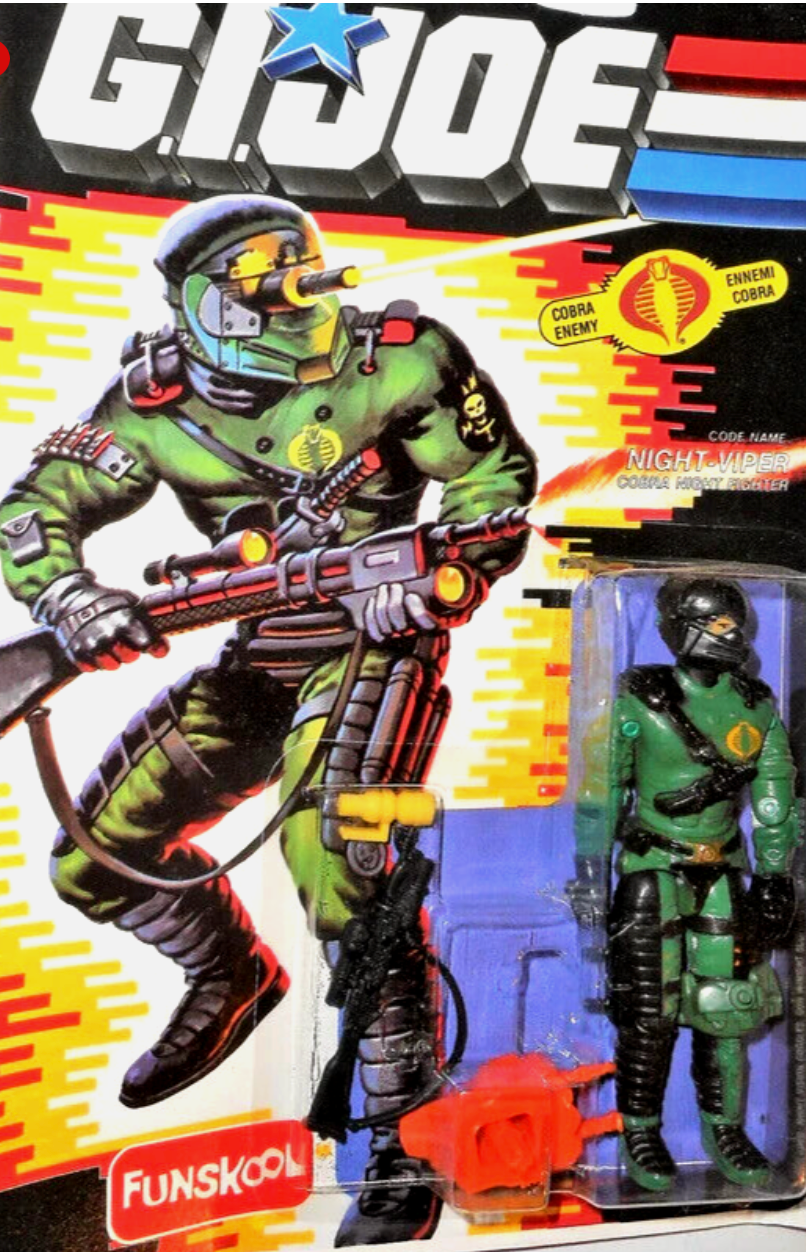
As the connection to headquarters suddenly cuts off, Night Viper realizes the Arctic wastelands are playing havoc with his electronic components. It’s fine, he’s trained without them. Besides, he has bigger problems.

He knows he has only moments to reach a rise out there in the drifts—his only chance to break line of sight and escape the assailants launching missiles from the rear. He fires his jet pack and looks back with a smirk.

The smirk doesn’t last. It collapses into a grimace as the pack sputters and dies in the cold.

He smash-lands far short of his target. The odds that his attackers would hit theirs—and end the mission—just tripled.

At that moment…Mom told me to come inside.

Cinematic Play and the Blurred Boundary

I used to play with GI Joes the way Spielberg cuts a movie.

That exact scenario above unfolded in my front yard with this exact toy.

When I was on my hands and knees, staring into a kind of bokeh trance: the four-inch mercenary was sharp and enormous in my imaginary foreground, while the reality of me arranging plastic figures blurred into the background. I wasn’t a nine year old watching the story. I was inside it.

My hands were the same wind under the missile and the slipstream the jet pack was cutting through. My mind was a mash of sound and light—SFX, music beds, internal dialogue, trench grunts, radio chatter. Damage landed in multivariate ways and characters moved freely. Emotions registered, monologues maintained, stakes shifted effortlessly.

The stories themselves were simple, and pointless. I wasn’t interested in campaigns that began formally and ended formally. What mattered was motion. I stacked scenarios sideways and vertically, endlessly. They could go somewhere or nowhere. It didn’t matter. The act of imagining—of sustaining momentum—was the point.

When Toys Started Telling Me How to Play

I’m describing how it felt to play as a kid, because I want to convey how it felt when I began to notice the toys I used my imagination to activate, started to be sold with preloaded imagination activations of their own; battle damage, real projectiles, and SFX.

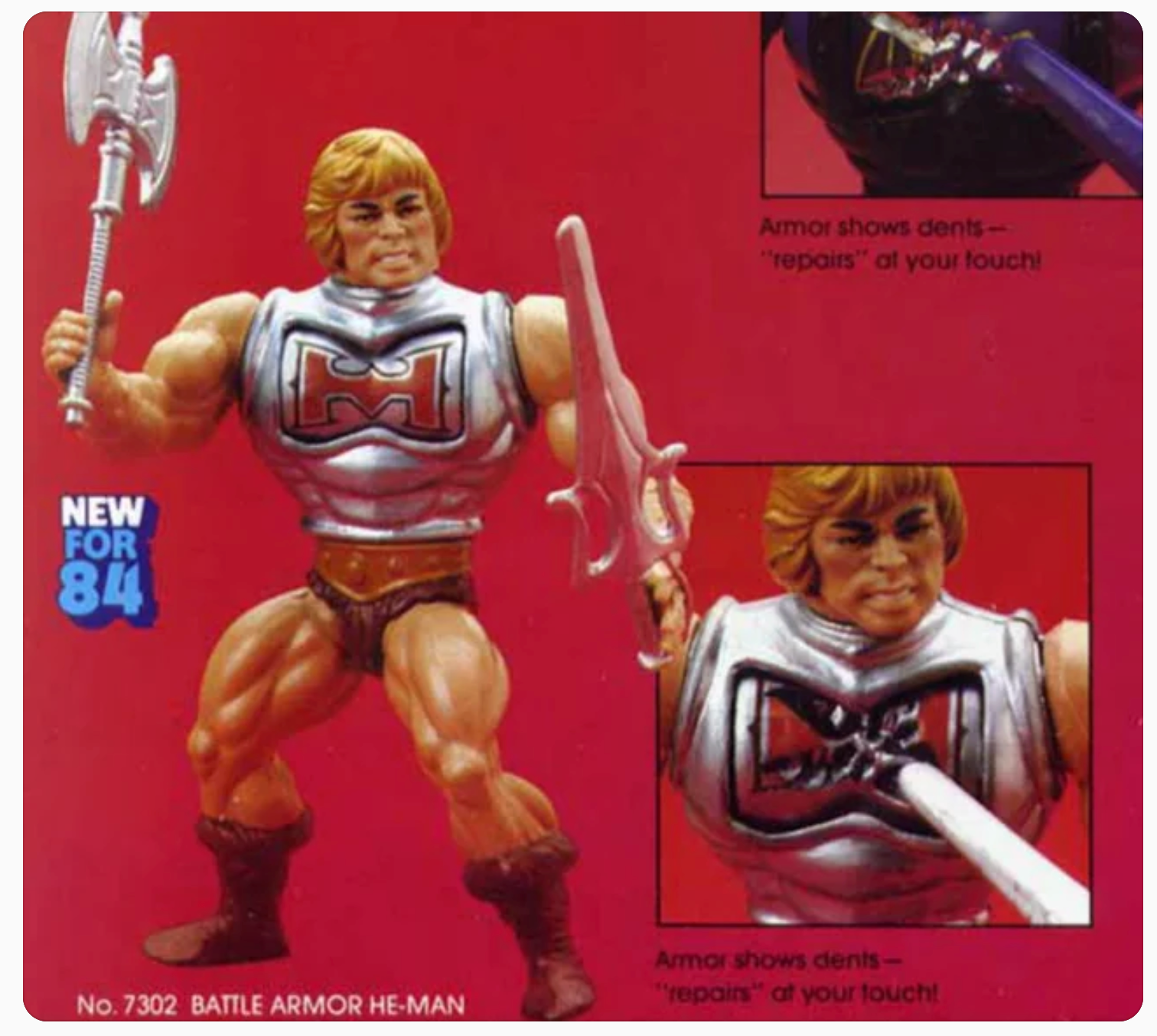
I can’t remember if it was this He-Man battle damage figure that first set me off, but it’s a perfect starting point, because suddenly imagination had a “right” way to operate, a way positioned as better because it was more real. He’s hurt. But hurt by what, I remember thinking? The damage has to match the story. The story’s gotta bend to the scuff. The battle damage-reversal didn’t control the play, but it narrowed it enough to feel restrictive, limiting, and pre-scripted.

The same thing happened with the first GI Joes that actually fired projectiles. Mildly exciting, until you realize you had to design battles at distances the weak missile could reach. Again, this was supposed to unlock imagination with a preloaded feature. Instead, it fenced the play into the toy’s limitations.

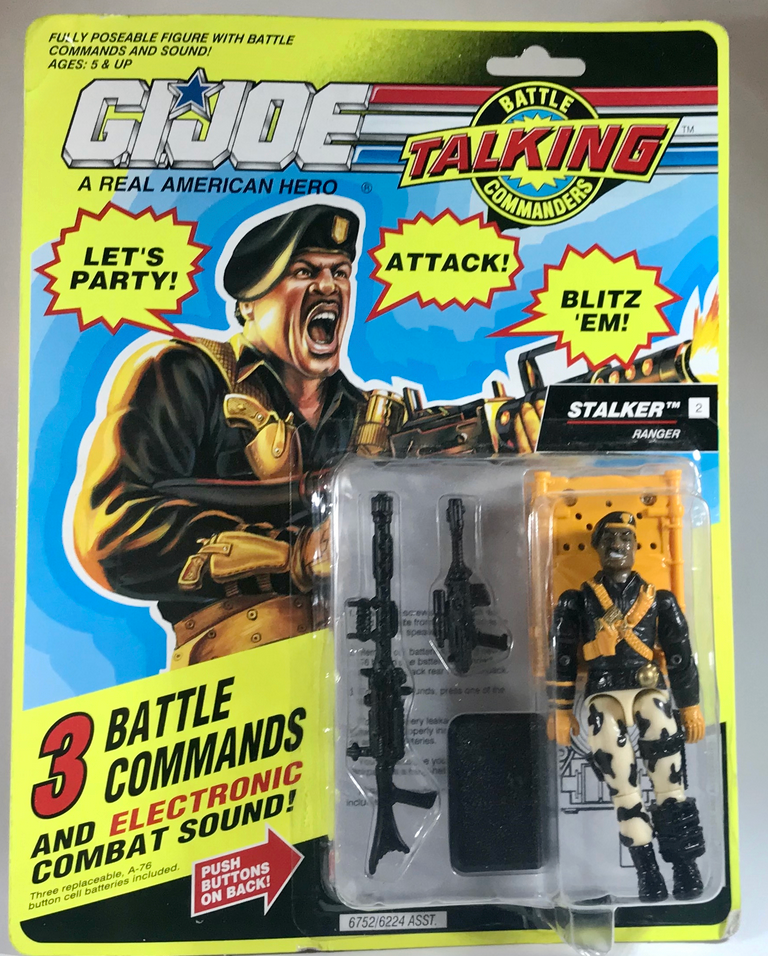
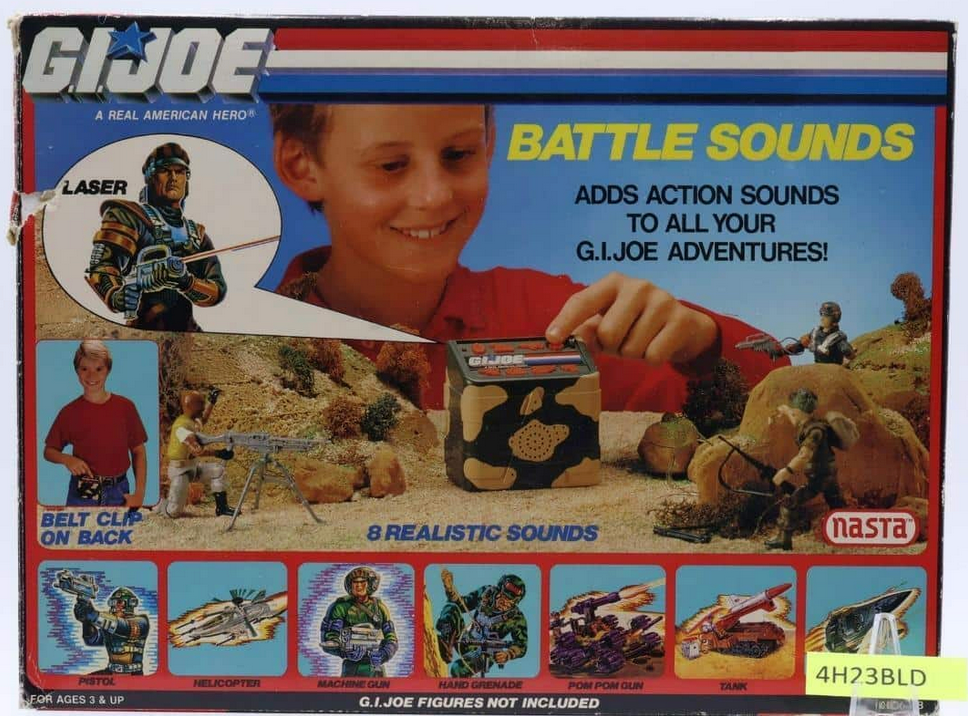
And particularly when the toys started being sold loaded with SFX, I felt the manacles of pre-fabricated imagination being thrown onto me the heaviest.

The battle sounds and catchphrases felt like plasticine prison cells. When playing with these “talking” toys, you had to wait for the perfect moment, or specifically and always artificially, manufacture one, where certain sounds or catchphrases like “let’s party” made sense. The SFX of explosions came from the toy, not from where the missile landed. I remember being beside myself about this (I was a weird kid) aware that us kids were being sold imagination, but all I saw was limitation after limitation.

Royalty-Free Imagination

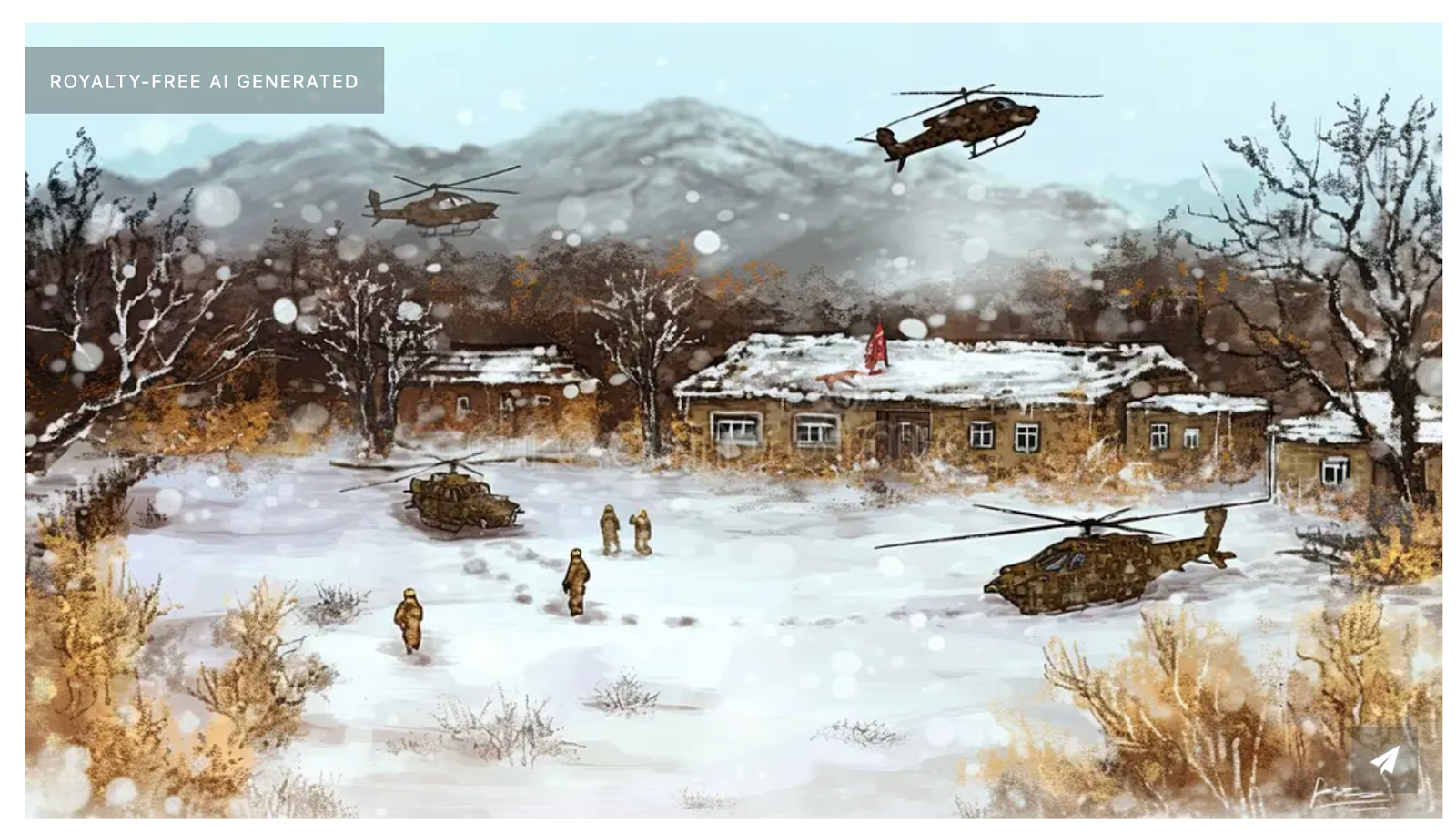
In reality, the battle scene at the top looked like this….

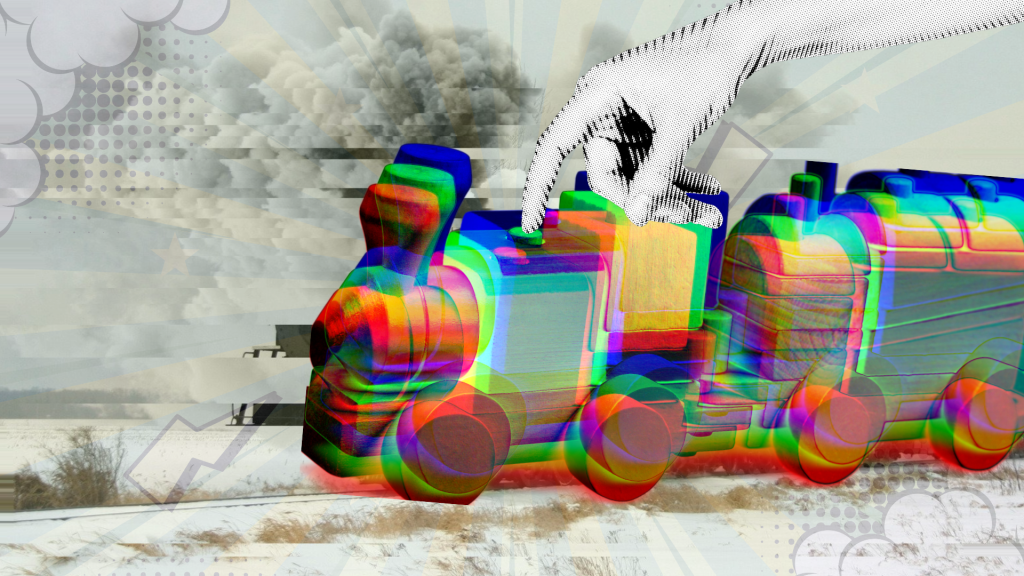
In my head, it was an arctic wasteland ravaged by war. And in the spirit of “show, don’t tell,” I considered using GenAI to create an image of my imagination, but skipped it—and funnily enough, while searching for “snowy battlefields,” I came across a royalty-free GenAI image below that looked close, clearly fabricated, and dropped the central puzzle piece of this essay right into my lap.

Never mind that “royalty-free AI” is legally incoherent. The phrase gives the game away. It reveals a mindset: extract value without compensating creators—and more insidiously, erase the provenance, labor, and supply chain of imagination itself.

We usually think of AI in terms of replacing individual roles—photographers, illustrators, writers. But GenAI stock imagery makes the deeper shift to production itself obvious.

If the work isn’t yours, harvest it. If you can’t harvest it, fabricate it and usurp the entire supply chain.

Royalty-free AI generated stock image sites don’t just suggest, but directly point to the deeper shift: GenAI companies aren’t here for the content, but already are working to replace the product, producer, and production of imagination entirely.

Playing With Fixed Toys Keeps Imagination Fixed

The Disney–OpenAI deal snapped all of this into focus for me. Here was the newest chapter in the evolution of toys with pre-loaded imagination activations.

Everyone is allowed to play with the toys—but only certain ones, and in certain ways, and only on a certain platform. Characters and players both are trapped inside lore and canon, endlessly recombining what already exists, bouncing self-referentially within a closed system.

In this new sandbox world, players are required, but brand-new characters or games or universes invented off the platform, are not.

It feels like freedom, but isn’t this just more pre-fabrication?

If this technology truly expands imagination, shouldn’t it help us move beyond it rather than deeper inside it? Wouldn’t that be real imagination?

Or are we only allowed to pre-imagine—imagining what’s already been made manageable? Switching out imagination with highly managed imaginings?

Is there a deeper myth hiding in the sandbox?

Pushes button – “Let’s Party!”

The Illusion of Imaginative Freedom

I get it, it feels like GenAI gives you creative wings. But ask yourself: who built the sky you’re flying in?

If your ideas only take shape when they happen in and conform to a tool’s expectations, are they yours? Or are they being shaped in a platform-based feedback loop that edits creative ideas before you get to feel what it’s like to have them?

GenAI might seem to expand imagination, but often it replaces the messy, ambiguous, nonlinear act of imagining with the polished outcome of having imagined.

It’s not expanding your imagination but expanding the efficiency of expressing things that look like imagination.

GenAI is to imagination what pre-loaded activations were to my noisy GI Joes. They are sold to feel like an enhancement to imagination and creativity—until you realize they dictate the scenario, restrict the range of interpretation, and clumsily script what should be spontaneous. Over time, and ultimately and inescapably simply because it’s a closed-system, players are nudged toward predictable play.

The Cost of Effortless Imagination

I didn’t write this because AI is useless—it has real power, especially with clean data sets. I didn’t write it to dog on anyone who loves GenAI; have at it. I wrote it because I recognize a familiar trick: something offering to help, to enhance things we should want enhanced, while quietly shifting the boundary of where effort, uncertainty, and ownership used to live.

Cognitive hijacking doesn’t announce itself. It arrives as convenience, as the latest hotness. And by the time you notice it, you’ve already adjusted. The battle damage was always those same scars, the sounds were always brittle and distant, the scenery was always royalty-free, the play easy, effortless, unowned—and forgettable.

In a closed system optimized to replace offline imagination with online activations, to remove creators from creation, producers from production, and production from supply—generating endless demand from recycled air—we should at least ask where the fresh oxygen will come from, find out how to step off the machine long enough to catch our breath, and get back into our own minds and reclaim the power of imaginary play and creativity.

Rewriting The Mythology of Blame and Shame In Marketing

An honest look at how blame and shame distort marketing, what happens when teams confuse control with responsibility, and what we can do to change the story line.

If you’ve never been on a marketing team that has operated under:

  • panic
  • magical thinking
  • misleading metrics
  • scapegoating
  • unrealistic expectations

…then this article isn’t for you.

Similarly, if you’ve never felt the following as a marketer:

  • guilt & shame
  • imposter syndrome
  • perfectionism
  • fear of failure
  • over-apologizing
  • taking accountability for things outside your control (e.g., “We didn’t go viral!”)

…you can close this tab.

And finally, if you’ve never felt like you’ve had a role (even a small one) in the problems in your life and work, you can not only stop reading but take a winning lap.

You’ve won life!

For everyone else, hi, I’m Jake Sanders, and in the past 11 years in this industry, I’ve been blamed for bad sales numbers when the only marketing budget was my salary, I’ve felt ashamed I couldn’t hold a ranking amidst inscrutable Core Updates. I’ve been made to, made myself, and made others feel like absolute dogshit based on poor results for things I thought could, but fundamentally can’t, be controlled.

I have felt this invisible blame and shame. I’ve manufactured it. I’ve handed it out.

If you’ve gotten to this point on the page, that means maybe you have too.

I’m here to rattle the bones of an emotional skeleton in our professional closet – the fact that blame and shame invisibly, palpably, negatively, and in most instances, pointlessly impact marketers. We have to unveil and fix the death shroud of blame and shame, and that work starts by acknowledging it’s real, admitting to and smoothing out some wrinkly truths we navigate daily because of it, and asking ourselves one single question: what can we actually control?

The Psychological Role of Control in Marketing

Let’s be honest, in full technicolor – do you think me, you, or the Joe and Jane marketer out there has any meaningful amount of control over these things, and, be for real:

  • Algorithms
  • AI
  • Competitors
  • Economic conditions or stock markets
  • Platform decisions
  • ‘The buyer’s journey’
  • Impression quality
  • Consumer attention
  • Cultural momentum
  • Legal, regulation or compliance

How many event ballrooms, LinkedIn hot takes, whitepapers, webinars, and pay-to-learn schemes have we attended/downloaded/seen promising to help marketers master navigating the above?

Still feels like I’m wrong though, doesn’t it? Deep inside.

I know I bristled while writing the list above. I still feel in my romantic heart that ‘one great ad’ can change the algorithm, a single drop of soul-shaking creativity could flood the market, one military-grade playbook would hack it, with enough money, with enough tech, one silver bullet would shoot my werewolf.

Maybe. You and I know better. Or, we’re getting there.

So, what is in control (ideally) of marketers?

  • Strategy
  • Creative quality / Distinctiveness
  • Positioning
  • Distribution/Cadence
  • Customer Experience
  • Budget Allocations
  • Internal culture and discipline
  • Measurement frameworks

Again, there are mountains of content and advice on enhancing, optimizing, and improving these controllable aspects of marketing, all fine and good – but if they’re being used with false confidence that they’ll increase control of the uncontrollable, it’s gonna fail.

Sounds like a hater perspective again, doesn’t it? Feels like it to me.

Let’s keep cooking…

The biggest issue, the titanic impact the marketing industry is facing, is a psychological one – not a business problem or a math problem or a strategy/framework problem, but a matter of mental perspective and discernment around CONTROL.

If someone doesn’t know the difference between what they can and can’t control, their mindset, ego, their whole identity pivots around a misconception, which ends up inverting their faith, cognitive functioning, and entire way of thinking.

What we can’t control often masquerades as what’s most measurable.

What we can control looks fuzzy and out of reach by comparison.

Said more simply…

We mistake visibility for control

The things marketers can’t control—impressions, clicks, reach, conversions, algorithmic performance, attribution models—are the things that show up cleanly in dashboards. They’re quantified, refreshed in real time, and framed as levers, so they feel actionable. Measurement creates the illusion of mastery.

Meanwhile, the things marketers can control—strategy quality, creative distinctiveness, positioning clarity, consistency, internal discipline, long-term brand signals—are harder to see, slower to validate, and messier to measure. They don’t update every morning. They require judgment instead of dashboards. So by comparison, they feel vague, subjective, and “out of reach.”

So the inversion happens:

  • The measurable looks controllable (but isn’t).
  • The controllable looks immeasurable (but is).

Marketers control the inputs—strategy, creativity, consistency, distribution, and brand signals.

They cannot control the closed systems, the probabilities, or the behaviors that ultimately decide outcomes.

But they can engineer them better if they play the right odds.

So this first part is critical. You have to be wise and courageous to definitively differentiate and accept what you can control and what you can’t.

Acceptance is NOT Resignation

I’ll say it again – Acceptance is not resignation.

Sit with this one.

Reflect on your feelings – doesn’t the word, “acceptance” bring to mind passivity. It feels weak, right? Feels like you just have to accept it. Right?

But how do you feel when you’reaccepted?” That’s massively different, isn’t it?

Real acceptance isn’t settling or compromising, but recognizing the ‘just-so’ nature of something or someone as a fact. We are loathe to do that, because it connects to CONTROL. Which means, we have a massive problem confusing acceptance and resignation because we are not wise or courageous about control.

Until you fully accept what you can’t control, you’ll never have the power to change anything.

The Impact of Blame & Shame in Marketing

Let’s bring blame and shame onto the stage, and describe briefly how they play out across the controllable and uncontrollable aspects of marketing—where they get misdirected, where they get absorbed unfairly, and where they shouldn’t exist at all because they create no value and distort reality.

Marketers often aim blame outward, at algorithms, platforms, or consumers. “Meta deprioritized us” or “people just don’t get our value prop” becomes a comforting narrative, but algorithms don’t owe you stability and consumers don’t owe you attention. Even predictable issues like programmatic waste or media under-delivery get framed as shocks rather than environmental conditions and strategic/financial limitations the team chose to operate within.

Inside organizations, the blame naturally reverses direction. Marketers absorb pressure for things no one can truly influence: quarterly sales swings, the cultural roulette of creative performance, the inherent and more than natural brokenness of attribution, or the chaos of black-box platform changes. They’re even held to account for problems rooted upstream in product, pricing, and distribution, treated as if communications & promotions alone can guild a lily and magically force the market to behave.

And then there’s the unhelpful emotional layer we slather, get slathered with, and slough off; shamed over creative underperformance when budgets are thin; shamed for not mastering the myriad parts of ad-tech (which are moved around every night by vampires, like in Dark City); guilt around imperfect audience understanding (we can’t understand some of our family members, but we know how consumers think?); or pressure to “optimize” weak strategy into success (the oldest and rankest tale in marketing’s emotional library).

Blame and shame collect wherever marketers, brands, and the business world clings to the illusion of control—pretending uncertainty is certainty, treating probabilistic systems as predictable, or using small levers to mimic mastery over forces they can’t steer. The result is a tangle of inflated expectations, warped accountability, avoidant leadership, burnout, and a culture that rewards performance of confidence instead of actual clarity.

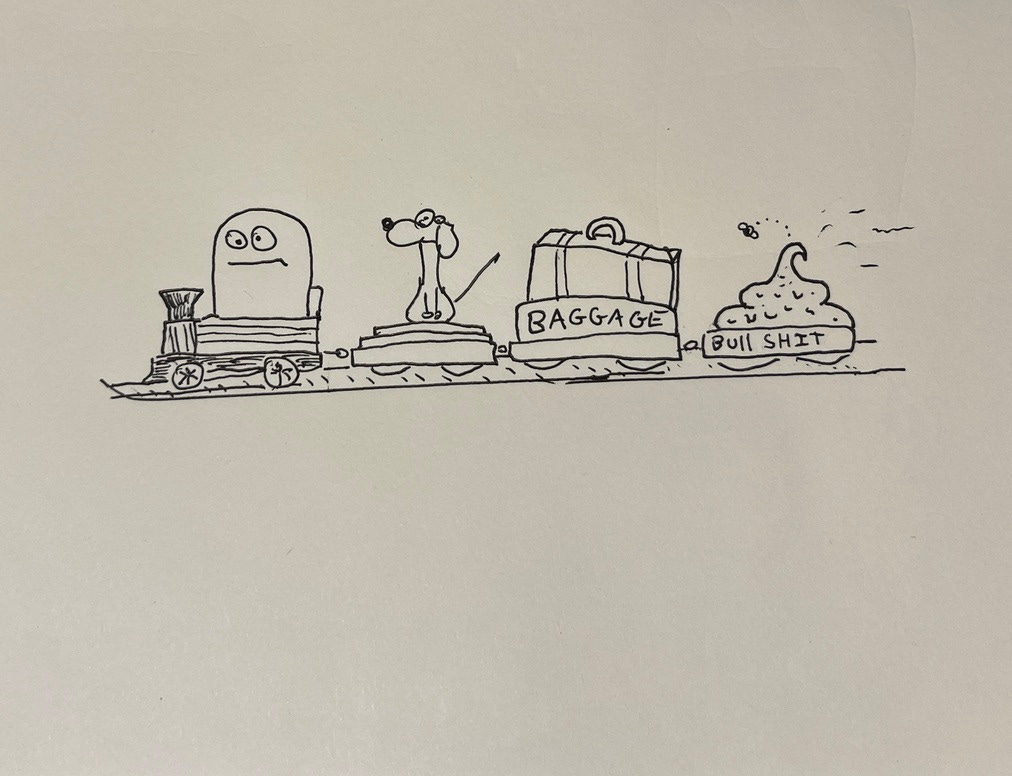
The work gets better the moment the blame & shame train stops and grounded sense replaces senseless flagellation.

How do we knock this unhelpful shit off?

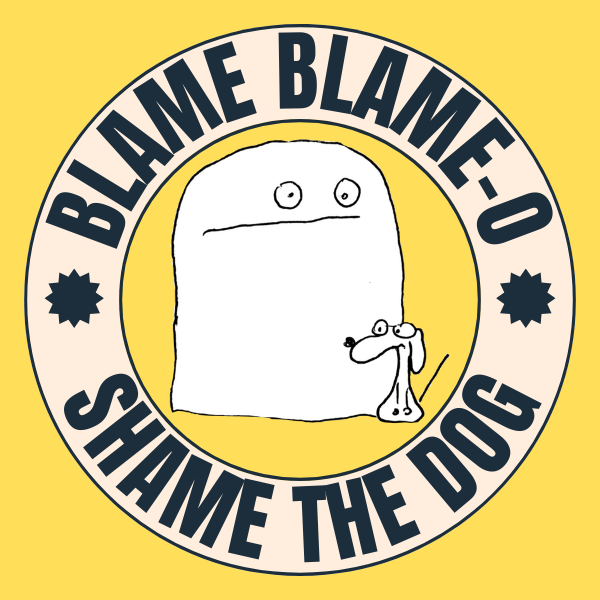
The Myth of Blame-O & Shame The Dog

Double click to interact with video

I created Blame-O and Shame the Dog by accident while exploring the history and mythology around Paul Bunyan. I wrote an article about the research, and it’s worth quoting here for context;

“When Paul Bunyan (a pure content marketing play) was popularized in early 20th century literature by advertising executive WB Laughead, from the Red River Lumber Company, to mythologize and gin up public support for deforestation (particularly of protected Ojibwe lands), they didn’t really focus too much on his history, because the nation was young and without history. Fuzzy references to a before time, murky parentage, a crib 200 feet high, and untamed lands.

So the urge for Bunyan to do his thing and create the country, is not necessarily coming from anywhere, or answering to anything – it’s a clean slate myth, or it’s a myth that cleans the slate by its own steam (hot air).

A modern American myth might require a bit more backstory – but is it because Bunyan lacks precedence that his legend was so impactful? You don’t have to understand much anything else than awe and wonder to have these stories work on you. In fact, ignorance is a great canvas to paint a myth on. This isn’t to say smart people can’t get mythological, or that myths are suited for dumbasses, but the expansion of myth rests on audiences having a fuzzy grasp on facts.

I think it would behoove us to start mining some new myths that work for us, from the bottom up, or we’re gonna keep getting top-down myths that work on us.“

You can learn all about Blame-O and Shame the Dog’s origin story, but their function is to work first as physical manifestation of, then as a mirror of, and finally as a repository for, the dysfunctional behaviors and thinking associated with blame and shame, that has up until now been invisible.

Without a scapegoat for the insanely complicated tapestry of shame and blame that blanket our professional lives and smother our personal ones too, we’ll just keep piling on layers and won’t realize we’re the one’s doing the suffocating.

If we can blame Blame-O instead of ourselves or others, we stop using our finger to point and we put it on the pulse of what’s real and in our control.

Blame-O is a mythological symbol of honesty, accountability, clear measurement, evidence-driven and long-term thinking.

Blame-O not only illustrates the uselessness of blame, but identifies and dispels bad assumptions, magical thinking, or unscientific logic.

If we can shame Shame the Dog instead of ourselves or others, we start to recognize and prioritize what’s real over what we think we want to feel.

Shame the Dog is a mythological symbol of psychological safety, realistic benchmarks, ethical marketing, self-respect, and standing tall.

Shame the Dog not only illustrates the pointlessness of shame, but helps to identify and eradicate the instances where teams are over-owning things that have nothing to do with fault.

How to Use Blame-O and Shame The Dog

These characters are not the solution to all problems, but a metaphorical mechanism to manifest a mindset for actually doing work and coming up with solutions to solve them more effectively.

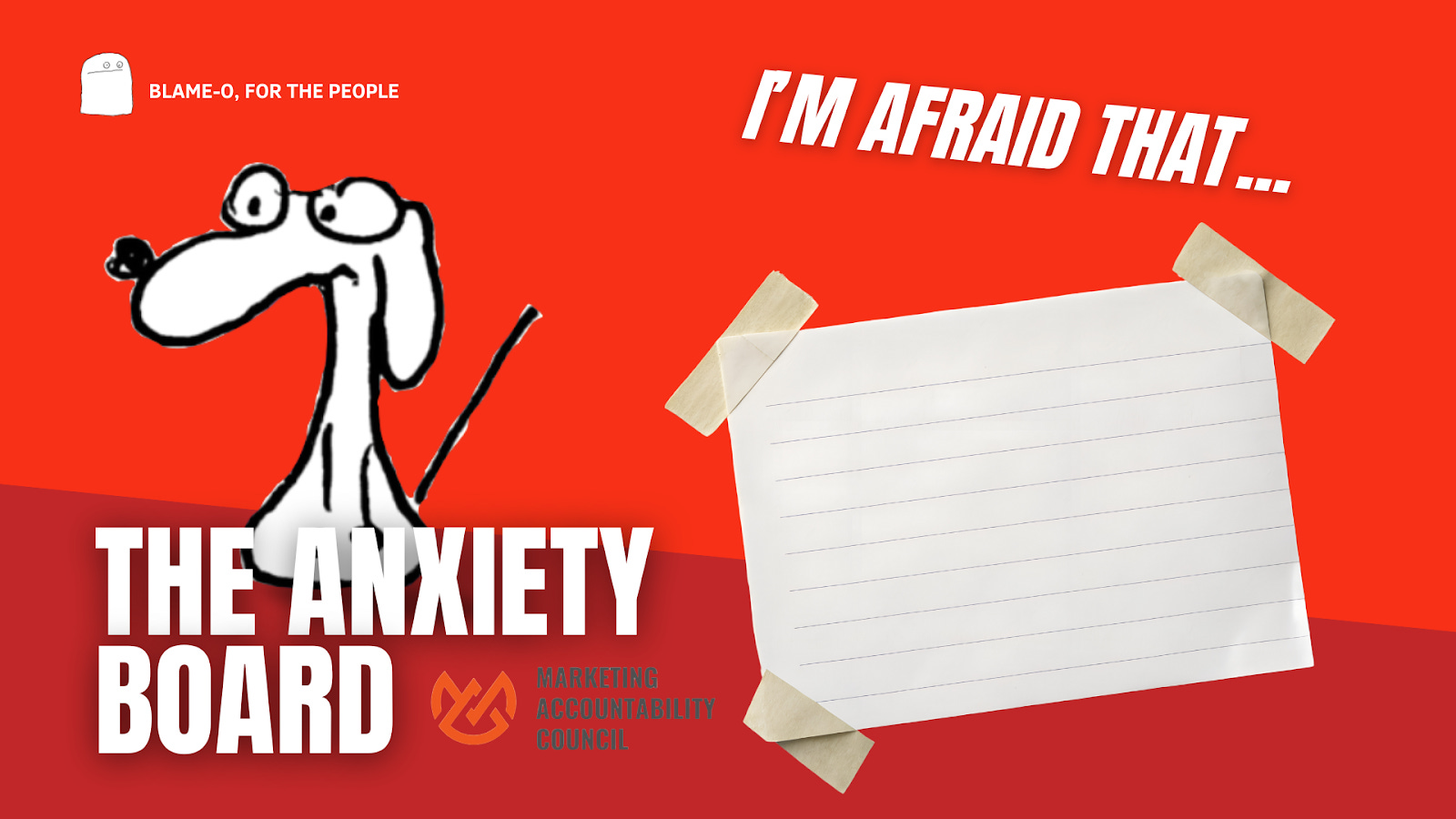
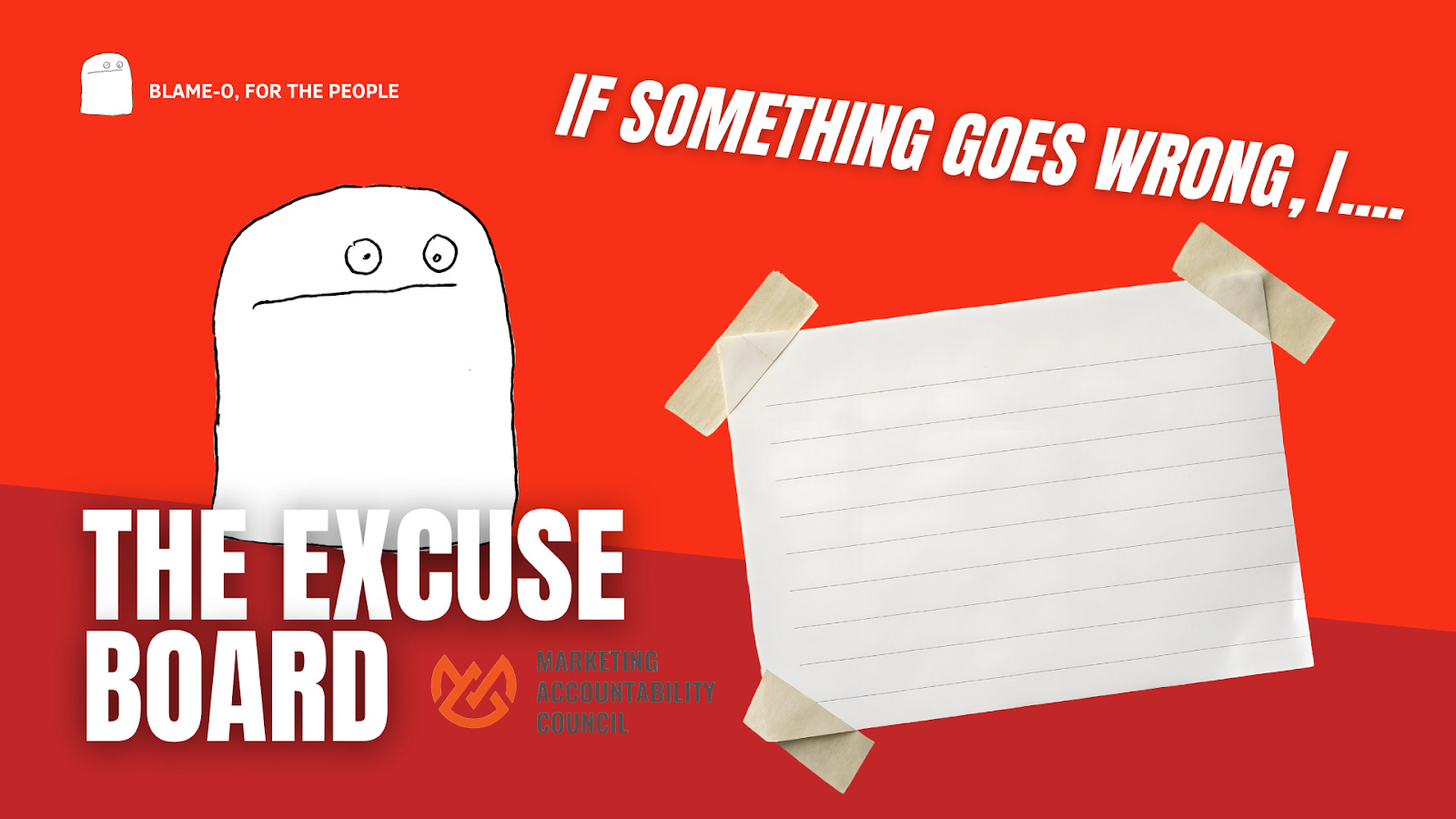
The easiest way to utilize Blame-O and Shame the Dog in marketing is to create two documents; an excuse board, and an anxiety board.

If you can write down all the excuses and anxieties you have around a project or job, and discuss it with your teammates, you instantly establish a transformative place to reflect, commiserate, and properly locate & dispel any shame or blame before it happens, grounding yourself, your team, and everyone on board in science and not self-punishment.

Blame-O and Shame the Dog are teaming up with the Marketing Accountability Council in the new year—expect more cartoons, tools, and training to follow.

Bringing Blame and Shame Home

As I’m trying to finish this and bring it home, I realized, we really need to talk to the people I dismissed at the top. The people who don’t see the blame or feel the shame like we do; we gotta talk to the clients and bosses and leaders that fundamentally believe they can control the uncontrollable, not because they are sociopaths, but simply on account that they’ve never questioned the difference.

How might you bring this up? Tell someone that they might maybe kinda be 100% delusional?

This conversation is difficult because it’s not about tactics but identity and how people understand competence.

Many leaders, ourselves included, learned that being “in control” is what makes them effective, so pointing out limits can feel like questioning their judgment and capabilities, not just their information.

That’s why the goal can’t be to correct or inform them, but to shift the frame. A useful move is to focus on alignment and risk, not blame:

“I want to make sure we’re setting goals we can actually stand behind. Can we separate what we directly control in marketing from the conditions we have to respond to?”

This keeps the conversation collaborative rather than corrective, though I imagine this question alone could get awkward and twisted, so tread in a team spirit kinda way, and lightly.

From there, the goal would be to distinguish between internal levers (strategy, creative, positioning, budget, measurement) and external forces (algorithms, competitors, economic shifts, buyer behavior). The insight lands more cleanly if they’re involved in the sorting themselves.

You can then name consequences without blame: when goals are anchored to controllables, performance compounds, when teams are judged on external forces, results get noisy and frustration rises.

The reframe ideally ends up as: marketing can’t control the environment, but it does control how intelligently and creatively we can respond, which is where real accountability and true advantage live.

Blame and shame thrive wherever we confuse influence with control. With help from Blame-O and Shame the Dog, we tame that confusion and take back the power—inside teams, across organizations, and within ourselves.

The work gets lighter, clearer, and better the moment we stop punishing people for perceived realities, and start holding ourselves accountable for how we behave in this one.


A Canto on Can’t, or, Why Some Futures Never Arrive

In a world that worships tech, ‘can’t’ is heresy; but it defines our limits.

As we head into the unknowable future, I think discerning between Didn’t, Couldn’t, and Can’t is an increasingly important line of inquiry to pursue and skill to sharpen.

If something didn’t happen, is it because it couldn’t happen, or it can’t?

If a technology didn’t take off, is it because it couldn’t at the time, or that it can’t ever?

The importance of this question is obvious when you realize, in the techno/religious consciousness, there is no problem technology cannot be positioned to be the savior of.

There is no ‘can’t’ for technology or technologists. The ‘can’t’ way of thinking has to be eradicated. Can’t, can’t exist.

And if there is a Can’t we agree exists, we are very quiet about this heresy. But we all know it; that Can’t is definitively out there, in the Didn’t around the corner.

Setting the Frame for Can’t

I was wondering the other day, why I wasn’t creating, trading, and mining NFTs or selling them in the metaverse. Why didn’t that future arrive? Was it because it couldn’t arrive at that time, or that it can’t ever? Or is it something even deeper, or, perhaps simple and shallow?

In our technopoly-based society, ‘can’t’ is the closest thing we have to a sacrilegious word. Anything and everything is possible for the doers and dreamers. All the failures and “didn’ts” of the past are the result of lack of access, imagination, and grit. I write more about this in “The Myth of Fairness in the Sandbox”

To the techno-determinists, the reason some glorious future didn’t happen is because it couldn’t at the time. Never that it can’t happen.

The promises and pillow talk of the hucksterers and con men of the past and present, the armageddons that have come and gone, the gallons of urine that never alchemized into solid gold, the utopian visions that swelled up and died on the vine; the story of humanity hinges between failed breakthroughs and “just you wait.”

In an odd paradox, our culture of determination, striving, and hard work, has rewired the interpretation of most future-tech failures as “premature,” very rarely “impossible.”

When It’s Actually ‘Can’t’ (Not ‘Couldn’t’)

Defined and known natural laws, like thermodynamics, biology, gravity, make up the hard floor we build our dreams on. There’s also fluctuating quantum principles, philosophical considerations, and other “laws” that are implicit and veiled which also influence and define the limits we can act and think within.

Whether we take all this into consideration or not determines how far we’re able to take certain innovations or ideas.

The hard truth is, there are definitive ‘cants’ in the world.

Perpetual motion machines can’t work because they violate the laws of thermodynamics. You can’t get unlimited energy without input, ever.

The scarcityless scarcity of NFTs showed us scarcity is impossible on top of infinite reproducibility, this is simply supply and demand.

A universal metaverse as a life replacement can’t happen because VR spaces ignore human embodiment, social structures, and physical needs.

We’re not riding around in Segways, we’re not dodging level 5 autonomous flying cars, we’re not traveling faster than light, and we’re not teleporting to the grocery store.

But if I pay attention to my brain, there is a part of me that reads the above examples and quietly says, “not yet, but not never.” Why is that?

The Collective Pretend

In imaginary group play among children, anything is possible as long as everyone agrees to collectively pretend.

If kids can ignore that they’re in the living room, they can easily be in outer space. If they overlook the rug from Ikea, the floor can be lava. And, the more they lean into pretending, the more they experience depth and realism in play. At this point, it’s fun.

In imaginary group play among adults, AKA existence in society, the same rules apply.

Among many other social fabrics, money, law, religion are pretend, consensual hallucinations. They work only because everyone agrees they work, and they scale up through selective ignorance in the adult world in the same way lava floors do in kidland. And in opposite contrast to the fun of imaginary play, the pretending adults do turns into faith, families and friends, finance, and fiduciary reality.

And in both cases, the moment when someone stops seeing lava and sees a floor, or questions the flawed logic beneath the groupthink du jour, the impossible meets its maker. Some things (good and bad) only work if everyone agrees they work, others fail because no amount of agreement can fix the underlying fraud.

For NFTs to have taken off, we would’ve been required to agree to pretend and remain ignorant about the infinite scarcity aspect and plain-wrong economic principles. For us all to be in the metaverse, we would’ve been required to divorce from reality and ignore the embodied nature of human existence.

Point being: the reason these particular things didn’t take off is they required us to remain stupid.

And it’s because we really don’t like feeling stupid that silly ideas actually get as far as they do.

The Psychological Case for FOMO-sapiens

If you’ve ever had a secret kept from you, or found out something important too late, you know the feeling of missing out and you might over-correct and turn into a FOMO-sapien, living life based around avoiding the fear of missing out.

Along with ignorance, another reason our society keeps falling for hype and perpetual futures of “not yet” instead of “never” is the same reason we don’t want to miss out as individuals; fear.

There is a whole litany of companies and consultancies, like Gartner and McKinsey, and predictive technologies that are based around fear and preventing a critical miss. The industrialization of techno-optimism makes it difficult to escape the cultural inertia of fear.

The technopolists believe “can’t” is the mind killer that stops progress, but Frank Herbert’s definition of ‘fear as the mind killer’ is more appropriate and accurate.

Simplicants think contemplating the “can’t” is what kills momentum and dumbs us down, when it’s more likely the deep terror of being wrong that propels genuine smarts into the stupidest shit imaginable.

Smart-people-dumb-shit, is what I’ve called this. Idiocy isn’t just for the idiots!

Why We Can’t Afford to Ignore Can’t

I’m not gonna point fingers, but I don’t think I’m saying anything crazy by mentioning the bubble in AI, referencing the insanely poor business strategy, pointing to the scaling failures of the flagship LLMs, referencing the articles about workslop, the failure rate of AI projects, or listing the HUNDREDS of lawsuits these companies are embroiled in from governments, parents that have lost kids, publishing companies, and competitors.

I could list the fundamental laws, philosophical and religious principles, and legal & moral codes that clearly detail the unsolvable misalignment between humanity and AI, but these have all been ignored by the blase-faire. The richest men in the planet are toxically irreverent in the face of so many different kinds of “can’t” and the financial hope is that we remain ignorant and stupid and pretend the floor is lava.

Which is why we can’t ignore the cants anymore. But, we have to define them, in order to defend them.

Whether it’s science, law, religion, spirituality, philosophy, each of us can find and reestablish a grounding interpretation for the ‘cants’ in life. When we identify with principled thinking and rigorous reflection on one or many mental anchors of meaning, we can define our own thinking and interpret information more clearly.

The hope of the simplicants behind AI is that we will forget all cants and take a chance, unmoor ourselves completely from these principles and embrace the future without any hang up or hesitation. But the further we lean into the future, the more we’re vacant in the present moment.

We can’t let that happen.

In a blue-flame brilliant article from JA Westenberg, “I’m Done Future-Proofing My Life,” they articulate in fewer words what I’ve tried to lay out it in too many, so I have to share this chunk:

“We’re spending more time rearranging our ambitions around speculative graphs than doing the actual work in front of us. We’re outsourcing our sense of purpose (and any // all direction) to futurists who, if history and their own track record is any guide, will likely be wrong.”

The future is not a problem to be proofed against. The future is an inevitability that will break us, one way or another, whether we prepare or not.

My goal is this and only this: to survive tomorrow with some dignity, to keep faith in what I care about, to meet disruption without surrendering to its omniscience before it even fucking arrives. Simply put: I refuse to let the specter of the future rob the present of meaning.”

Get amongst it → https://www.joanwestenberg.com/

Navigating the Future Through Negation

At the end of writing this, I suppose I’m making a case for negation as a positive force. We seductively think ‘can’t’ is the word of quitters, but it’s actually a guiding force to getting to what matters and what’s lasting, faster than chasing the can-cans.

Here is a quick reference framework to differentiate between didn’t, couldn’t, and can’t:

Didn’t happen: Social or infrastructural misfire (e.g., electric cars in the 90s).

Couldn’t happen (yet): Awaiting breakthroughs in tech or cost curves (e.g., reusable rockets before SpaceX).

Can’t happen: Violates physics, economics, or human nature (e.g., perpetual motion machines, scarcityless NFTs with speculative value).

We don’t have to be less interested and curious and imaginative about the future, but we need to be more precise about what’s possible. Otherwise, we’ll keep mistaking nonsense for destiny, can’t for couldn’t, and the absence of life for living.

The Marvelous Exploits of Blame-O

A modern mythology about blame & shame

Blame-O is the titular antagonist behind all scapegoats throughout history. Wherever there was blame, there was Blame-O. Stories about Blame-O have never been heard outside the conflict zones and arenas of aggression that fall under his realm of influence. These are now being collected by scholars, scientists, and educators who declare that Blame-O might be the most important figure in all of modern history.

The best authorities have never recounted Blame-O’s legendary exploits in narrative form, because up until recently, Blame-O did not exist.

Blame-O was not always Blame-O – but started out as the first (and final) scapegoat herder.

Since the beginning of civilization, things haven’t always gone according to plan, and people haven’t always gotten along.

Struggles, conflicts, and desires show up where peace once ruled, and in these moments of unrest and conflagration, society would turn to the scapegoat herder to give them some thing, they could blame for their troubles.

Having centralized the blame onto the scapegoat, society could kill the goat together, write a story about it, and move on.

The math was simple

Overtime, as conflicts and civilization expanded, the scapegoat population dwindled in response, until finally the scapegoat herder ran out of scapegoats, collective myths began to die, and at that moment, the herder and his canine companion left their home to walk the Earth; Blame-O and Shame The Dog were born.

Today, Blame-O and Shame The Dog have their work cut out for them. The modern world has become so complicated and intertwined that there are too many points of blame & shame for humans to handle.

For any singular issue or conflict in the modern world, there are typically hundreds, if not thousands of blame-worthy subjects, making it essentially impossible to isolate the correct one – but that doesn’t stop us.

We blame and shame this organization or that policy, this group of people or that ideology, this neighbor or that stranger.

But the shaming piles up and doesn’t work, because the blame never lands on a scapegoat, and since there’s no sacrifices there’s no collective myths being written, which means society can never heal.

Blame + Shame ≠ Scapegoat ≠ Myth = No Stasis

Enter: Blame-O (and Shame The Dog)

When scientists, aided by advanced computational modeling, realized that Blame-O and Shame The Dog could hold the key to healing our divided societies, the results were met with enthusiasm.

The mechanism behind this potential solution to world peace today is based on the ancient equation that helped societies heal in yesterdays long ago; with Blame-O and Shame The Dog, we can mythologize a scapegoat, which we figuratively sacrifice and then we move on and heal.

Don’t blame them, or yourself; blame Blame-O.

Don’t shame them, or yourself; Shame The Dog.

You’re probably feeling bad for Blame-O and Shame The Dog, but that’s where science might help. You see, Blame-O and Shame The Dog are Made-To-Blame®, they’ve been keeping up with humanity since the beginning, and they have been created expressly for the purpose of taking the shame and blame for everyone on the planet, that’s over 8 billion people!

So the next time you find yourself in a blind rage, look to Blame-O, who can take blame for any and everything – from a stubbed toe to an earthquake – and the next time you want to shame someone – for anything from stupidity to liquidity – Shame The Dog, who always feels awful about it, so you don’t have to.

The legend of Blame-O lives on, and the future chapters of this saga remain to be written.

Where will Blame-O and Shame The Dog show up next?

Chances are, closer than you think….

THE SCIENCE BEHIND BLAME-O

Blame-O leverages several well-established therapeutic principles to help people process and manage difficult emotions.

By providing a designated target for negative feelings, Blame-O and Shame The Dog employ affect labeling—the psychological practice of naming and localizing emotions, which research shows can reduce their intensity and improve emotional regulation. This mirrors puppet play therapy, where individuals can safely express fears and worries through an intermediary. The concept behind Blame-O also draws from object relations therapy, which uses external objects to help people understand their internal emotional landscape, and transitional object theory, where meaningful items provide comfort and self-regulation during stressful periods.

Additionally, like the Hopi tradition of “shame clowns” who use gentle performance to address community issues, Blame-O and Shame The Dog offer a culturally acceptable way to externalize and process negative emotions while maintaining psychological safety and promoting emotional well-being.

WATCH/SHARE ON YOUTUBE:

"Welcome to my party, pal"

A report from the Nakatomi Plaza of your soul

“Welcome to the party, pal.”

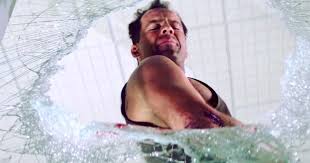
It’s something that John McClane says in “Die Hard,” after he throws the body of a terrorist, many stories from the embattled Nakatomi Plaza, onto the patrol vehicle of Sgt. Al Powell, a witless LAPD detective that is now, “in the know.”

Up until this moment, and ultimately after the terrorism, the story is about re connection and family. An off-duty NYC cop meets his wife and kids in California for the holidays, but is waylaid at a party that turns into a hostile takeover, McClane springs into action, the LA cops are called, Sgt. Powell responds, he’s sent off by the terrorists, and then the invitation to the party falls onto (and destroys) his squad car.

“Welcome to the party, pal.”

I think about this quote a lot, and then this morning, I started wondering why…

I think we’re all looking for our,
‘welcome to the party, pal’ moment.

We’re all McClane, facing our own internal Nakaotomi Plazas; figurative hostile takeovers happening within, what is supposed to be, a peaceful space of reconnection. We’re crawling around our own unique airshafts. We’re fighting our own authorities. We all have our own Hans Grubers to face.

And this is offline.

One of the side-effects of the algorithmically curated, cubist reality we call life online, is a lot of the hostility and terrorism is curated on screens in social feeds and news headlines, framed to stop scrolls and hearts, content only we see, so we’re alarmed, and when we feel like we’re being ignored, we want to throw something out the window and ask someone/anyone/everyone to join us in the fight.

But here’s where it twists in the online, hyper personalized and fractured world; it’s now, “welcome to MY party pal.”

DieHard McClane needed people to know about a general problem everyone was facing.

Digital McClane is asking for anyone to know about the specific problems they are facing.

One is reacting to life as it happens, the other might be reacting to algorithms aimed to amplify anxiety and existential angst.

So before we launch another assailant out of a digital window, the real question to ask when we feel like we’re in a DieHard situation might be, “welcome to whose party, pal?”

Also – take back the Nakatomi Plaza of your soul. Yipee-kay-yay, MFers.

Does Marketing Feel Like Weakness?

Marketing is perceived less as a tool and more as a tell, a sign of weakness, struggle, or even social desperation. Could this be related to class?

Spend time with Veblen’s ”Theory of The Leisure Class” and “The Culture of Contentment” by JK Galbraith, and you’ll see there’s something iconically wrong with American idealism around wealth and leisure. Both seminal works reveal wealth’s strangest effect: how it creates a kind of reality distortion field where the rich, cushioned from consequence, mistake their insular worldview for objective wisdom.

I think, a kennel club kinda snub-nosed thinking around marketing has been bred into the upper echelons, which makes up the executives who then bring this strain of thinking to advertising/business, and it’s essentially summed up in this quote from a corn ghost in the 1989 film, “Field of Dreams”:

“If you build it, they will come.”

In a conversation online the other day, someone mentioned that the C-Suite views marketing as a “dark art,“ summoning sales out of a crop circle. But I wonder, among certain strains of the “business class,” if marketing is seen as a pricey thing you have to do if you don’t have a corn ghost and you’re unpopular? The thought is, do as little as possible because if you try too hard, you look like you’re struggling.

Marketing is sales leaving the body.

Marketing is a sign of weakness if you’re not surrounded by marketing. Are rich people watching a bunch of ads, or are they paying to avoid them? They famously don’t know the price of milk. You don’t see a bunch of flyers in the hallways of a country clubhouse.

Is it so far off to think, some of this thinking is gonna leak into the business brain?

Why Marketing Could Be Seen a Sign of Weakness

In a land of top-shelf brands and luxury labels, it’s hard to make the case that the upper crust doesn’t believe in the power of marketing and persuasion. Scott Galloway has famously and numerously stated that advertising is a tax on the poor. I think the view of marketing as weakness comes from a few things:

  1. Paying to avoid ads.

    • Wealth buys distance from marketing. You pay for ad-free platforms, private clubs, exclusive access. This creates a class-based empathy gap. If people aren’t experiencing marketing like the gen pop does, they start to devalue its necessity or misjudge its utility.

  2. Thinking great products “sell themselves.”

    • Wealthy folks (especially those who’ve inherited or bought into growth machines) tend to conflate visibility with inevitability. (read: “The Product Delusion”) If something is good, it will succeed. If it needs marketing, there must be something wrong with it.

  3. Marketing is associated with struggle.

    • To advertise is to admit you’re not in demand. There’s a whisper of “if you were really that good, people would come to you.” Which is, of course, a fantasy, but a disastrously powerful one.

  4. There’s a performative power in effortlessness.

    • In luxury culture and the leisure class, trying too hard is taboo. And that thinking leaks into how business is done. Flashy marketing feels try-hard. Quiet exclusivity feels “earned.”

This Belief Trickles into the Business Class

When marketing is seen as something only needy brands or weak businesses do, the entire strategy gets deprioritized, especially by those in control of the purse strings. Because of the whispers of the corn ghost, the directive is:

“Don’t look desperate.”

That’s the aestheticization of success and hard work, not the actual practice of it, again, a theme that is hammered into a class-based truth by Galbraith. And it is deeply at odds with the real mechanics of brand growth, which we know from Ehrenberg-Bass and marketing science research:

  • Visibility matters.

  • Familiarity breeds favorability.

  • Mimesis (people copying others) is the foundation of culture and purchase behavior.

Step Up To The Plate

Stop waiting for a corn ghost to tell you to build the perfect thing, and stop thinking advertising is just expensive sign twirling for clowns. You don’t need to market like you’re struggling, but you do need to market like you exist. You have to reframe marketing as a memory game, not a shame game:

  • You’re laying breadcrumbs for future relevance, not begging for attention.

  • It’s not “trying too hard” if you’re building a mental and physical presence for the light buyers who won’t care about you until they do.

Rich people may avoid ads—but even rich people buy things they’ve seen before, especially if other rich people are using them. That’s mimesis. That’s marketing.

💡 What This Means Practically

If you’re working inside or with a business where this stigma around marketing exists, here’s your approach:

  1. Reframe marketing not as a cost, but as insurance.
    You don’t buy fire insurance because you’re on fire. You buy it because you don’t want to be.

  2. Appeal to risk mitigation, not enthusiasm.
    Don’t pitch marketing as a bold dream. Pitch it as prudent, proven, protective. Brand salience smoothes out sales cycles.

  3. Respect the status-seeking nature of business elites.
    High-status people copy other high-status behaviors. That includes the brands they adopt. Marketing is mimesis; it’s biology.

From a certain vantage point, marketing can look like weakness—but in truth, not marketing is the actual liability.

The only way brand marketing can ever take off is by building a proper runway for memorability.

Walk backwards from “The Close”….people won’t buy your brand unless they’re convinced, they aren’t convinced because they have no brand preference, they don’t know if they like you or not because the majority aren’t even aware you exist.

Market dominance is always going to beat out “favoritism,” and yet we’re convinced that being someone’s “favorite” is the way to dominate a market. Most people’s “favorite” choice is a commercially dominant default that’s been drummed into their head as being the “smart move.”

Just like the mantra behind Catch and Release Marketing says; let your marketing be easy to see, easy to try, and easily thought worth it. That’s not weakness. That’s how you actually play the game.

The Myth of Fairness in The Sandbox

This story starts from a divot on a golf course, and ends in a sandbox built on a cloud.

Preamble for an unfair world

After a drive that missed the green and ended in a divot where he couldn’t see the hole, my friend’s younger golfing partner for the day, smacked his teeth and said, “it’s unfair.”

The game, as this guy (Sean, let’s say) saw it, was unfair. Not the way he played it, or his equipment, or anything specific, the whole of golf was unjust.

When Sean asked my friend why he played the game, the response was that golf was a great “problem engine.” The reason my friend liked golf was the very same reason Sean hated it; the game is a series of unplanned, in-and-out-bound problems that you willingly give yourself to solve.

This got me thinking about one of the places where we learn fairness in its earliest form – play.

And then I started to think about how games like Minecraft and other open-ended, world-building games have taken off in the last few decades, and what that may have done to the popular conception of “fairness.”

And then I pondered the vibe-coded, limitless-possibility renaissance that is taking place with AI as stated in this article I read from a VC, depicting a future of software as a service that is actually service as a software, turning reliable products into composable canvases, sandboxes; essentially, MineCraft for businesses.

Somewhere between hazards, playground rules, pixelated worlds, and vibe-coded sandboxes, our idea of fairness, and what success in business and life is supposed to be, and how it’s most likely attained, might be being overwritten.

On Play and Creative Resilience

For 13 years, I worked as an educator with kids in summer camps, schools, and science museums, and in that time I learned how to play from the masters of the art. Play is critically important to development and learning, and has a functional role in a fully flourishing, thriving life.

My children love to play and I’m often right in there with them, and the biggest issue I’m seeing lately is fairness, “that’s not fair they get this” or “that’s not fair I have ice powers, but not water powers” (a real concern).

What I noticed is that “fairness” is deeply considered and argued endlessly over, not while playing games (like our pal Sean on the links), but specifically while they are engaged in open-ended, imaginary play.

As a jazz musician, poet, artist, and confident improviser, I love to play, and there’s a time and place to get silly and pointless. But I also have learned creative, genius, out-of-the-box thinking in play, comes from well-defined boundaries.

Like I explain in this clip from “The Cheap Genius Theory,” creativity isn’t something you’ve never heard before, but something that mixes novelty and cliche. There’s a difference between free jazz and swing.

Open ended, imaginary, illogical – these are the traditional hallmarks of brilliance and creativity, something kids should be encouraged to explore – but as a creative artist, these terms make me scared.

If every idea is on the table, you’re not headed anywhere, you’re a hoarder. If there’s limitless possibilities, you don’t develop a knack for what plausible genius is.

If everything is out-of-the-box, there’s nothing inside to compare it to. The box is gone! So are you!

On Games

I took my kids to visit their grandmother recently, and she put out an old-school game for the kids, “Pick Up Sticks.” The game is simple; you take a handful of sticks, drop them in a pile, and use one stick to continuously reclaim others from the pile without disturbing the surrounding sticks, if you do, you lose a turn. It’s simple, but challenging.

Every time you play Pick Up Sticks, you are playing a new version of it. The sticks won’t always fall like they did the last time. No quantum computer could handle this game, because, what worked last time might help you, but not more than fully showing up to the current pile of sticks. The skill here comes from embodied experience and mindful, flexible presence within well-defined structures.

Games have definite rules and regulated ways of playing. 5-card draw doesn’t work with an infinite deck. Tetris isn’t open to switching the shapes, you fit what you’re given. Freeze tag is only freeze tag if you freeze when you’re tagged. Mario isn’t going to float in mid-air to the flag, you gotta hit your head on some bricks.

If you hit your golf ball into a divot, it’s not unfair – it’s called playing golf. Maybe the concept of unfairness comes from work ethic, or grit?

On Grit

In the last 20 years, there was a spate of grit-based philosophies that sprouted up in the educational circles I interact with, the narrative given to kids was that we use grit and really work problem solving into skills which turns into achievement. Just work really hard, grind it out, and skills show up later.

Recent research proves that grit has little to do with overcoming learning barriers and achieving outcomes.

I’m speculating, but perhaps our young Sean on the golf course may have been told about grit in school, and tried to apply it but found out it wasn’t quite the ticket. That is unfair.

But I think this Unfair World outlook might connect back to games, more specifically, open-ended games like Minecraft.

Fields of Dreams

Minecraft was a smash when it launched in 2009. No missions, no story – just build, explore, and mod. The community defined the rules and the value of the platform. It was a multiple of the Field of Dreams “if we build it, they will come”

And people showed up. Minecraft is the best-selling video game of all time, and it really isn’t a game, but a sandbox. Players can play a story mode, but the popular traction seemingly comes from the “Creative” mode of play, where you can gather resources, craft, and engineer whatever your heart desires.

Whereas games in the past put you on a determined course with limited resource and you had to play and improvise within explicit confines, open-ended games empower players to make their own rules, adjust fairness to taste, and with barriers removed, they never have to feel the friction of their out-of-the-box ideas, because there is no box.

This is creativity incarnate. This is true freedom, ya?

Looking at this through the lens of “The Cheap Genius Theory” the popular assumption that Minecraft is an engine of creative thinking misses a few points;

  • Players are most likely to copy what they see, not make what’s never been seen

  • The game rewards finishing builds, not reflection

  • Creativity gets flattened into speed-running recipes

  • Trapped within physics and lore it’s hard to dialogue with disciplines beyond it

  • It’s self-contained, so no interpretive layer can discern mimicry from mastery

It’s a great venue for practicing tinkering, but a poor place to train the connective tissue that turns tinkering into world-changing ideas.

Service As A Software

The main reason I’m bringing all this up is the “trillion dollar” shift in SaaS (software as a service), made possible with AI Agents, to SaaS (service as a software). Much better than “agents as a service,” which is AaaS.

The thought here is that rather than ship a final product, like software that works 100% of the time, the high-composability in AI technology and agentic coding applications, allows us to now continuously mod and build software that is always evolving.

“The traditional “deploy and maintain” model has become “deploy and continuously re-engineer,” says this article from Foundation Capital, an investment arm that has no reason to shake your hand funny when they deliver these words.

“In the new AI world, buyers don’t purchase software; they purchase the outcomes it delivers,” they tell you. And this sounds empowering, but it actually brings fairness into play.

Old software gave everyone the same finished product—shared wins, shared glitches.

Today we all get the same sandbox kit; fairness stops at equal parts.

Connecting this back to the theme at hand, the idea that enterprise software should mirror Minecraft, a sandbox where users invent value, is seductive but flawed.

Most people don’t want open-ended freedom; they satisfice, picking the least-worst option, not the most creative one. The myth of “cheap genius” celebrates spontaneous invention, but real creativity depends on deep, often invisible knowledge and a cultural context that makes novelty legible and valuable.

When companies release tools expecting users to define their purpose, they attract mimics, not makers, and end up with templates instead of innovation.

Minecraft worked because it was a game that came with a culture, syntax, and feedback loops. If there is to be a future for service-as-software, it can’t just rely on blank canvases. Guided recombination, structures that nurture emergence, and scaffolding that turns chaos into meaning is the only way to bubble up real innovation.

Land the plane man…

So we return to that divot on the golf course, where Sean declared the game unfair. What he could’ve been saying, was that golf refused to be Minecraft. It wouldn’t let him reshape the terrain, adjust the physics, or redefine success on his terms. The divot was just a divot, demanding he play from where his ball landed, not where he wished it had.

That’s the paradox of the litterbox lottery moment: we’ve mistaken constraint for cruelty and structure for limitation, when in fact the opposite is true. Real creativity, the kind that builds bridges between disciplines, that turns tinkering into transformation, emerges not from limitless possibility but from the productive friction of well-defined boundaries.

The future belongs not to those who can dream up anything, but to those who can make something meaningful within the material, majestic, and maddening constraints of the world as it is.

About Paul Bunyan and Myth

Paul Bunyan was about expansion and the loud explosion of the American dream – we need new myths to wake us up to the shrinking, silent implosion of it.

I’ve been spending time with this truly American tall tale, and the story behind the story is our nation’s story. Below is a collection of reflections on the larger than life character, and what it meant and means to the country and our mythology going forward….

When Paul Bunyan (a pure content marketing play) was popularized in early 20th century literature by ad exec WB Laughead, from the Red River Lumber Company, to mythologize and gin up public support for deforestation (particularly of protected Ojibwe lands), they didn’t really focus too much on his history, because the nation was young and without history. Fuzzy references to a before time, murky parentage, a crib 200 feet high, and untamed lands.

So the urge for Bunyan to do his thing and create the country, is not necessarily coming from anywhere, or answering to anything – it’s a clean slate myth, or it’s a myth that cleans the slate by its own steam (hot air).

A modern American myth might require a bit more backstory – but is it because Bunyan lacks precedence that his legend was so impactful? You don’t have to understand much anything else than awe and wonder to have these stories work on you. In fact, ignorance is a great canvas to paint a myth on. This isn’t to say smart people can’t get mythological, or that myths are suited for dumbasses, but the expansion of myth rests on audiences having a fuzzy grasp on facts.

Bunyan was one giant man, bigger than a thousand men. He casually invented cutting edge tech. His waste products become homes for wayward creatures. In being encouraged to make up stories venerating a giant man, men could feel their work tied to something bigger than them.

Now that our modern American hero is the very real and human entrepreneur, we’re less inclined to work with anyone else, because the next hero could be us, the next American expansion is up our own asses.

Bunyan’s mythological hiking trail started out in the forests chopping it all down, but its end is inside of us, and the axe is aimed to split all remaining logs in the universe, so we stop believing in and feeding from myths, and finally live them out. We can all be Bunyan now. That was the hope all along.

The tall tales are big on imagery and team – blue ox, cooks, “colored” kids skating around with hams on their feet to grease a giant pan, the seven axmen, little chore boy – full universes are required.

Throughout Laughead’s book, lots of random names and “experts” are quoted and cited throughout, giving credence to the bullshit – big numbers, big things, and a lot of men getting lost, hurt, or waiting around for help from being trapped or caught or just needing supernatural help.

Interesting to note natural phenomena were “installed” by Bunyan, like mountain ridges and the Aurora Borealis. The natural world is the way it is because some brave man sought to mechanize processes first and foremost. What is natural to us has been engineered by a giant man. Nature is actually abandoned technological experiments. Nothing more. There is veneration of the land, many mentions of locations and tracts of land, but it all ultimately comes from Bunyan.

There’s an interesting segment about Lucy, Bunyans cow, who answers the call of the limitless wilds until Paul decorated her with a bell borrowed from a church buried in the snow. Stealing from faith to provide function.

“If Paul Bunyan did not invent Geography, he created a lot of it”

Bunyan was a commercialized myth engineered by a lumber company to fight back against forest conservationists who took issue with expansion – the answer to the deforestation of our external world was to plant mythological seeds and steward the country’s internal nature toward the interests of business.

I thought Paul Bunyan was a myth that said more about our national character and grit than it did about the fundamental nature of a country built off expansion. The goal of Paul Bunyan wasn’t national identity, commity, or even mythology, but narrative control.

I think it would behoove us to start mining and growing some new myths that work for us, from the bottom up, or we’re gonna keep getting chopped down by top-down myths that are engineered to work on us.