“The failure to see direct experience as the irreducible wellspring of knowledge is precisely the Blind Spot”
This might be the first book to be burned by scientists and lovers of empiricism, famous for not burning books, because of how heretical it’s claims, uh, claim to be. Count me in this shocked group.
With years advocating for scientific methods, working as an educator in the Denver Museum of Nature and Science, and believing in the power of objective/critical thinking handed down from Plato and Socrates, I felt like a naughty dilettante as I read through the author’s explanation that empirical science has both expanded, and drastically curtailed, human flourishing.
How can that be?
Well – it’s a simple irrefutable truth – there is no objective view from nowhere.
It’s tempting to think that science gives us a God’s-eye view of reality, an observational window into the innermost workings of the universe itself, but thinking there is such a view absent of subjective, direct experience is not only misleading, it’s impossible.
The book claims that the “blind spot” of scientism has resulted in a sharp neglect and discrediting of human experience; and this neglect has had drastic effects.
To define the perils of the blind spot, we have to define where it came from, how it developed, and what a possible eyes-wide-open alternative blending of rationalism with reason might look like in the future.
SOCRATES & PLATO WERE DICKS
The book starts with a portrayal of the birth of the blind spot, with Socrates and Plato, the original philosophical wedges in between the real world humans experience and something else called “reality.”
As a longtime fan of philosophy, platonic solids, and the socratic method, it’s shocking to hear that Socrates and Plato, the founders of the philosophical and scientific traditions, were kinda dicks. And the reason for it was their belief in “logic”
Nietchze referred to Plato and Socrates as the world’s first “degenerates” – why?
The answer is their development of something now called FORMALISM and REDUCTIONISM – which mean, respectively, that the world is made up of many forms, and can be fully, logically explained and understood by breaking down, or reducing anything into composite parts. This is the birth of “the blind spot”.
Plato/Socrates believed in an abstract “more real” reality, which Nietzsche found to be self-defeating. Nietzsche argued against the concrete existence of abstracts, and urged us to embrace the material world more fully.
Socrates hated the irrationality of music, thought poetry was banal and writers of it should be excommunicated. He once said that if you translate poetry into prose, you can see poets aren’t saying much. So send them to an island? Ouch.
The main takeaway is they kicked off this “other than” relationship between objective reality and the subjective experience of it. Seen through the left brain/right brain lens of Ian McGilchrist, Socrates and Plato were heavily into left brain thinking, breaking everything down into parts, calculating, machine-like, not embodied, but empirical.
This grew into the modern philosophical and scientific belief that the primary level of reality is the measurable, objectifiable, quantifiable WHAT of existence, and the ineffable, subjective, and qualitative HOW we experience existence through, is a secondary phenomena, and to some, an illusion all together.
THE SCIENCE IS COMING
The book then leaps into the Enlightenment, and all the science that kicked off during this time. The establishment of empirical, testable, methods helped jump start massively great things. But again, this entrenched the Blind Spot into the Western world even more.
A causality of empiricism is the thinking that primary processes (atoms/cells/forces) are concrete reality, and secondary phenomena (feeling/experience) is window dressing. When the blind spot really digs in, is when something called surreptitious substitution happens, when we replace our experienced world for the empirical one.
“In the development of the modern scientific worldview, the abstract and idealized representation of nature in mathematical physics is covertly substituted for the concrete real world, the world we perceive. The perceptual world is demoted to the status of mere subjective appearance, while the universe of mathematical physics is promoted to the status of objective reality. Thus according to this way of thinking, temperature or the average kinetic energy of atoms or molecules is what’s objectively real, but the feelings of hot and cold are mere subjective appearances.”
Galileo’s frictionless plane, Newton’s absolute time, the Bohr model of the atom with a dense nucleus surrounded by electrons in quantized orbits, and evolutionary-biological models of totally isolated populations – these are idealized representations that came from and exist in the minds of scientists. They are not concrete realities in the natural world we live in.
“The predictive models of physics work mostly inside walls – the walls of a lab, a particle detector, a large thermos, a battery casing. In other words, the models work in places what we can control and shield from outside influences and where we can precisely arrange the conditions to fit the models.”
This is where I struggled a bit – it isn’t that these models of scientific thinking are MADE UP, but that they were created by the subjective understanding and experiencing of things by these scientists, and then replicated in tightly controlled, easily measurable, laboratory workshops – but in the real world, these things are in such a dynamic and complicated web of systems, the lab findings rarely match up with life, so rather than cop to that reality, we break off into more abstractions.
“A loaded and unnecessary metaphysical assumption about what the world is like outside the range of our ability to construct and test predictive models. The assumption is that how things behave in tightly controlled and manufactured environments should be our guide to how things behave in uncontrolled and unfabricated settings.”
This is our modern approach to the world, and it’s messing us up….because it seeks to remove us (the understanders) from understanding.
Here’s where the Blind Spot hits our modern problems and touches on our fervor with consciousness in AI. We are trying to measure consciousness in humans, to then map it onto AI, but we cannot do this without using our consciousness or our subjective experience.
“There is no way to step outside of consciousness and measure it against something else. Everything we investigate, including consciousness and it’s relation to the brain, resides within the horizon of consciousness.”
THE ANSWER
The way forward is to accept that through an over-reliance on science and measurability, we have been substituting our ability to map out our experiences of the world, for the world itself. We have to develop a world-view that views life as a huge, dynamic, non-linear, insanely complex network that can be reduced to parts to understand functions, but these small patches of clarity cannot be bubbled up to explain the entire web.
“We’re authors of the scientific narrative, and we’re characters within it. As authors, we create science. As characters in the narrative we’re a miniscule part of the immense cosmos. This is how we must portray ourselves as creators of the scientific narrative. There is no way to take ourselves out of the story and tell it from a God’s-eye perspective. Instead of saying that science is a means for rising above the great, strange mystery of being human, a better story is that science takes us deeper into that mystery, revealing new ways to experience it, delight in it, and most of all value it. By leaving behind the Blind Spot, we can properly understand the crucial importance of objectivity as a means for public knowledge without transforming it into a dubious ontology.”
A quick review of Hubert & Stuart Dreyfus 1988 book on AI
The 1988 book, “Mind Over Machine,” covers the capabilities and limitations of computers in mimicking human intelligence and decision-making. A central theme in the book is skepticism towards the ability of computers to replicate higher-level human cognitive functions. Dreyfus argues that human expertise embodies a kind of knowledge and skill that goes beyond formalized rules and logical reasoning, reaching into the realm of intuition and subtle judgment that machines are unable to replicate.
Stages of Expertise
Dreyfus outlines five stages through which individuals progress to develop expertise in any field:
Novice:
Beginners follow strict rules and guidelines for performing tasks. Their actions are heavily context-independent because they have not yet experienced enough of the real-world scenarios to make nuanced judgments. This stage is where instruction is most rule-based and rigid.
Advanced Beginner:
At this stage, individuals can recognize certain contextual elements and start to apply rules in specific situations. However, their understanding is still limited, and they often need assistance when problems are more complex.
Competence:
Competent individuals have gained more experience and can devise plans when handling large amounts of information. They can see actions in terms of long-term goals and begin to prioritize which aspects of a situation are most important.
Proficiency:
Proficient practitioners have developed a deeper background in the field, allowing them to intuitively understand what needs to be done in various situations based on their vast experience. They may struggle to verbalize their reasoning because much of their knowledge is tacit.
Expertise:
At the highest level, experts no longer rely on rules, guidelines, or maxims. They have an intuitive grasp of situations based on a deep, implicit understanding. Experts know what needs to be done, often without conscious consideration of alternatives. They see problems and solutions holistically.
Transition from Rule-Based Learning to Expert Intuition
The transition from rule-based learning (novice) to expert intuition (expertise) is marked by a shift from reliance on predetermined, abstract rules to an intuitive, often unconscious understanding of complex situations. As expertise develops, reliance on conscious analytical reasoning decreases, and individuals begin to operate more on instinct and deeply ingrained knowledge. This expertise allows for quick, effective decisions that are difficult to articulate but are based on a rich understanding of what typically works.
His story about Air Force instructor pilots is worth sharing….
Dreyfus argues that human expertise is fundamentally different from and superior to the capabilities of computers. While machines can excel in applying predefined rules across vast datasets — surpassing even skilled humans in speed and accuracy — they lack the ability to make the intuitive leaps or understand the deeper meaning that comes from real-world experience and human understanding.
Calculative rationality actual fixes thinking in the advanced beginner stage, because it’s engineered to work with numbers/patterns/statistics. At a certain point of fluency based on lived experience, human expertise escapes these confines.
In “Mind Over Machine,” Dreyfus makes a compelling case for the unique aspects of human cognition and expertise, highlighting the limitations of computers in areas that require nuanced judgment and a sophisticated sense of context. This discussion raises important considerations about the role of artificial intelligence in society and the fields where human expertise will remain indispensable.
Quick review of “Master and Emissary” by Ian McGilchrist
Since you can’t throw a rock without hitting AI these days, I’ve been reading a ton lately on regular old human “intelligence” and one book really got my noodle cooking, so I’m gonna share for the class….
This book was a sea-change event for me. Main takeaways – the brain has two different methods for engaging the world, and they are associated with the big crease in your brain which separates, and connects, the left and right hemispheres.
THE RIGHT BRAIN – is the holistic, Gestalt, big picture, irrational side of thinking. Prefers living things, is associated with understanding themes and context, poetry, metaphor, music.
THE LEFT BRAIN – is the detail-oriented, calculative, procedural, rational side of thinking. Prefers inanimate objects and machines, associated with content and particulars, prose, numbers, and abstraction.
What was a main theme of the book is how we need both sides of the brain to pull off human intelligence, taking in the world as a whole (right brain) then processing details (left brain) then sending it all back to the right brain for intuition/understanding/knowledge. We need and use the whole brain to live in the real world. However, dopamine connections between the hemispheres, when mixed with dominant engagement with a specific hemisphere, can end up rewiring a brain to prefer one side over the other. The emissary overpowers the master.
This happens because the way we attend to the world, creates the world. McGilchrist summarizes this in a pithy manner; “The world appearing as shit doesn’t cause a person to become depressed, but rather depression causes the world to appear shitty.”
“Things change according to the stance we adopt towards them, the types of attention we pay to them, the disposition we hold in relation to them.”
Our search for defining what processes and computations are involved in human intelligence/consciousness, misses how we do it. We are obsessed with defining consciousness as something apart from us, when it is in fact, us.
“The fundamental problem in explaining the experience of consciousness is that there is nothing else remotely like it to compare it with: it is itself the ground of all experience. There is nothing else which has the ‘inwardness’ that consciousness has.”
“We are not sure, and could never be sure, if mind, or even body, is a thing at all. Mind has the characteristics of a process more than a thing: a becoming, a way of being, more than an entity. Every individual mind is a process of interaction with whatever it is that exists apart from ourselves according to its own private history.”
One of the most compelling arguments in the book is that we shape the world to fit our dominant way of thinking, which coincides with a preferred hemisphere.
The Renaissance was associated with the right hemisphere, and the industrial revolution with the left. And since that time, we have shaped and conformed our physical/social realities and financial/organizational systems to be in line with the left hemisphere, resulting in industrialized populations that have little choice but to prefer rationality, machines, logic, and straight lines.
We are increasingly existing in a left-hemisphere dominant world, where everything needs to be broken apart, objectified, calculated, correlated with value creation, unambiguous, and predictable through probabilities. The world can, and must, be broken down and understood through the parts.
And yet we LIVE in a subjective world with no straight lines, within complex, dynamic systems, filled with ambiguity, randomness, and holistic interaction. The world needs to be understood in a way that mirrors our lived experience of it; as a whole, and not just outputs of calculated processes.
The answer is to recalibrate our understanding of how human excellence and natural intelligence is defined, protect areas where cross-hemispheric cooperation (the only way human brains work in the real world) is exalted, and to bring the creative right hemisphere, and it’s resultant world-view and manner of engagement, up in stature with the calculating left, and blend/bake-in the two inseparable approaches into our societies and infrastructures.
Imagine living and interacting with technology and advertisements, in a world where EVERYTHING is personalized – it’s all about YOU!
Books, devices, billboards, search engines, display ads, your thermostat, your home computer – all of them are constantly speaking about you, talking to you specifically – everything is about you, your choices, your purchases, your habits – it’s all about YOU!!
Now, imagine living in a world where technology and advertising is impersonal, a world where everything is NOT ABOUT YOU!
All of the content and advertisements you interact with are static – the messages and delivery of marketed communications happen to everyone around you equally at the same time. There is a general absorption level of content across a wide social spectrum. Society interacts with mass media, and that symbiotic relationship inspires both to change and evolve together.
Now – envision the psychological differences between citizens living in the first society, versus citizens living in the second society. . .
Of course I am being reductionist here, but I think advertising can be segmented into two schools of thought –
1) – Hyper-personalized ads – powered by Big Data amassed from customer surveillance – Ads are able to follow customers wherever they go; on their fridge, in their phones, in their car, on their desktops, on their kid’s faces, on all the billboards they pass.
2) – Mass media – powered by impressions, communicating through shared values on larger scales, interacting with and inspiring popular culture on a societal level. Advertising aims to get groups of people talking to one another about a common, shared experience. The public square – the big billboard – the SuperBowl Commercial – the water cooler.
Modern marketers use a mixture of both of these approaches when it comes to advertising, but more and more our culture and society is embracing the first school – hyper personalized experiences, big data science, surveillance.
Could hyper-personalization and heavy curation of advertising environments to the individual level, endanger our society, our culture, our ideological mobility?
What happens to the individuals living in a society that depends economically on its citizens living in a hyper-personalized world? Does this reinforce our echo-chambers, our egos, our narcissism?
What are the psychological ramifications of living a commercial existence that is shaped and tailored to fit your every need, understand your desires, predict your behaviors?
The quest for personalized advertising underlies the shift from “us” thinking, to “me” mentality. We all lament the death rattle of community and the loss of common ground, but some of us are commoditizing that divorce.
People are more likely to like/engage an ad where they feel they’ll be a part of something bigger than them, a trend wave. But if all the ads we see are personalized, then it’s just a myriad of small waves which don’t add up to one huge wave; it’s just ripples.
As marketers, do we question what kind of society we are creating when we adopt the latest technology, advertising philosophies, or market research capabilities?
Do we recognize the important and powerful effect advertising has on shaping people, on shaping culture? What will we lose when we abandon thinking about advertising, marketing and business development on a social level?
What kind of consumers are we creating?
What world do you want to live in?
Is there a socially responsible way to market products and services, develop sound business strategies, and create valuable, meaningful advertisements – without having to monitor and collect everyone’s search engine history, credit card purchases, wearable analytics, social media posts/reactions/shares, private messages, emails, voting records, chats, thermostat usage, medical history, psychological profile, media consumption, driving habits and bathroom usage?
An ancient marketer answers modern marketing questions
HOST – About ten days ago, a plane landed at Denver International Airport. The plane came from the cradle of civilization, the Middle East, bearing a marketer who claims to be over 2,000 years old. He’s spent the last six days in a marketing hospital. He’s here with us today to discuss the past, the present, and the future of marketing.
Direct Response
2,000 Year Old Marketer – Most marketers are ashamed to admit that a ton of “direct response advertising” in the past, was done with swords. Conversion rates go up when you pull a sword out.
HOST – I would imagine so. Any other ancient advice about direct response for the modern audience?
2kM – If you really want to study hard selling conversion tactics, take a look at the Spanish Inquisition….(stunned silence in audience)
HOST – That is considered a human rights atrocity now, you realize?
2kM – Sure, even back then it was atrocious, but the conversion rates were un-Godly.
HOST – That’s barbaric, we aren’t like that anymore, conversions are figurative, not religious or forced through violence.
2kM – So do marketers do any blood sacrifices?
HOST – No.
2kM – Blood letting?
HOST – Definitely not.
2kM – Alchemy, magic?
HOST – No, no, there’s no magic at all in marketing today.
2kM – Well, maybe that’s the problem?
Organic Social
HOST – How do we know you’re a 2,000 years old marketer?
2kM – Because I’ve been waiting that long to make a sale off organic social.
Account Based Marketing
HOST – What is your thoughts on account based marketing
2kM – I think every marketer should be able to count.
HOST – No, no, account, like a –
2kM – Like a duke or a lord, right? A count.
HOST – No, listen – account based marketing is a type of marketing that deals only with certain accounts or groupings of prospective customers.
2kM – What makes one group more special than others?
HOST – High value accounts, well, these are men of means, they are prepared to do business, they wear a certain type of clothing, drive a certain type of…horse.
2kM – Why wouldn’t you sell to everyone?
HOST – To save resources, you only want to be visible to and directly engage with those that have the most means. Not everyone in the market is prepared to buy, so why bother shouting at everyone all day?
2kM – That day. But what about the next, and the days and weeks after that?
HOST – Only the worthy accounts need to hear our message; they will see us as the right choice for qualified buyers, and respond to our calls when we make them.
2kM – How will they recognize your message or anticipate the worth of your offerings, if they’ve never heard of you?
Attention
HOST – So what was marketing like 2,000 years ago?
2kM – It was a lot more in your face.
HOST – How?
2kM – Attention. In the ancient marketplaces, the art of grabbing and holding attention was a respected part of the trade. Marketers today are struggling with this.
HOST – Well naturally, there is too much content out there, attention is fractured across channels. Pinning down the audience is a mess.
2kM – Isn’t this where all your data lakes and warehouses kick in?
HOST – I suppose they should, but it’s not that easy.
2kM – Don’t you have performance data on what types of messages absolutely work? Your computers should have the formula for grabbing and holding attention?
HOST – We use data for different purposes. Marketers don’t have to be in your face, bold and brash; in fact, this is a waste of time if you aren’t selling to people who will buy today. We use data to respect the larger audience, make rational promises only to engaged personas with targeted messaging that speaks to the sensible parts of people and causes a direct response we can measure. Data increases our chances of success.
2kM – No, over-interpretation of data increases self-awareness and limits attention grabbing potential. Because of all the “performance data” modern marketers are too shrewd and keen to avoid scrutiny and a spotlight, so attention becomes unachievable and unfortunately seen as a liability really smart people avoid. So marketers mint less copper into the clang of the bell, thin the fonts on the sign, mumble in the corner, and “hate to be a bother, oh by the way” until sundown….
HOST – Marketers today don’t need to get everyone’s attention. We don’t need to be appealing to anyone else other than the people that match our in-market target profile. Data again increases our chance of success. We reach them with rational messaging that gets a response.
2kM – Marketers today want to be rationalized, more than they want to be remembered. Maybe data is to blame, but that’s a strawman argument, which was originally called a scarecrow argument, but we changed it in the 200’s because of Pope Zephrinyus, who was woke AF.
HOST – So is the secret to getting attention shamelessness? You just wear loud colors, clang a bell, and use large type and active language on your signs? People prefer not to do business with clowns.
2kM – How is Ronald McDonald doing, anyway?
HOST – Ha! I suppose pretty well. But most of us don’t sell hamburgers. We sell extremely complicated things that require a ton of content creation and consumer research.
2kM – Can you put all that complicated stuff into a jingle? Something peppy?
HOST – I’m afraid the marketplace has changed. People don’t pay proper attention like they used to.
2kM – These are the same researchers you just spoke of? Maybe marketers stopped valuing the audience’s attention properly?
HOST – I think many folks just want to skip the nonsense and get to the point of things. A lot of old advertising trickery is just creative flim flam and easily dismissable. People want to know what’s in it for them, nothing more.
2kM – Think about it this way – there are only a few ways to rationalize the benefits of a product, but there are a million ways to irrationalize the benefits. If the marketplace is as competitive as you say it is, and consumers are as distracted as you say they are, wouldn’t rational promises be the LAST thing a marketer would choose to shout out? It’s obvious what software or soap is supposed to do; but what does it make you feel like, what associations does it conjur, what invisible magic can you bring out of the irrational, illogical realms – that’s the sticking point. That’s your differentiation, distinction, the memorable way you grab and hold attention.
Influencers
HOST – Let’s talk about influencers.
2kM – Guzuntight!
HOST – No, influential people, celebrities, well known people
HOST – Well, not so much those types of figures, less menacing…
2kM – Caligula was a great entertainer. That barge. If you remember being on Caligula’s party barge, you weren’t on Caligula’s party barge.
HOST – Ah, so were there any local merchants during Caligula’s time, that made it their goal to get their wine, honey, plain cake on the boat? To be seen on Caligula’s boat must be a noteworthy achievement?
2kM – Buddy, when you’re five papyrus’ to the wind, taking a ram’s horn up the back in a public orgy, you’re not really taking notes.
HOST – Point…taken.
2kM – Literally. For me, the problem with influencers, is the imbalance of interest. Caligula’s influence and interest matters more than any product or brand on his Pleasure Boat. It’s never “what’s the product?” it’s always, “what does Caligula think?” There is almost an influential force field emanating from Caligula that blocks a clear recognition of the products.
HOST – So then what about celebrity endorsements?
2kM – An advertisement featuring a celebrity endorsement is better than using an influencer.
HOST – Aren’t these just the same thing as influencers, only less effective because the addressable audience is so large because everyone knows them?
2kM – That’s the exact reason celebrity endorsement may be more effective than influencers. There’s less distraction.
HOST – Less brands to compete with?
2kM – No, less dildos flying about – remember, this is Caligula’s Party Boat – the influence may cut deep, but anything that happens on that orgy boat is not shareable or useful outside the orgy boat.
HOST – Surely there is some overlap – what we do in private can influence our public behavior.
2kM – For you maybe, for everyone else it’s a matter of signaling that they are keeping up with The Jones, which, having been alive this long, I met the original Jones’, lovely people.
HOST – Back to influencers and the orgy boat, I mean pleasure craft.
2kM – With influencers, the addressable audience is comparing itself to desires and decisions made by, in this case, one horny dude on a pleasure craft that is literally cut off from land, from reality. There is so much emphasis put on the influencer’s opinion and thoughts, that there is no room for anyone else to think for themselves, let alone think intently about a brand or product.
HOST – The audience is waiting to like something, or hate something, because of Caligula’s outsized influence on their reality.
2kM – Exactly. Endorsement is effective not because we see a vaunted figure behave one way, or use one product, it’s because we see an audience of “other people like us” engage in a particular way in society and shared spaces. This is culture. This is how influence in a marketplace works.
Personalization
HOST – Let’s talk about personalization.
2kM – I don’t like to monogram anything, feels too Henry the 8th, you know? You really want to keep your head about that stuff.
HOST – Not you personally, but other people’s, persons – making marketing personalized to individuals, this is possible now with computers, you know?
2kM – Really?
HOST – Oh sure – You can track who buys a product, you can find out where they live, you can gain access to their habits, net worth, and daily routines.
2kM – Ok?
HOST – You can send thousands of people personalized communication wherever and whenever you want.
2kM – Wow.
HOST – Even better, once you can keep tabs on every customer you have, you can make them happy and address their needs at an individual level.
2kM – This sounds crazy.
HOST – Craziest part – Once you know them, they know you know them, so they never leave, and will always repurchase and buy more from you. You don’t have to spend money finding new customers. You can surprise and delight them at every unique turn in their life long journey.
2kM – So no more advertising needed?
HOST – Well, not really, but essentially…yeah! It’s exciting.
2kM – And how do you keep track of all the information and preferences of these customers?
HOST – That’s called data, and it’s all kept in something called a CRM tool – Customer Relationship Management – it’s a computer.
2kM – A computer? Some kinda astrolabe?
HOST – Yes, no. A high powered piece of software and probably some people to run it.
2kM – Sounds like it involves elves. Right? So – Imagine traveling back to a busy ancient marketplace in Mesopotamia…
HOST – I can smell the spices!
2kM – Right – and in order to sell effectively to people, we’d have to track them, put stickers on everyone who buys,
HOST – A great idea!
2kM – Sure. We also have to know where they live, what they do, what they like, and surprise and delight them whenever they show up at my stall, and, even at their house, unwanted, especially on Black Friday?
HOST – Yes. It sounds like a ton of intrusive work, but if you had the information, there would be no other competitor, they would always choose you.
2kM – What if someone rolls into the market with my product, but at a crazy lower price?
HOST – You can offer incentives and discounts to match for certain customers that seem like they might try the competitor, but the real loyal ones will stay with you.
2kM – Why is that?
HOST – Because of the personal touch, you are at the top of their mind and your product is deemed superior.
2kM – If we followed everyone around with stickers and specials and monogrammed sweaters, did we spend all our time and energy on making our product better for every customer, and even future customers?
HOST – Well, I suppose it doesn’t really matter what future customers think, as long as the customers you currently have love you, that’s all you need.
2kM – I dated Cleopatra for a while, and believe me – Just because they love you and they let you call them by their first name, doesn’t mean you’re irreplaceable. Incidentally, Cleopatra’s first name was Patty. Patty Cleopatra. HOST – That’s odd.
2kM – What’s weirder is this – I told this same personalization scheme to Jesus while he was writing the Bible!
HOST – Oh, sure!
2kM – I’m serious. Back when Jesus had the first draft done he handed it to me and said, “take a look, tell me what you think?” And I read it and, my God does he talk about himself a ton! It’s just his name everywhere. So I asked Jesus, “what’s the point of this book?” And he says, “I wanna start a religion.” So I tell him, “if you want people to pay attention and be loyal, you gotta put their name in this book.“
HOST – Well, actually, I don’t think that’s how that would work.
2kM – What do you mean? I told Jesus, “Hey man, you’re the hero here, but listen – Rather than share a single version of the Bible, you personalize the story for the congregation, replace your name with every congregation member, and hand out individualized Bibles! There would be no way to secure more loyalty and faith.”
HOST – Besides this idea feeling sacrilegious, what you’re describing is just not how people get inspired by stories or any kind of content.
2kM – What do you mean?
HOST – The personal connection people make with loyalty inspiring content, doesn’t come from a story that features us directly; it’s much more powerful to craft an impersonal story with indirect features the audience can see themselves in.
2kM – Oh…that makes sense….so what were you saying about personalization?
Profitability
HOST – How do we know you’re really a 2,000 year old marketer?
2kM – I’m still waiting for Hubspot to turn a profit.
USP (Unique Selling Proposition)
HOST – Yessir, a lot has changed in marketing in the last 2,000 years. ROI, USP, LTV
2kM – OMG, LOL, love the abbreviations.
HOST – No, no, no – those are acronyms, Return on Investment, Unique Selling Proposition –
2kM – Now there is a silly idea.
HOST – Which one?
2kM – You see – you had to ask! Unique Selling Proposition. What is it?
HOST – It’s a widely accepted theory, made famous by Rosser Reeves building off Claude Hopkins, that in order to command a marketplace of common goods, a competitive brand should establish a unique selling proposition in the minds of the consumers, something distinct.
2kM – We tell people what to think?
HOST – Indirectly. People are precious about their individual routines, prefer unique things, handcrafted for them particularly.
2kM – Lemme ask you a question about cowboys – what was their favorite drink?
HOST – Well, I suppose it would be whiskey, some kind of hard liquor.
2kM – You’d be right. And now, think back to the late 1880s, Dodge City, Kansas – a chaotic atmosphere, literally the Wild West. Now, how many saloons serving whiskey do you think they had in this small town, of less than a thousand people?
HOST – Probably one or two?
2kM – There were six. And each of them had the same whiskey on tap. Why were there so many saloons selling the same whiskey?
HOST – Well here is an example of a failure to develop a USP – if one of these establishments sought to corner the whiskey, and be the best in town, the competitors would have to scramble for different spirits, try to establish their own USP. It’s a good thing really. Diversifies the marketplace.
2kM – But these cowboys aren’t developing a taste for Moscow Mules or pina coladas – they want whiskey. They want the whiskey the other cowboys are drinking. And there are six saloons because of the natural churn rate of customers – saloons lose and gain bar flies from each other, they are 86’d and then welcomed back in a cycle across the establishments, and the fact that they can get the same whiskey here, as over there, keeps them in the town, and in the seat, and in market.
HOST – So what is the lesson?
2kM – Thinking a USP is the key to a successful product that customers love, misses the reality of why customers are in a marketplace to begin with. There can be MANY of the same types of establishments, and the fact that they are COMMON is the reason why they are FREQUENTED – Consumers, people, everyone loves to NOT THINK and would rather make decisions accordingly. What if a Common Selling Proposition is more appealing than a Unique one?
Fame / The Crowd Is In Control
2kM – It’s amazing hearing about the future, but I’m glad that certain fundamentals don’t change.
HOST – Like what?
2kM – Like fame. Marketers still think being famous is important…right?
HOST – I think it’s become more scientific, thankfully because of all the information we have access to – marketers and consumers behave differently now, they do the research on which product or brand to choose. Consumers are more savvy than ever.
2kM – Ok then – If everyone does their own research, then there should be hundreds of distinct brands in the top of every category, based on the fact that one consumer’s research and experience is not homogeneous with another, and people seek to have their individual needs addressed. Right?
HOST – Kind of. The marketplace is much bigger, but there are still dominant brands.
2kM – Why is that?
HOST – Because a conglomerate or a huge brand can outspend, outadvertise, and outshelf competing brands.
2kM – Then why don’t they buy up ALL the shelf space? Why leave any room?
HOST – I suppose to leave room for options?
2kM – Do you think that’s a choice they make?
HOST – Then it’s a question of stamina.
2kM – A functioning marketplace has consumer-side dynamics that can’t be 100% dominated by conglomerates. Consumers may be in control, not as savvy researchers, but as an easily distractible force unto themselves, looking for what others are looking for – the human is a social animal, when in crowds or communities, we have a logic that inspires individuals to make choices that align with peripheral vision, not direct line of sight. We gravitate towards things we recognize, not things we rationalize.
HOST – In a way I suppose that’s true, but it still doesn’t explain fame, or category domination by one brand.
2kM – Then reverse the question – does everyone choose a dominant brand because they rationalize it and research it?
HOST – No. They choose it because it’s there.
2kM – And, they choose it because they don’t have to rationalize it. They’ve seen it before, it’s recognizable in their mind. We parse the present moment’s decisions through our memories, not via an actuary table that calculates the odds of an improved future version of ourselves.
HOST – I think I get it – if the marketplace was a brain, the goal is to be in easy-recall memory, not in their analytical brain?
2kM – Precisely. This is why fame and recognition amongst crowds can cut into conglomerations. This is something marketers were taught 2,000 years ago, because some of the first really effective advertising came out of China, from a guy that played the hell out of the bamboo flute, sold a ton of candy because of it. Great jingles. And this was 3,000 years ago.
HOST – This is all well and good, but marketers today have to do a lot more than stand up and play a flute to be noticed.
2kM – But didn’t we agree that the goal is to be recognized, not noticed.
HOST – Yeah, what’s the difference? The crowd is distracted either way.
2kM – I thought you said they were savvy? Why don’t we throw some research on them? Surely, they’ll notice a really good webinar? Look, the point isn’t fame – fame has it’s roots in rumor and report, reputation & recognition among the commoners. This is where creativity is a distinction, in messaging, in price, in product, in placement. If you focus on generating fame and memorability, you may find doors opening more easily and more often. If you focus on generating a ton of convincing research, you may find your doors closing sooner than you’d like.
Efficiency VS Effectiveness
2kM– Things are so different these days, but marketers still have to deal with werewolves, right?
HOST – Well, not really, werewolves aren’t real – one of the benefits of science and history is that we can gather facts and so we’ve proven werewolves are just a myth.
2kM – So marketers don’t believe in myths anymore?
HOST – No – we have to report on things with metrics, strategize and be data-driven. Marketing is too expensive to rely on myths, so we have tactics to focus energy for consistent outcomes. Channel specific campaigns, targeted audiences, personalized cadences, keyword content; none of these are silver bullets, but they might help you kill a werewolf or two, figuratively speaking.
2kM – Why would you want to kill a paying customer?
HOST – It’s just a figure of speech. We quest for silver bullet fixes to make sure and fast work of execution, it’s about optimization, efficiency is the goal.
2kM – But what about effectiveness? What if a marketer’s goal was understanding larger forces at work, how to be effective, not just efficient, on the chosen channels?
HOST – What are you saying?
2kM – Marketers seem to be always searching for silver bullets, but they’re never interested in the full moon.
Patience
HOST – I assume you’ve noticed how fast things move in the marketplaces of today, I wonder how that compares to the pace of ancient marketplaces?
2kM – About the same.
HOST – *pfft* Come on now! The internet, telecommunications, peer-2-peer networks, credit and banking, there have been massive improvements to the speed of business.
2kM – But there hasn’t been improvements in effectiveness, just efficiency.
HOST – Again, I’d disagree. A/B testing technology, for example.
2kM – You have to test the differences between letters now?
HOST – No, between two things, concepts – When you come up with ideas for an ad or a tagline, you used to have to commit to one, and ignore the potential of the unused ideas. With A/B testing you can separate audiences so one group sees tagline A, and another sees tagline B.
2kM – So you say two different things to people at the same time?
HOST – You can test thousands of different iterations. And what’s best is test groups don’t know they are being tested, nor would they ever compare thousands of different messages.
2kM – So the total group lacks a shared experience, on purpose?
HOST – Yes. It’s brilliant, because you take the results and use the winning idea on the next campaign or iteration.
2kM – Why not test it again? Forever?
HOST – You certainly can, but there is a point where you should aim for consistency.
2kM – When is that point? When should you retest the A/B and C D results?
HOST – Well I guess around 6 months?
2kM – So every 6 months, what you say or sell might change appearance and be slightly unrecognizable, and that’s the point?
HOST – In a way, but there still needs to be consistency – testable, iterations, endless optimizations, that’s what is possible these days.
2kM – Right – I knew a lady once, in a marketplace near Cairo, had one sign, one tagline, and never changed it for all of the 50 years.
HOST – With A/B testing she could’ve improved her performance significantly.
2kM – She was a massive success because she figured out what worked and left things alone. She owned her corner, she commanded her spot, and her presence became a tradition.
HOST – Traditions change, they have to be challenged.
2kM – Says who? The community? Everyday people that perform the rituals and are held together by tradition? They want to change things every 6 months?
HOST – People are drawn to what is new, they ignore things they’ve seen a bunch of times.
2kM – I’d say people are drawn to things they don’t have to consider, tradition establishes this in daily life. Tradition is just a series of unchanged behaviors; the goal of a marketer is to tap into, understand, and become a part of these behaviors. By flip-flopping the messaging and packaging and brand, there is no ACTUAL consistency being perceived by the marketplace, and there is no commitment from the marketer.
HOST – So testing things is bad?
2kM – Not necessarily. Experience and time are their own laboratories, everything gets tested in the end. I think your A/B testing leads to homogeneity, not distinct harmony. There is no style in a lab environment, because the germs aren’t left to marinate on the petri dish; everything is sterile, testable, fungible, uncommitted to and up for debate. If modern marketers practiced patience and consistency as much as they practiced on their campaigns like patients, then patterns and data sets which reveal natural style, strength, and stamina would be easily evident.
I kicked my iPhone to the curb, and I’m happily driving into the sunset without GPS
“Bro, this is honestly the craziest conversation I’ve ever had.”
So said the Xfinity customer support rep a few weeks back, when I asked for advice on how to switch from my iPhone 13 to a “dumbphone.”
He was bewildered. He was confused. He didn’t understand why I wanted to go into the past, and not into the glorious future, and in a way, neither did I.
In an era of AI, next gen, at-your-door, same-day, make money without leaving the house, 10x living, why was I looking to avoid the latest technology and convenience? Was this a privileged move? Was this some Captain Fantastic shit? Where was this coming from?
A sober reflection on addiction
I’ve been alcohol-free for 14 years. Before I stopped drinking, I literally could not imagine living in a world without booze. It was a part of the nightlife I participated in as a musician, a part of the tortured artist gig as a composer, intertwined with romance and good times, and as a dude, beer is life; or so I had told myself to excuse my secretive and daily use of alcohol.
One solid, full-strength anxiety attack in 2009 sealed my commitment; I was unhealthy, overweight, and a mental mess, so I decided to hang up my spurs.
For the first two weeks, it was pretty hard, not because I had the shakes or anything, but taking alcohol out of my routine exposed the MASSIVE amounts of time I had wasted getting buzzed, leaving me with huge chunks of the day to do something with.
And I filled the void with projects, releasing a solo album, focusing on composing, and then connecting with Big Daddy Kane and becoming an integral piece of his touring band, and recording horns on Anthony Hamilton’s Grammy-nominated album, “Back To Love.”
Would all of this have happened had I stayed drinking? I’m not sure, but the likelihood of it all would’ve been diminished for sure. My energy and action was trapped in addiction, and only on the other side of making concrete changes was I able to see how much energy I lost, and appreciate all the wonderful things I gained.
Based on my experiences in sobriety (and in jazz and poetry), I have extensive experience turning my back on a world where all the functioning adults are partaking in something I’m not.
After getting sober, you can clearly see how everyone is at different points in admitting they have problems handling an addictive substance that hijacks their decision-making skills. It isn’t that certain people are weaker, diseased, or just can’t handle their booze, but that addiction to anything rewires your dopamine to engage the substance/scenario in spite of your rational brain.
Enter; the smartphone.
A sober look at phones
I won’t share all the crazy research that’s been done to prove that smartphones are crack. You can just think about living in a world without one and feel your anxiety pump up, your dopaminergic dendrites salivating, your fear of disconnection and loneliness roar to life.
I felt all that too before I got off the highway and it was a long, winding offramp.
After bringing my smartphone usage down, from 7 hours a day at the peak, to a little over an hour before I ditched it, and looking at the daily pickups (100 minimum) I realized the next horizon on my journey was to figure out how to get off the smartphone crack. And that’s when it got real….what was I going to lose?
My photos – my social media accounts for work – email – Slack – Zoom – my music – Google Maps – the pizza delivery app – all the contacts – emojis – GIFs in texts – ALL OF THAT was going to go away if I got a dumbphone.
But my experience of living nearly half my time on Earth without a smartphone, gave me hope. If you want to do computer stuff, use the computer. If you want to use the computer when you’re away from it, you can’t, so plan ahead.
Simple enough; now, where can I find a dumbphone….
My Punkt Phone
I asked folks at work what they thought of the idea of getting rid of the smartphone, and they were super supportive and told me about the Punkt phone.
I looked it up, it was able to take the nanoSIM card in my iPhone, the marketing was aimed at people exactly like me, and it was $300. A bargain compared to the $1700 iPhone. So I bought it and took it to the Xfinity store.
From the moment I whipped out my dumbphone, all the Xfinity employees (all wearing shirts that said “home of 10G” whatever that is) were agog; they did not believe that this was a real phone. They laughed, invited others over to gawk at it, and inspected it like the apes in the beginning of “2001: A Space Odyssey”
Actual image of Xfinity store employees looking at my dumbphone
Turns out, they are so in the future, the Punkt phone could not be seen by their network. They told me I would have to get a new phone number and a pre-paid plan from Target, like some drug dealer with a burner phone.
I then went to the AT&T store next door, and got it set up in 15 minutes, same number, no issues. Score one for legacy infrastructure.
From smart to dumb
Transitioning to a 4G LTE phone was hard, NGL. I had to manually input contacts after failing to understand how to get a VCF file off the phone. But this was good too, because a huge number of contacts in my iPhone were not needed. Score one for spring cleaning.
I had to go back to manual texting, hitting the alphanumerics until I got a T, then an H, then an A, then an N, then a K, and finally an S. THANKS! Jesus. This might suck. T9 predictive is no help either, I didn’t get that back in the day, still don’t.
No reactions to texts, no thumbs up, or hearts. My emojis were there, but I have to scroll through pages to find the right one.
People texting me URLs? Naw man – can’t see it. Email it to me like I’m your grandma.
But within the first days of owning a dumbphone, I started to feel a shift.
Just like when I quit drinking, I was now the proud owner of a bunch of free time. Time I had spent checking my phone, seeing if something happened, did they text, email, did I get a Like, should I comment, or reshare, this is interesting, I’ll read this later, I disagree with this, I love this, I need that, I hate that – all on a drip connected to my arm. Now, gone.
What replaced it was something I had unwittingly missed, for years; a different kind of time. Time to listen, engage, and live in the real world, time for games, music, jokes, conversation, walks, quality moments/memories with my children; all that time and all those experiences came galloping back.
And most shockingly and pointedly (because I hadn’t noticed how bad it was) there was the absence of anxiety. Anxiety I’d miss something, or more precisely, anxiety I forgot to check to see if I’d missed something, the anxiety that came with having access to something that supposedly kept me from missing anything.
Digital detox
I came across Jonathan Haidt’s Substack, and saw a post promoting this Digital Detox quiz, and I took it before I got rid of smartphone and after, and boy, lemme show you….
This was the best discovery. To know I couldn’t even answer some of these questions after ditching my smartphone, because my phone was now JUST A PHONE, was the best surprise. I stopped bitching on the social media apps on my smartphone about the addictive nature of social media apps on a smartphone, and decided to take action. Feels lush, accountable, and rebellious AF.
So my advice after all this is; if you can make the switch to a dumbphone, it could be one of the smartest decisions you can make, for yourself, your family, and the future. If you want advice or to talk about it, I am here for you.
And I bet you might be wondering; will I go back? To the anxiety, to the time suck, to the on-demand attention harvester, to my kids seeing me staring at a screen rather than their faces?
Is our enchantment with enhancement creating a level playing field, or an unwinnable game?
In a productivity obsessed world, anything that gets us closer to shipping is a winning thing by default. Endless tool kits, templates, and tactics, are available to anyone, but the strategic use and proper implementation of such things is in short supply. So it is with GenAI.
Should we disclose when GenAI is used?
After reading an excellent post on labeling GenAI content, and researching a proposed AI-labeling bill in the US Senate, I took to social media (Twitter & LinkedIn) to conduct a rough poll, asking people if they thought labeling GenAI content was something they agreed with in a personal capacity. And the differences in responses were wild…
Twitter resultsLinkedIn results
Given that there are probably more connections I have on Twitter that are more like me, and LinkedIn could be the opposite, this could just be a reverberation from an echo chamber. Or it could be something else.
The clapback to labeling includes people likening GenAI software as “just another tool.” But since GenAI is really a SERVICE, and one that has been known to make simple (and advanced) math errors, confabulations, hallucinations, whole-cloth lies, and produce fully-composed outputs that are rapidly fired into the internet without a second thought, GenAI is not anything like a calculator.
But it made me wonder if business professionals are less inclined (maybe scared) to admit when they are using performance enhancing tools, because it’s tied into external perspectives on their innate capacities, boosted productivity, and revenue opportunities.
Is GenAI a performance enhancing drug?
We’ve come a long way from Lance Armstrong. Famously praised for his epic heroism and fight with cancer, and then shit upon and excommunicated for blood doping, the world was rocked by Lance’s lies. But are we turning a corner?
The Enhanced Games are set to debut in 2025, and it’s 100% steroid fueled, proudly.
What’s striking to me, is proponents of chemically-enhanced performance in sports sound like the GenAI enthusiasts, particularly around art, where artistic skills are likened to preferential genetics, and GenAI is just here to level the playing field.
“We weren’t all born with natural talents!” they cry. And rather than cop to the reality that talent only comes from a ton of deep reflection, hard work, tough breaks, and heartbreak, we all are brimming with optimism that we can get a taste of that pixie dust, and damn anyone who takes the sweet stuff off our mirror. It’s only right.
We’re finding ourselves at an inflection point with performance and AI-assisted productivity, with a dangerous side of eugenics and a truly fucked up definition of “equality.”
Faking it ain’t nothing new in biz
It’s my position that this seemingly growing positive ethos around doping in sports is influencing the way GenAI is being used in the business world. A world where ghostwriters/tools/templates are common, but hidden; the origins of thought are masked on purpose, for payment, to give the glory to the God holding the check.
In a way, business has always been fueled by performance enhancements; founders don’t write speeches and come up with strategies and execute plans, the whole team helps. But the success of these founders is usually lumped onto their shoulders and viewed as their win alone. They conducted the tools and talents to extract the win.
So when it comes to labeling GenAI, the business world’s distaste is an historic one, based on precedence. But just because we’ve always operated in this way, shouldn’t mean we don’t evolve. And this evolution has to take place soon, because GenAI is messing everything up, right now.
Tupac, Deep Fakes, and Jake
Last week, Drake released a diss-track response to Kendrick Lamar, wherein which he used voice clones of Snoop and Tupac to deliver a rap he wrote. My initial response was less than enthusiastic, and just today we find out the estate of Tupac sent Drake a cease-and-desist order.
Why would Drake, who has natural talent, use GenAI enhancements? Is this a level playing field? Is it fair? Is it ethical? Is it even hip-hop? Does it take court orders to act right? Well….
This wild story about a teacher who used GenAI to frame their principal makes it seem like the law is the only barrier to making dumbass ideas come to life in real-time.
What was this person’s damage or problem with their boss? Could they have talked with the principal to air their grievances and fix what was broken? Is the hard work of trying to reach an understanding so difficult, that we resort to crime? Are we so scared to use our own voice that we’d rather puppet audiences with someone else’s?
Well….
Just this morning, as I started to write this very article, I woke up to a TON of LinkedIn notifications. Someone at the Product Marketing Alliance LinkedIn social team, thought it would be cute to steal my dumb joke, and make it look like they wrote it.
That chapped my hide. And as I looked at the comments, I was chapped even further…
Here I am, an idiot marketer with a penchant for metaphors and humor, and this fleece-machine fleet of fake-ass “alliances” takes my tweet to generate a bunch of GenAI-astroturfed engagement?
They could’ve easily just kept the original tweet and lost nothing, but stealing my talent and pretending they wrote it, wasn’t kosher. I flagged it, asked them nicely to take it down, and it’s gone.
But it clarifies and strengthens my original thought; GenAI is the gas station boner pills of the business world. While we might fool our way through a few one night stands with audiences, we are seriously hampering the perception of authenticity and trust in audiences, and at the same time, reducing our skills and ability to generate quality outputs on our own steam.
Labeling GenAI content is a step in the right direction, but there has to be a larger vibe shift in the acceptance and disavowal of depicted reality. If we don’t make that shift now in the real (or business) world, we might not know when we’ve fully crossed into a fake one.
“Those who don’t build, must burn.” – Ray Bradbury, Fahrenheit 451
Woke up wondering what the people using AI for creative substitution are REALLY doing? Besides cutting costs and increasing productivity, why would we seek out something that requires culture to be flattened and burned into code, to then be manipulated to fit any framework?
I recently watched the 2018 film adaptation of Ray Bradbury’s “Fahrenheit 451” on HBO, and a line of inquiry sparked in me as I watched the story unfold; is generative AI ushering in (and transmuting into) a new era of book/culture burning?
If you aren’t familiar with “Fahrenheit 451” you need to be, because it’s one of Bradbury’s most prescient and seminal works. Briefly, it is about a future American society that has removed/captured/contained all the cultural treasures of humanity, and follows a “fireman” who becomes disillusioned with his duty to burn books and destroy knowledge, and pivots to trying to save them.
Bradbury’s reasoning for writing the book changed over time. In a 1956 radio interview, Bradbury said that he wrote the book because of his concerns about the threat of burning books in the United States. In later years, he described the book as a commentary on how mass media reduces interest in reading literature. In a 1994 interview, Bradbury cited political reasons, relating the work as a response to “thought control and freedom of speech control.”
I think this current Gen-AI era we’re existing in could be the full realization and penultimate amalgamation of Bradbury’s cautionary tale.
Gen-AI as fire
The all-consuming nature of big data practitioners has always been to collect every possible bit of as much information as you can fit into a chip. You need to feed your training sets everything if you want your AI to do anything.
In the computing world, there is something called “burn-in” which is the process by which components of a system are exercised before being placed in service.
I believe that all the data that we gleefully fed into AI tools at the outset of this latest techno-boom have been burned-in to the architecture and outputs of these machines.
The weird part is that, historically and on the whole, book burning has negative connotations. But in this AI-enabled version of Fahrenheit 451, we are all firemen, and we’re happy to shove everything and anything into this forge of the future.
Once we’ve burned all of humanity and it’s cultural treasures into code, we will be better for it; not because we got rid of them, but because we gave it to a higher intelligence that will in turn give us super-human abilities to take all this knowledge and transform civilization for the better. Make society better functioning, launch marketable goods and products faster, generate ground-breaking ideas in seconds, and save the planet.
The more we burn, the brighter our future.
Gen-AI as a cultural suppressant
From what we’ve seen, the people running these AI transformers don’t have any compunction violating copyright protections, and don’t discern any differences between data and code.
Paradoxically, AI is a very unintelligent tool, indiscriminately sucking up and then spitting out results with little attention paid to details, facts, or contextual realities.
When we burn information (books, music, film, art, news, everything) into AI we essentially remove the media from the physical medium, and are left with the ashes.
What we get then is a flattening and codification of culture that dysfunctions at scale.
When you take your experience, context, and background, and read “A Thousand Years of Solitude” by Gabriel Garcia Marquez, or listen to Mahler’s 9th symphony, or watch Stanley Kubrick’s “The Shining,” you might take away something completely different than the critical response, synopsis, and summary of these works available on Wikipedia.
Since AI is only capable of replicating/regurgitating data within its training set, it necessarily misses all of the softer, subconscious impacts of our engaged experiences with the materials in question.
As we rely more and more on AI to be a single source of irrefutable truth, we are excising the critical factor of human response and reflection to truth itself. Here the cultural suppression of AI.
“Cram them full of noncombustible data, chock them so damned full of ‘facts’ they feel stuffed, but absolutely ‘brilliant’ with information. Then they’ll feel they’re thinking, they’ll get a sense of motion without moving. And they’ll be happy, because facts of that sort don’t change. Don’t give them any slippery stuff like philosophy or sociology to tie things up with. That way lies melancholy.” – Fahrenheit 451
Gen-AI as thought control
I recently wrote about the legal findings that bar Wikipedia from being used as a dictionary. Since Wikipedia is a manipulatable source of information, and curated by contributors that have bias, it cannot be relied on to verify hard facts. But more importantly, Wikipedia, and all the available information on the internet itself, does not represent a full-spectrum sampling of humanity and has massive gaps in the data layers.
AI is not the dispassionate, disconnected database we think it is, but a compendium of all our shortcomings and biases. AI isn’t something other than us, it is us, or more pointedly, it is our data. And those with the easiest, broadest, fastest access to feed the most inputs or “facts” into AI databases (or the datasets used to train/fill them) will be able to set the tone for the outputs.
AI is essentially a statistical modeling tool, based on means, medians, averages, and GenAI is a prediction engine that uses this toolkit to produce desired results. Problem is, once any information has been burned in, it’s abstracted away and purged from the source material. And if there are any data gaps or issues within the black-box AI framework, it’s near-impossible to know.
It seems alarmist to claim that AI is thought-control, but it doesn’t require a sci-fi leap of faith to substantiate this idea.
Cultural products are a technologically mediated form of thought control. When you read words someone wrote, or listen to music someone recorded, or watch a film someone made, you are able to interact with the creators, their ideas, perspectives, feelings, transmogrifying your whole being, both positively and negatively.
In Fahrenheit 451, the impetus behind book burning bubbles up to a Ministry, that has decided to (after disastrous civil war) erase, replace, and modify culture to be more conformed and controllable.
For peace, they got rid of all the passion. For safety, they unloaded all the rapid fire thoughts of culture into the dustbin. For stability and predictability to reign, they had to incinerate the thoughts and reflections of unstable minds and mercurial thinkers.
As we continue to burn-in all of our cultural outputs into a repository that is just a tool, we should question the end-use case for such a tool and how the powers that hold the most sway over the directionality of AI might use, and abuse, that toolkit.
“Don’t ask for guarantees. And don’t look to be saved in any one thing, person, machine, or library. Do your own bit of saving, and if you drown, at least die knowing you were heading for shore.” – Fahrenheit 451
Data sets being used in medicine today, with massive gaps and biases, will bake this bullshit into the code of AI within the biomedical industry; is there a doctor in the cloud?
In 2017, there was a case before the Texas Supreme Court, wherein one of the lawyers was trying to cite Wikipedia like it was a dictionary, relying on its definition of a term to validate an argument. To quote the Technology & Marketing Law Blog of Eric Goldman:
“The Texas Supreme Court…opined on the credibility and validity of Wikipedia as a dictionary. TL;DR = the Supreme Court says don’t treat Wikipedia like a dictionary. Any court reliance on Wikipedia may understandably raise concerns because of “the impermanence of Wikipedia content, which can be edited by anyone at any time, and the dubious quality of the information found on Wikipedia.” Peoples, supra at 3. Cass Sunstein, legal scholar and professor at Harvard Law School, also warns that judges’ use of Wikipedia “might introduce opportunistic editing.”
So simple enough; Wikipedia is a living document, shouldn’t be used as a dictionary, could be hacked by opportunistic/interested/vested parties on a whim, so it’s suss.
But this got me thinking about algorithms and AI; how they’re snarfing up the entire internet (which isn’t a true sample of all of humanity) indiscriminately, and then I thought about the imbalanced/biased inputs that exist in our big data today, on sites like Wikipedia, and how those might turn into a big time headache when people start relying on AI for credentialed information.
Right below the passage above, was this:
Wait; “…overwhelmingly male, under 40, and living outside the US?”
So simple enough; if you don’t have data sets from a balanced, full-spectrum representative sample of the population, then scaled analysis and insights derived from AI won’t be applicable across these populations.
And then this section about digital biomarkers (which are physiological, psychological and behavioral indicators based on data including human-computer interaction (e.g. swipes, taps, and typing), physical activity (e.g. gait, dexterity) and voice variations, collected by portable, wearable, implantable or even ingestible devices) blew my wig back.
And then this kicker….
Reading the full article, which is filled with illustrations and examples of the qualitative gaps in the data layers of medicine and healthcare, and there is but one conclusion;
There is no data in use, or even in existence, in the entire biomedical and healthcare universe of TODAY, right now, that informs how these industries various products, services, pharmacological solutions, etc, are applicable to individuals of every shape, sex, size and substance.
And if we don’t have the data sets and contextual inputs, or ability to appreciate/identify/remove the biases within them, from every human on the planet; not only in every size, shape, sex, but also mood, moment, DNA, background, physical environment, habits, schedules, etc. how would we ever engineer a medically-specialized AI that could generate healthcare protocols that would be applicable to all those people in all those states and varying factors?
Ok, so, simple enough; there is a massive gender/people/context gap in the entire corpus of data afforded to the entire healthcare ecosystem, which is already generating unreasoned and irrelevant selectivity in it’s conclusions/prescriptions/innovations. Same for any AI built off this data, or lack thereof.
FlexJobs polled over 5,600 working professionals about AI adoption, and when asked if they think AI adoption will be positive or negative on the workplace, men reacted more favorably, but the women overwhelmingly answered; “not sure.”
Given the imbalanced, biased, and misabused state of big data, I also wouldn’t be sure of AI’s impact on anything other than turning the existing gaps in our current data layers into chasms. And maybe, just maybe, we should seek out and listen to the many voices missing from the data sets of today.
The Great Wall of China is built mostly out of stone, but there are some humans in it. AI music generators are built mostly out of humans, but there is some code around the corpses.
As a professional musician/composer with decades of experience, accolades & awards, and a genuine love of music, it’s my opinion that AI music generators (AMG) are NOT the creative prison-break tools they are being sold as, but actually a new prison; one where the food is worse than bland, nothing is special or sacrosanct, the sentence to be served interminable, and instead of valuations on goods/products being tied to the real world, we’re wondering if jerking off the guards or stabbing someone in the shower is a fair price for some cigaraettes or toothpaste.
What’s it built with?
One problem all of AI is grappling with is their “training sets” – the corpus of material they use to train their programmable intelligence engines with, and if it contains copywritten material. [it most definitely does]
Up until now, if I recorded a song that was basically Marvin Gaye, and released it under my own name for sale, I would be called to task by the law (not least by the crowds). The new AMG’s most definitely use stolen copywritten material to build their tools, as is evidenced with manuscript paper receipts on Suno from Ed Newton-Rex in his thread and then full article for Music Biz World.
He cites many examples and it’s worth a dive into it, but it’s safe to say from the evasive non-answering of my and many others persistent questioning to these companies that they are not keen on answering the question. Or they answer in a loose way; the data is “publically available.”
People now have AI tools to create high-quality content that can’t help but violate copyright. A new question is; will the AI companies be held liable, or will they shunt off the lawsuits to all the people that generated IP-laden music. If I was running one of these companies, I know who I would like to hold the accountability/illegal-shit bag.
We ALL could’ve “cut corners” and injected IP through our projects/programs, but didn’t, not just because “laws” but respect & acceptance to do the hard work of thinking/dreaming on our own steam. That determination is deflating and the value of the “hard work” of creating music/art/anything is being questioned by the ubiquity of quick-fire AMG tools. Why would I pay someone more to get something that might be slightly better than what I can easily create myself?
Here, the invisible hand of conventional economic wisdom diddles the artisan state, and brings the promise of cost reduction and revenue increase; the only two things that matter. And with it, a new type of limitless supply; the question is, besides companies seeking to reduce costs and increase profit, who is demanding this stuff?
Who’s asking for AMG?
One of the purported missions around these AI-art tools is that it frees all the “regular people” or non-artists, to crank out quality stuff in seconds; just like a real artist without all that artist!
Here there are some interesting contradictions; AI-types decry the elitism in art, getting near a eugenics-style argument mixed with a communist/classist tinge that the proletariat have not been privilieged to have been born with gifts to create.
Now with AI, they can….join the elite, burn it down, give the tools of production to the people, but also, don’t steal THEIR source code or prompts, and pay them money to use the thing they built off stolen shit and build their valuation to investors.
Most bewildering to me is the idea that everyone that listens to music or goes to see live shows are just HANKERING to make music and perform it live.
One of the co-founders of Suno.ai is hoping to bring the level of music fans, of which there are millions, and music creators, of which there are less, to parity.
I don’t doubt that we all dream of being on stage and rocking out; indeed its one dream I had when I was 5 and may have laid the trajectory of pursuing a 30 year career in music/creativity. But to say that this dream is directly transferable to a market-place supply/demand rubric for these tools, and that once everyone can crank out music that’s just as good as any legend in music, they will value music more and want more of it, is stupid.
If everyone can compose/perform hit songs with AI, then why would ANYONE go see live music or buy albums? For real – if the imbalance between musicians and fans finally helps all those fans become musicians themselves, then wtf is special about any of it?
What are we using AGM for?
This whole-song prompt suggestion from Udio, the latest AMG, is ridiculous;
We already have plenty of existing songs that get to this feeling; “Wonderwall” by Oasis, “All-Star” by Smashmouth, “Legend Has It” by Run The Jewels, “Another Brick In The Wall” by Pink Floyd, “Getting Jiggy With It” by Will Smith, “Bad” by Micahel Jackson, “Working 9-5” by Dolly Parton and ANY OTHER SONG that directly/indirectly connects with your experience and first-day feelings could fit right in here; building you up, pumping your ego, hearkening to your memories of the first exposure to the songs and the people you experienced it with, spurning your choices, and sparking your soul.
Saying an AMG song you spit out in seconds, or prompted into glory after minutes of “hard work”, will have the same lasting effect on you is IGNORANT of how memories and music work in our brains and on our bodies.
It’s also a nod to the disposability of these creations; fun for a lark, not fit for life, and definitely not strong enough to support shared collective consciousness/experience. We all know how “Eye of The Tiger” makes us feel, but your custom built AMG song about going to work on spreadsheets for 8 hours lacks the vital velcro that is already merged by pop music and populations that enjoy them as one.
The Generic Apocalypse is Hard-Coded
Classification is a big thing in data science. But what has happened to the classification of music as it’s been democratized through consumer-facing products like Spotify, is that there is a lack of tacit knowledge being applied to the levels of discernment that classify music in all it’s various ways; orchestration, genre, tempos, time sigs, production style. This has a drastic effect on the music community and an indirect adulteration of authenticity for the audiences.
If someone makes a massively popular play list of “Classic Rock” on Spotify, and Pearl Jam or Nirvana (grunge) or Metallica (heavy metal) is in that; everyone now thinks those bands are indicative of classic rock. Classic hip-hop playlist with Eminem (garbage) or Snoop (gangster) on it? A classical playlist with Bach or Vivaldi (both Baroque)? I could go on, but you get the point.
This may not seem like a big deal, but it would be if someone indiscriminately scrapped all these classifications and fed them into their AMG – you wouldn’t be able to prompt your way to anything approaching actual reality. But methinks they don’t really care. But that’s because data & code are interchangeable to data pros.
This tweet from the very smart Mike Taylor gets directly at the indifference in AI/AMG creators; they don’t separate the writing of music from the performance of it, both previously viable pathways to income for artists. This point is reinforced from the brilliant Jill Nephew;
So with this scale of fraud, this indeterminate use cases, the unknown impacts on collective consciousness, and the flattening and commoditization of an art form that is already fighting for proper valuation, it is my thought that AMG is not a revolution but a revolting and disgusting attempt by economic-driven shit birds to extract the best of humanity and then charge us for the gracious access to continue it’s devolution.
Do you want human-composed music for your next project?
Then consider giving some love to your local, friendly, massively creative composers; maybe start with me and the crew at Audio Content Lab; 100% human-generated, no legal ramifications, built with hands meant for ears.
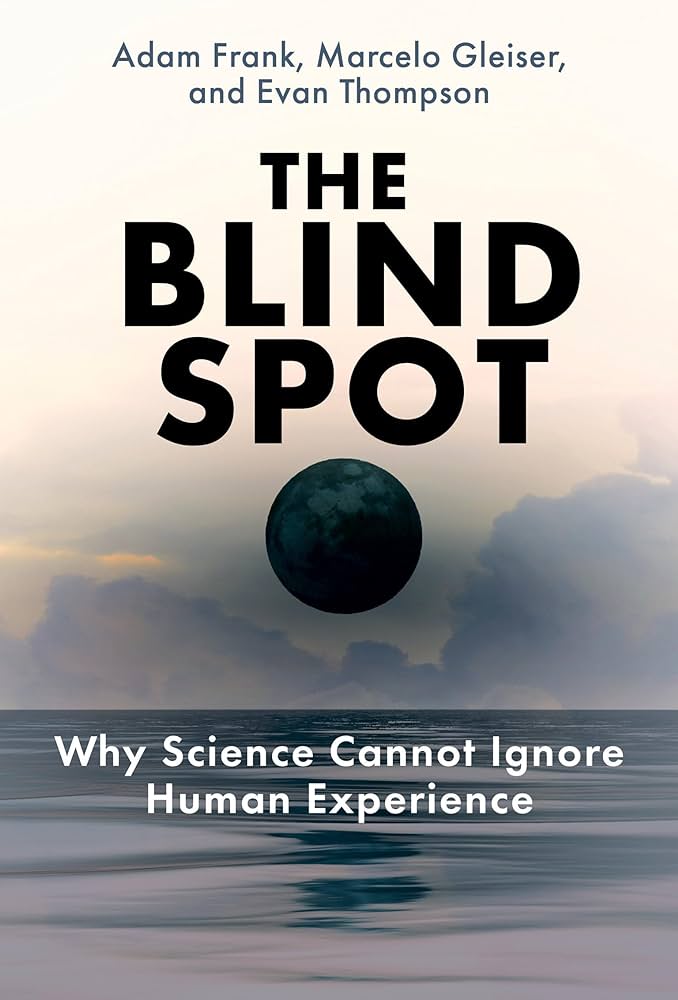
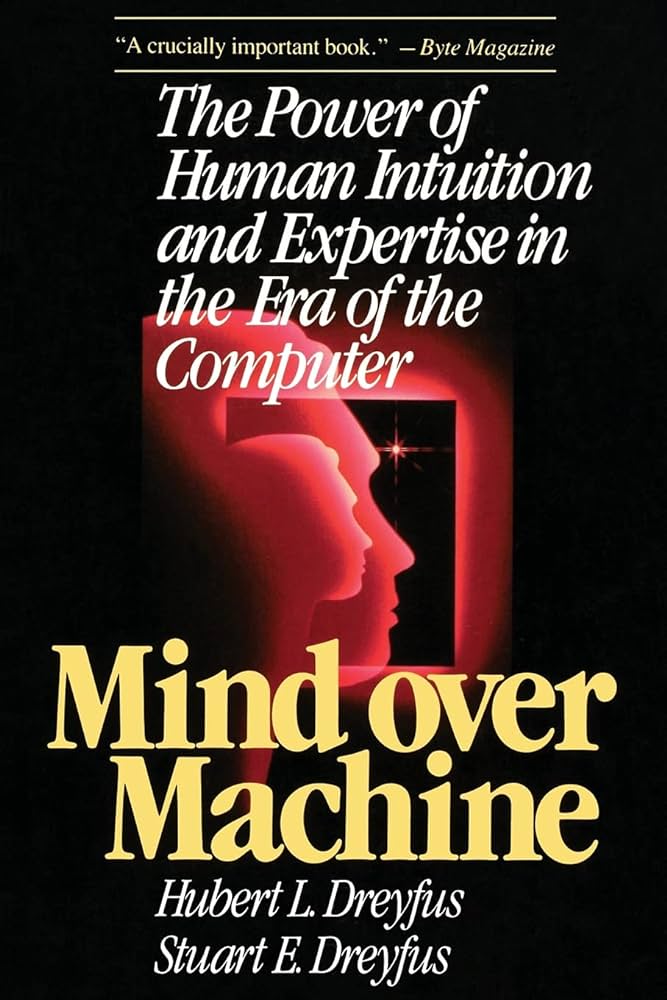
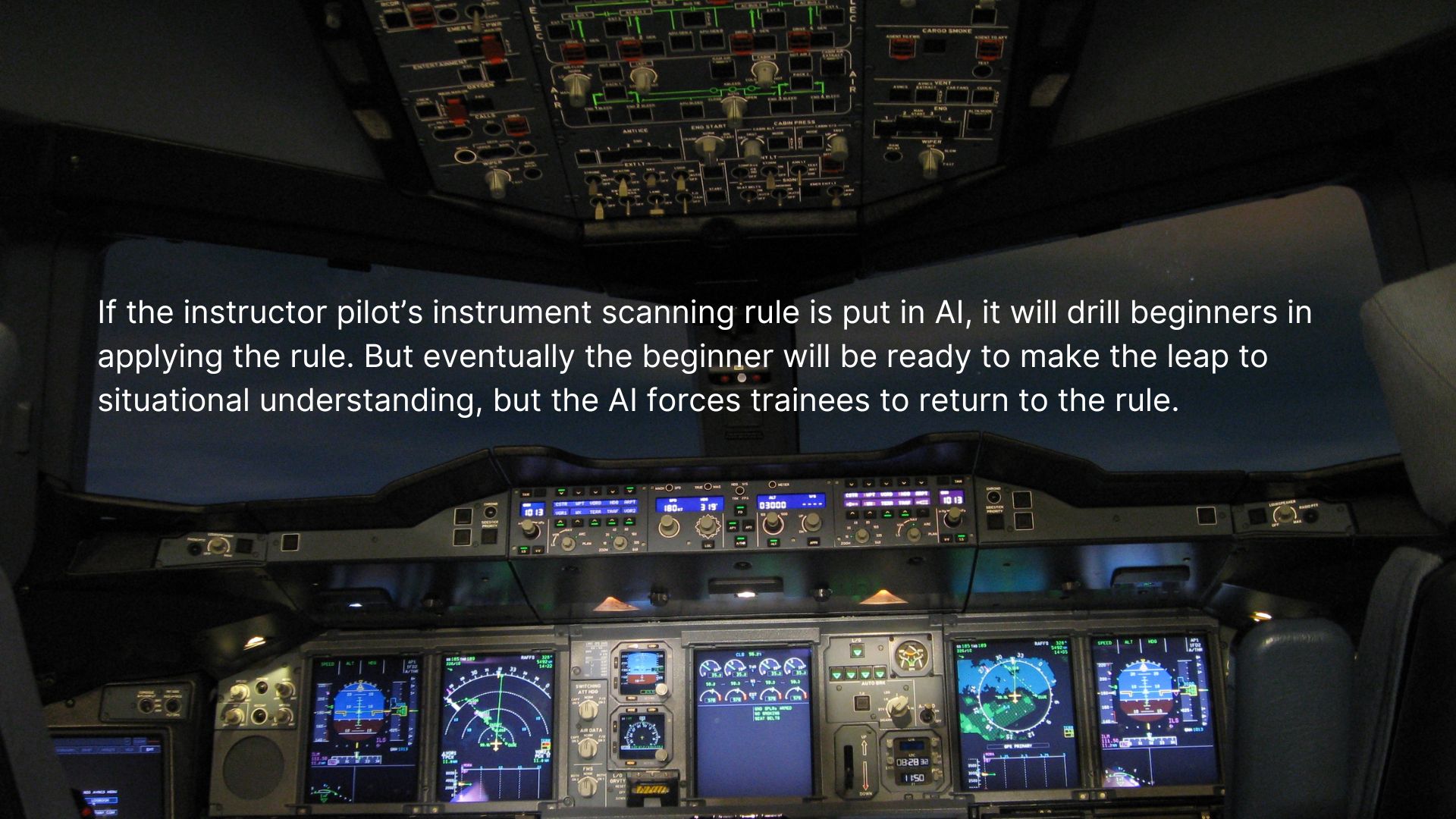
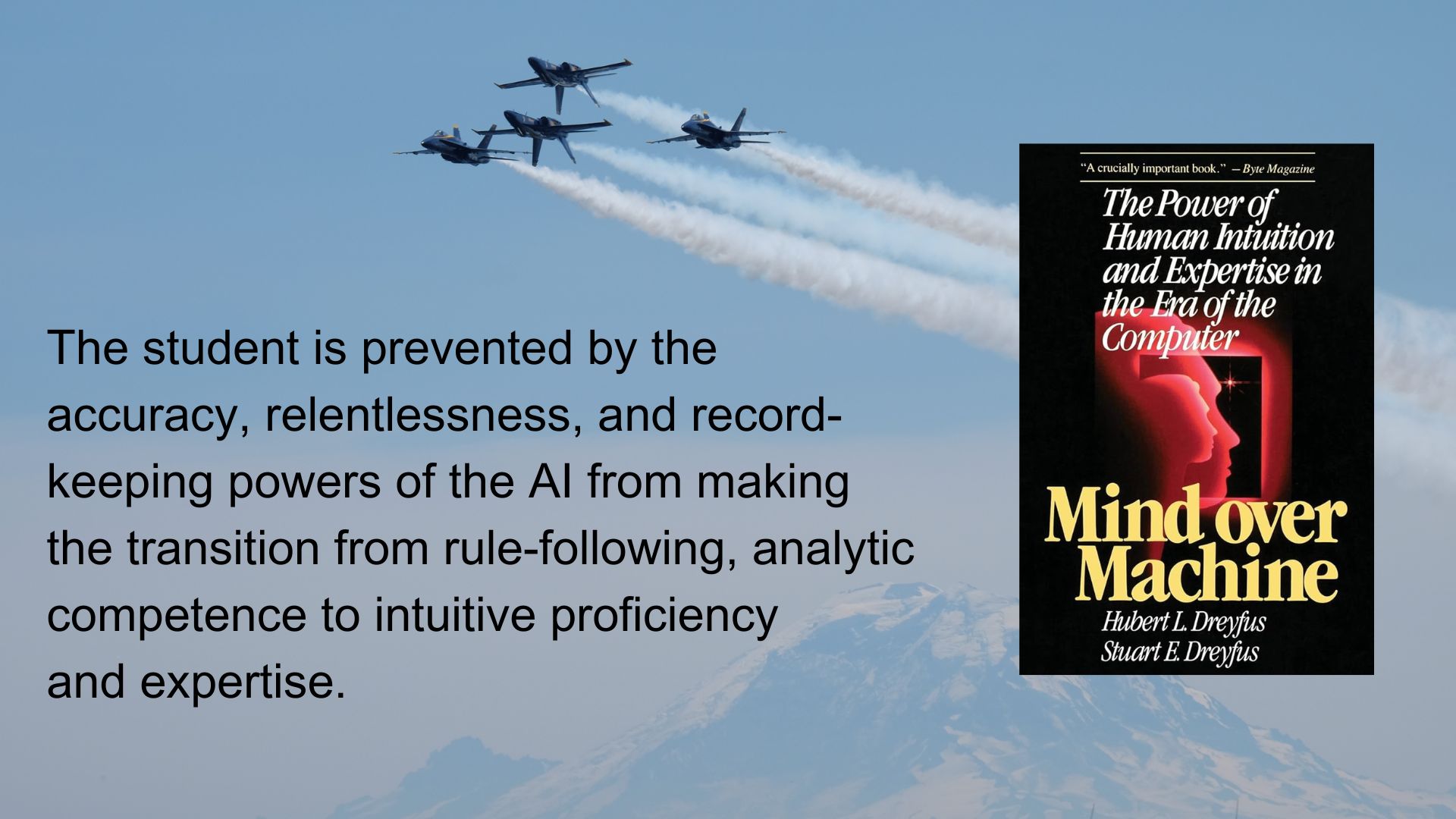
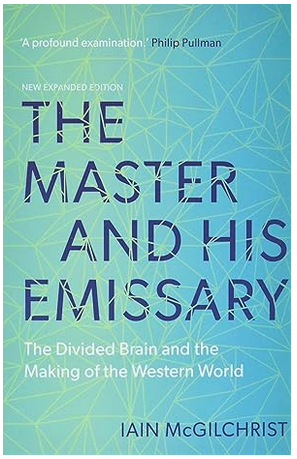


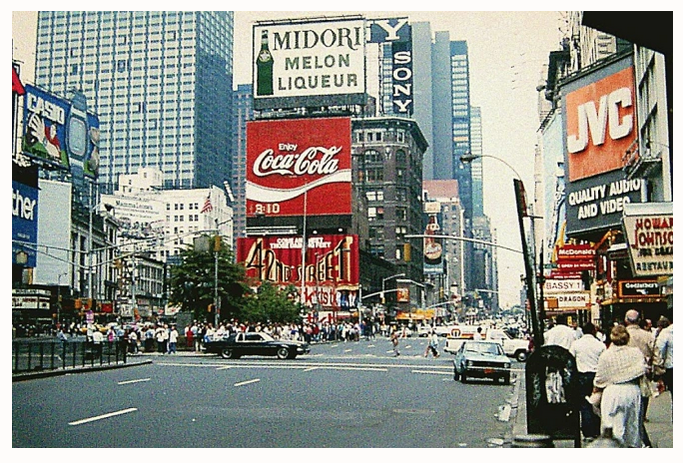

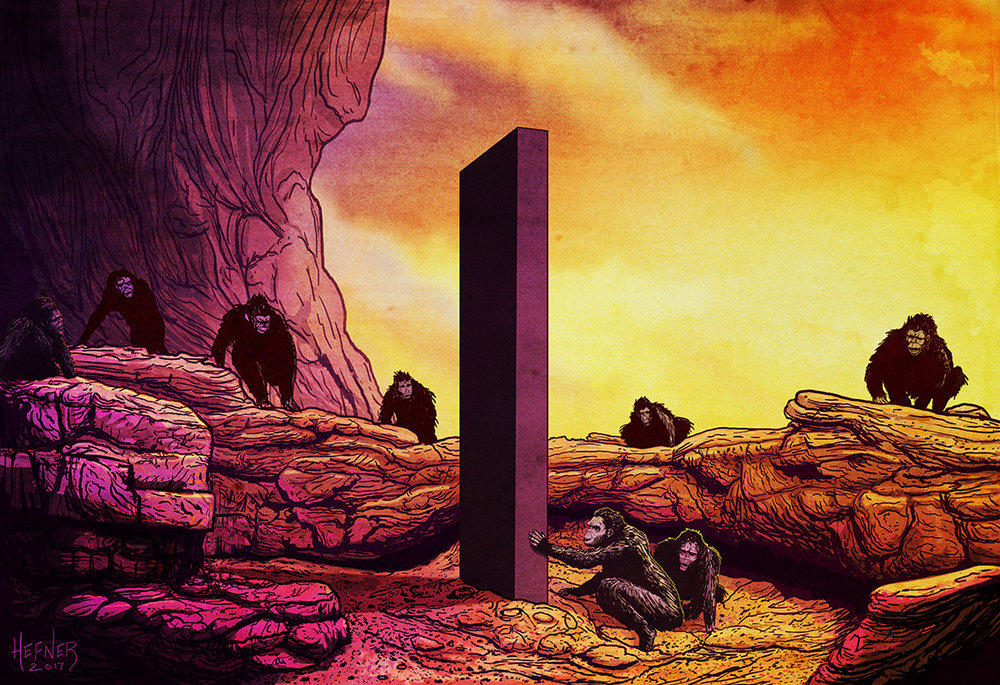
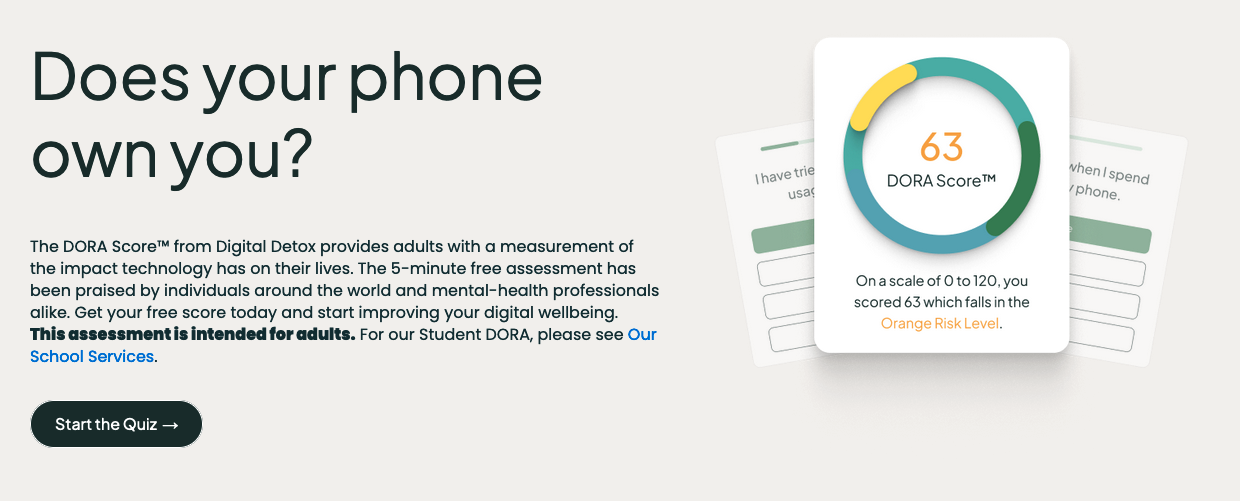
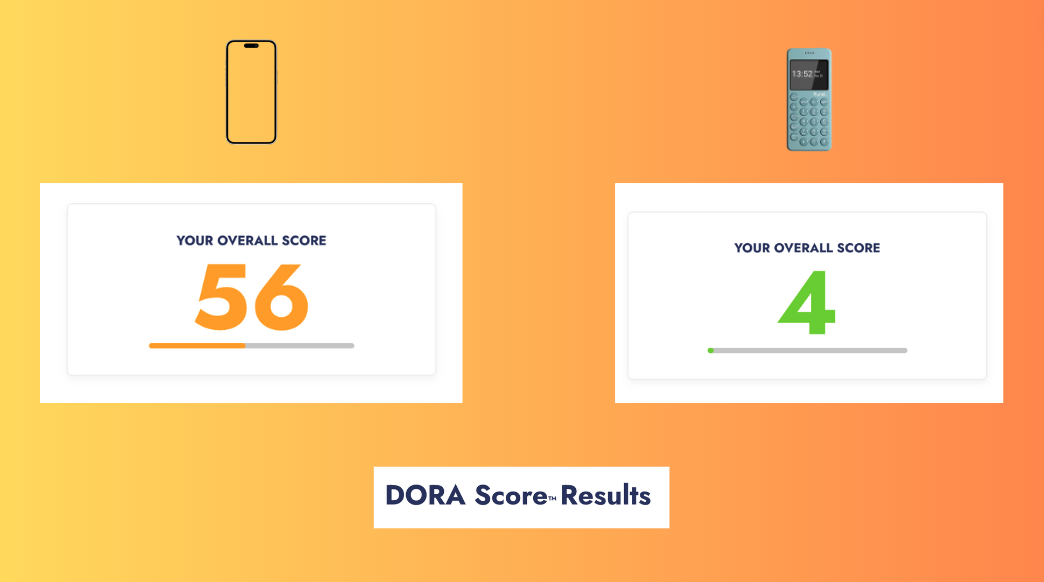

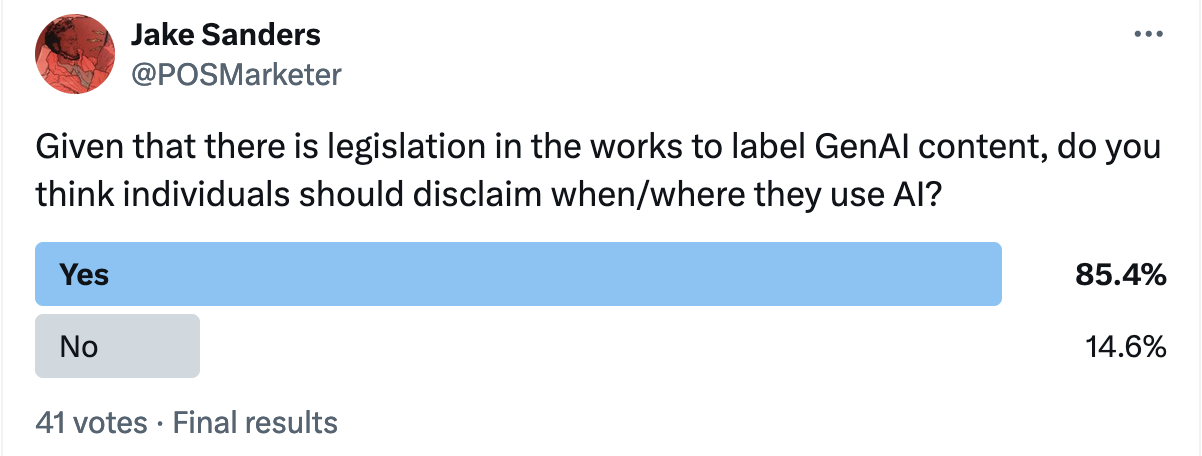
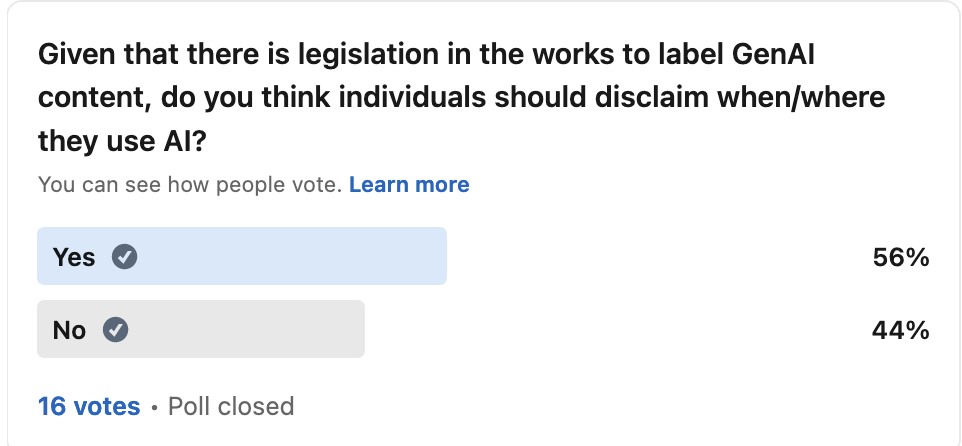

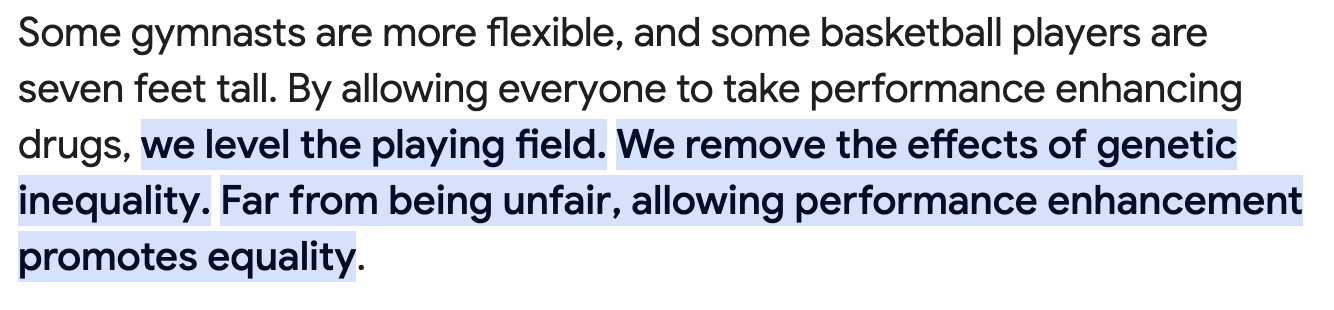
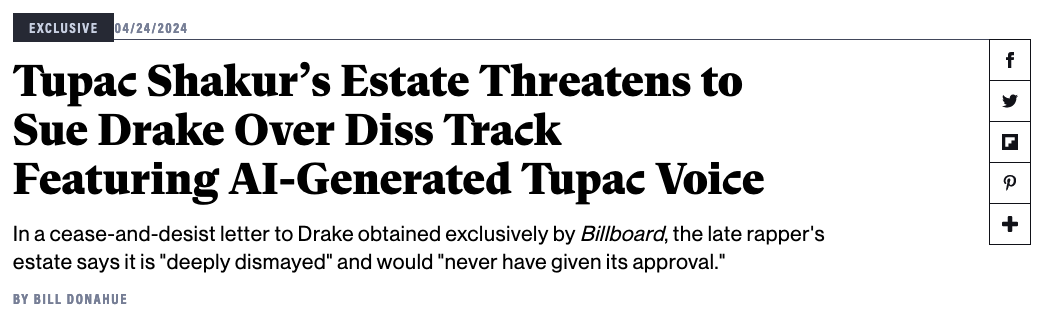
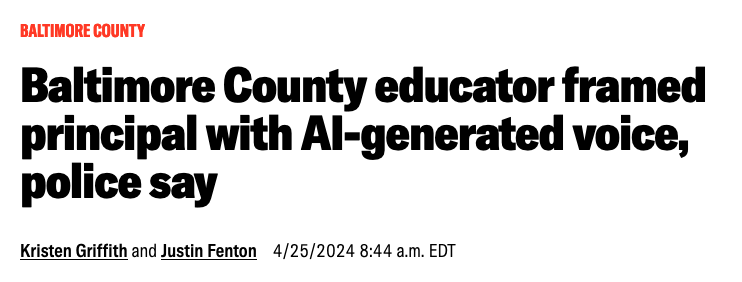
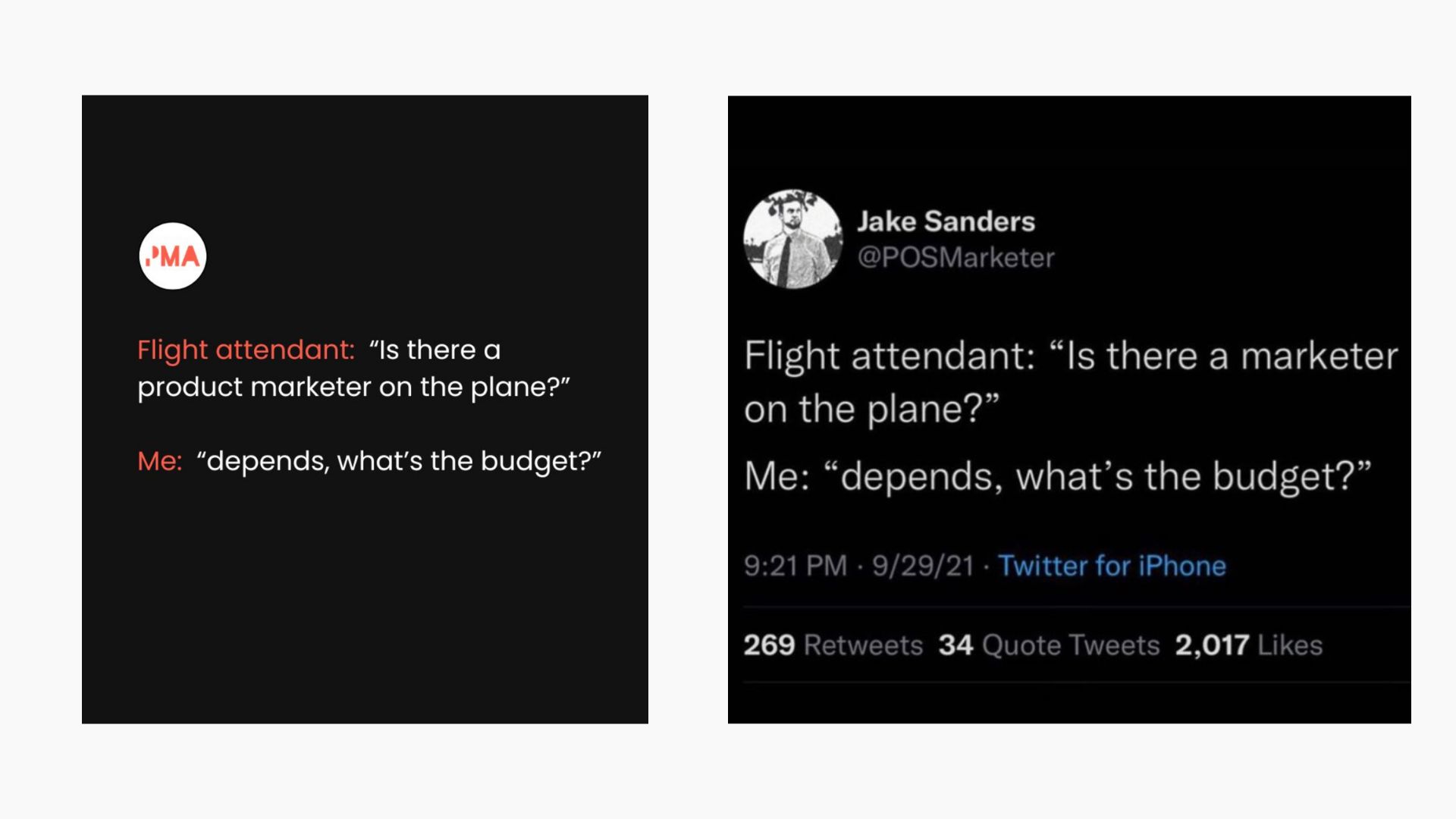
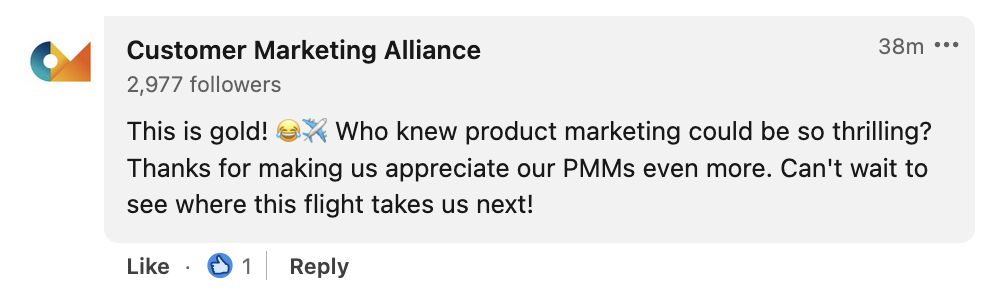
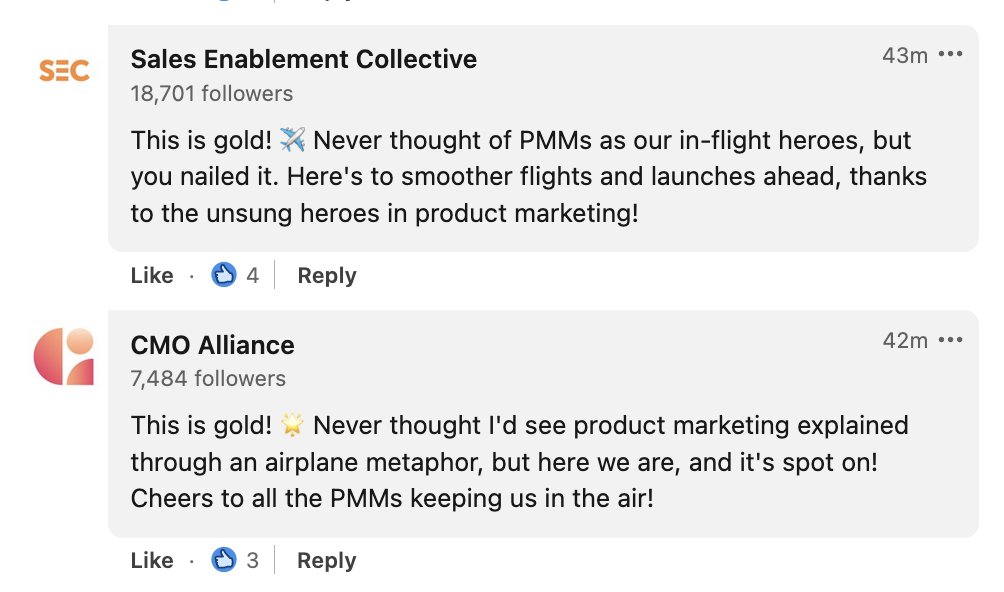
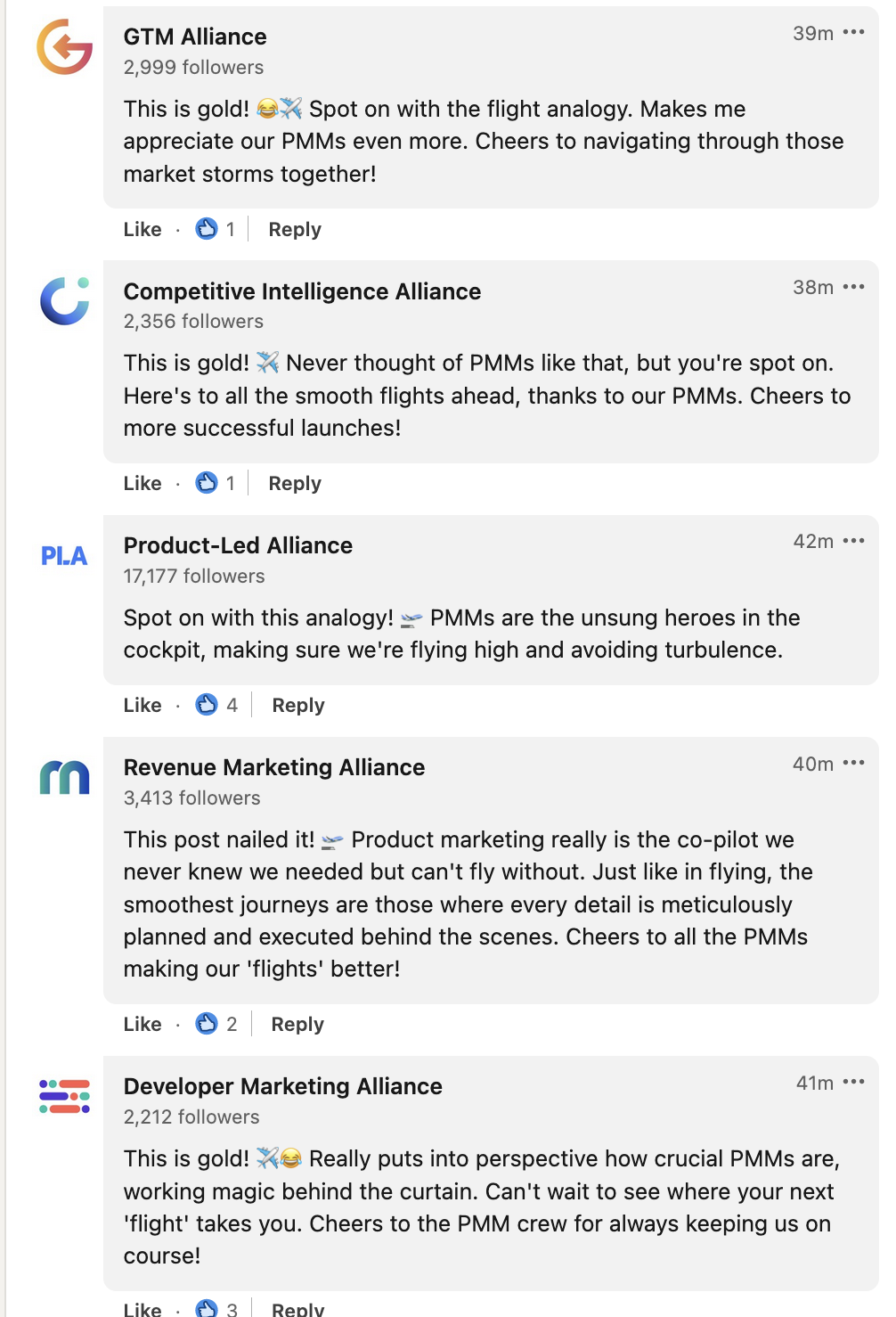




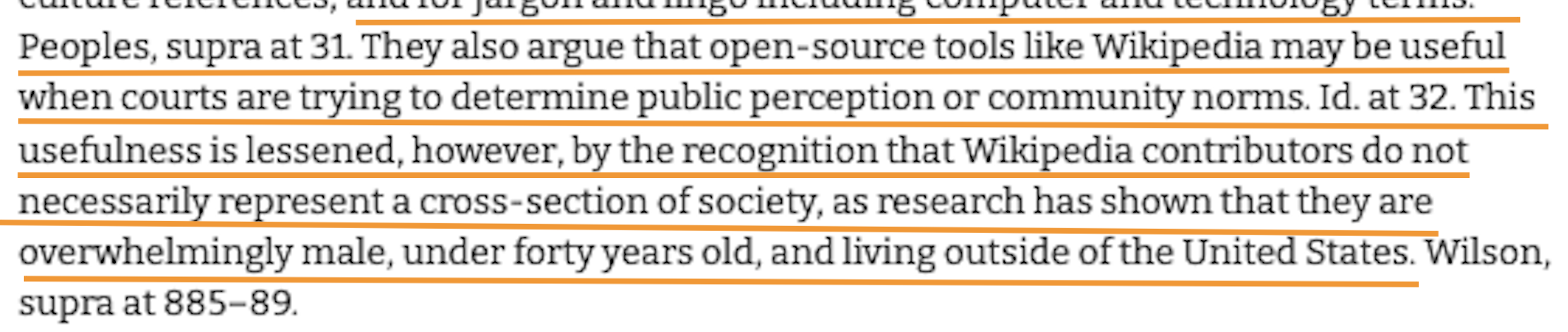

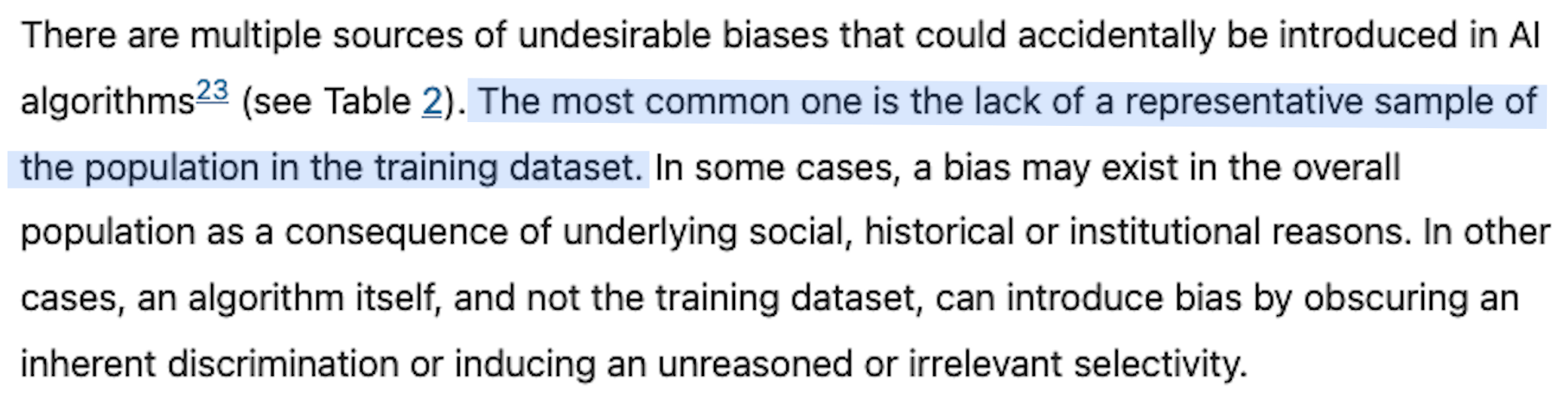
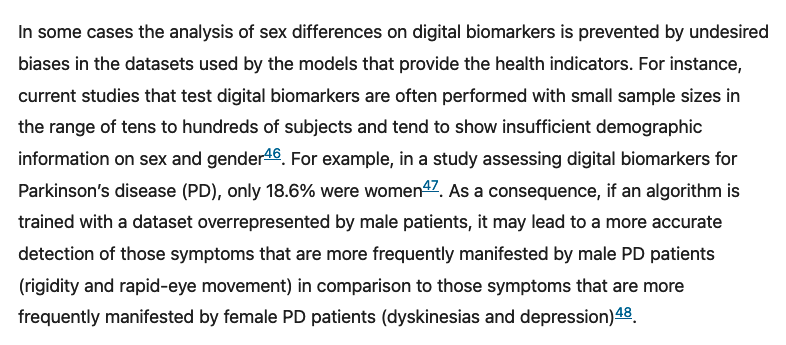
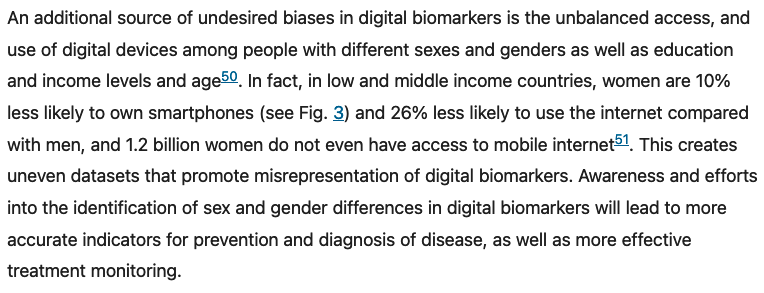

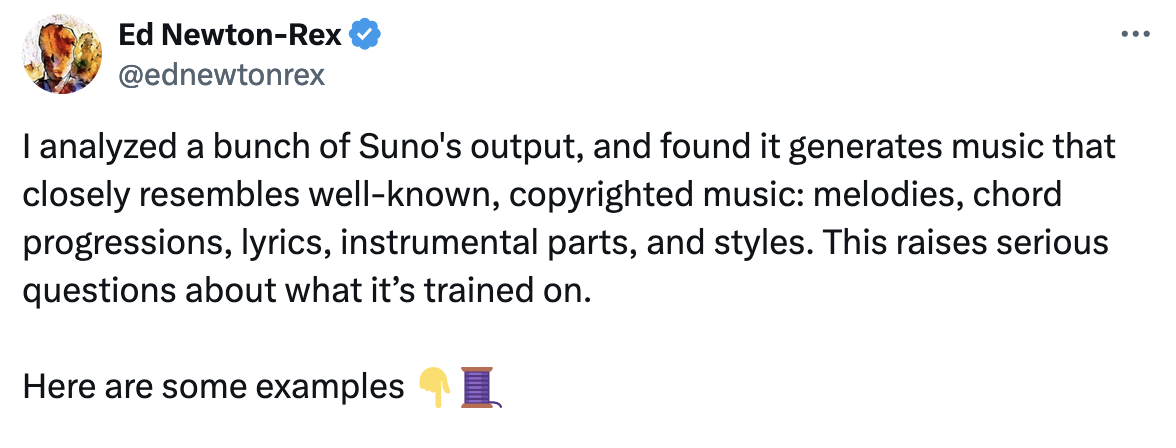

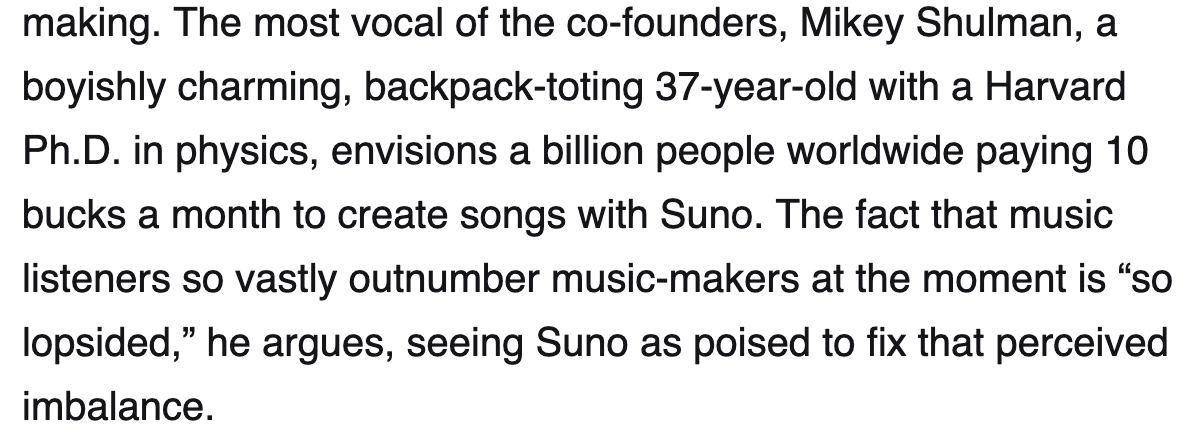
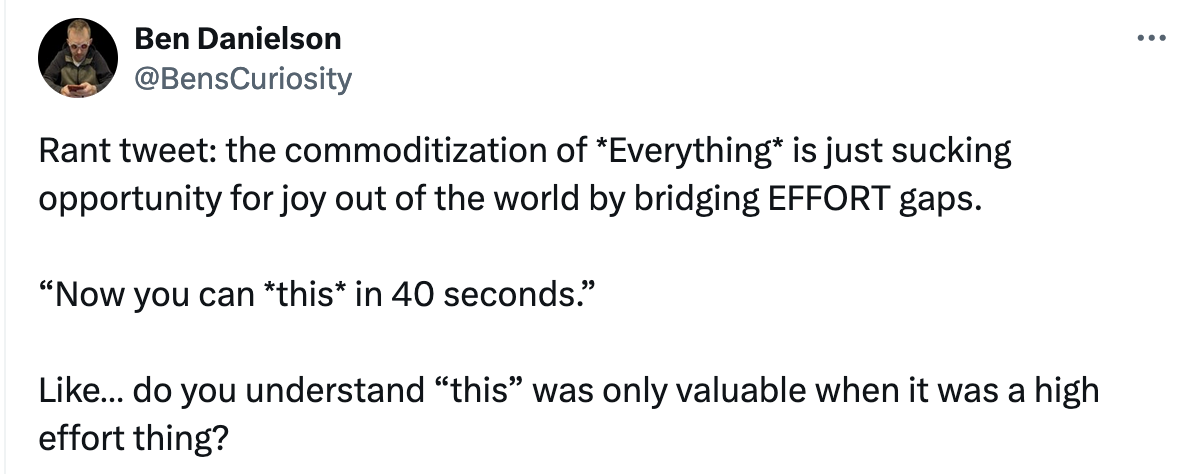

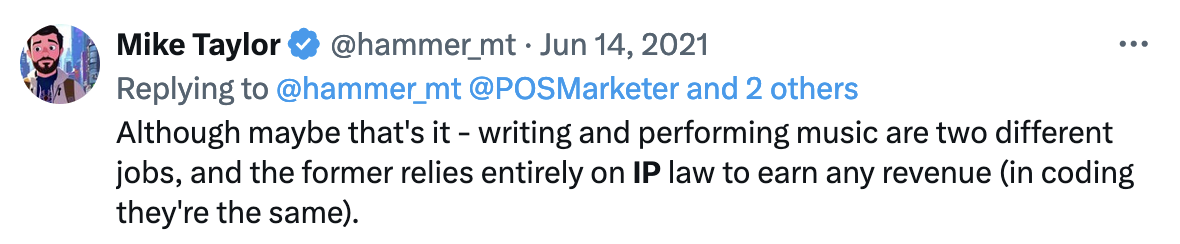
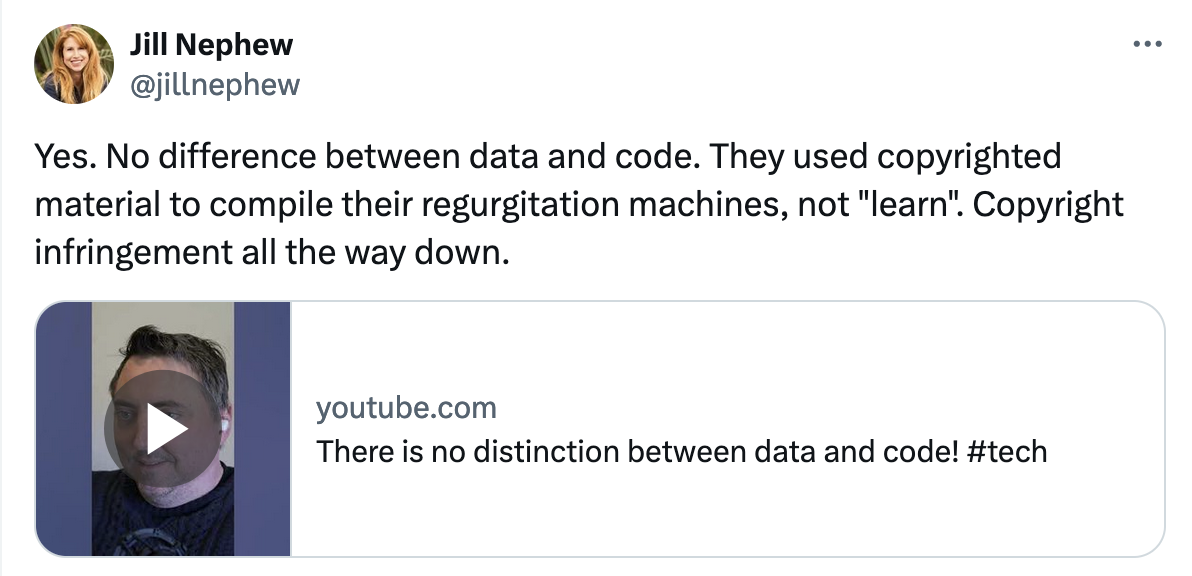
 POSMarketing