A Canto on Can’t, or, Why Some Futures Never Arrive

In a world that worships tech, ‘can’t’ is heresy; but it defines our limits.

As we head into the unknowable future, I think discerning between Didn’t, Couldn’t, and Can’t is an increasingly important line of inquiry to pursue and skill to sharpen.

If something didn’t happen, is it because it couldn’t happen, or it can’t?

If a technology didn’t take off, is it because it couldn’t at the time, or that it can’t ever?

The importance of this question is obvious when you realize, in the techno/religious consciousness, there is no problem technology cannot be positioned to be the savior of.

There is no ‘can’t’ for technology or technologists. The ‘can’t’ way of thinking has to be eradicated. Can’t, can’t exist.

And if there is a Can’t we agree exists, we are very quiet about this heresy. But we all know it; that Can’t is definitively out there, in the Didn’t around the corner.

Setting the Frame for Can’t

I was wondering the other day, why I wasn’t creating, trading, and mining NFTs or selling them in the metaverse. Why didn’t that future arrive? Was it because it couldn’t arrive at that time, or that it can’t ever? Or is it something even deeper, or, perhaps simple and shallow?

In our technopoly-based society, ‘can’t’ is the closest thing we have to a sacrilegious word. Anything and everything is possible for the doers and dreamers. All the failures and “didn’ts” of the past are the result of lack of access, imagination, and grit. I write more about this in “The Myth of Fairness in the Sandbox”

To the techno-determinists, the reason some glorious future didn’t happen is because it couldn’t at the time. Never that it can’t happen.

The promises and pillow talk of the hucksterers and con men of the past and present, the armageddons that have come and gone, the gallons of urine that never alchemized into solid gold, the utopian visions that swelled up and died on the vine; the story of humanity hinges between failed breakthroughs and “just you wait.”

In an odd paradox, our culture of determination, striving, and hard work, has rewired the interpretation of most future-tech failures as “premature,” very rarely “impossible.”
When It’s Actually ‘Can’t’ (Not ‘Couldn’t’)

Defined and known natural laws, like thermodynamics, biology, gravity, make up the hard floor we build our dreams on. There’s also fluctuating quantum principles, philosophical considerations, and other “laws” that are implicit and veiled which also influence and define the limits we can act and think within.

Whether we take all this into consideration or not determines how far we’re able to take certain innovations or ideas.

The hard truth is, there are definitive ‘cants’ in the world.

Perpetual motion machines can’t work because they violate the laws of thermodynamics. You can’t get unlimited energy without input, ever.

The scarcityless scarcity of NFTs showed us scarcity is impossible on top of infinite reproducibility, this is simply supply and demand.

A universal metaverse as a life replacement can’t happen because VR spaces ignore human embodiment, social structures, and physical needs.

We’re not riding around in Segways, we’re not dodging level 5 autonomous flying cars, we’re not traveling faster than light, and we’re not teleporting to the grocery store.

But if I pay attention to my brain, there is a part of me that reads the above examples and quietly says, “not yet, but not never.” Why is that?

The Collective Pretend

In imaginary group play among children, anything is possible as long as everyone agrees to collectively pretend.

If kids can ignore that they’re in the living room, they can easily be in outer space. If they overlook the rug from Ikea, the floor can be lava. And, the more they lean into pretending, the more they experience depth and realism in play. At this point, it’s fun.

In imaginary group play among adults, AKA existence in society, the same rules apply.

Among many other social fabrics, money, law, religion are pretend, consensual hallucinations. They work only because everyone agrees they work, and they scale up through selective ignorance in the adult world in the same way lava floors do in kidland. And in opposite contrast to the fun of imaginary play, the pretending adults do turns into faith, families and friends, finance, and fiduciary reality.

And in both cases, the moment when someone stops seeing lava and sees a floor, or questions the flawed logic beneath the groupthink du jour, the impossible meets its maker. Some things (good and bad) only work if everyone agrees they work, others fail because no amount of agreement can fix the underlying fraud.

For NFTs to have taken off, we would’ve been required to agree to pretend and remain ignorant about the infinite scarcity aspect and plain-wrong economic principles. For us all to be in the metaverse, we would’ve been required to divorce from reality and ignore the embodied nature of human existence.

Point being: the reason these particular things didn’t take off is they required us to remain stupid.

And it’s because we really don’t like feeling stupid that silly ideas actually get as far as they do.

The Psychological Case for FOMO-sapiens

If you’ve ever had a secret kept from you, or found out something important too late, you know the feeling of missing out and you might over-correct and turn into a FOMO-sapien, living life based around avoiding the fear of missing out.

Along with ignorance, another reason our society keeps falling for hype and perpetual futures of “not yet” instead of “never” is the same reason we don’t want to miss out as individuals; fear.

There is a whole litany of companies and consultancies, like Gartner and McKinsey, and predictive technologies that are based around fear and preventing a critical miss. The industrialization of techno-optimism makes it difficult to escape the cultural inertia of fear.

The technopolists believe “can’t” is the mind killer that stops progress, but Frank Herbert’s definition of ‘fear as the mind killer’ is more appropriate and accurate.

Simplicants think contemplating the “can’t” is what kills momentum and dumbs us down, when it’s more likely the deep terror of being wrong that propels genuine smarts into the stupidest shit imaginable.

Smart-people-dumb-shit, is what I’ve called this. Idiocy isn’t just for the idiots!

Why We Can’t Afford to Ignore Can’t

I’m not gonna point fingers, but I don’t think I’m saying anything crazy by mentioning the bubble in AI, referencing the insanely poor business strategy, pointing to the scaling failures of the flagship LLMs, referencing the articles about workslop, the failure rate of AI projects, or listing the HUNDREDS of lawsuits these companies are embroiled in from governments, parents that have lost kids, publishing companies, and competitors.

I could list the fundamental laws, philosophical and religious principles, and legal & moral codes that clearly detail the unsolvable misalignment between humanity and AI, but these have all been ignored by the blase-faire. The richest men in the planet are toxically irreverent in the face of so many different kinds of “can’t” and the financial hope is that we remain ignorant and stupid and pretend the floor is lava.

Which is why we can’t ignore the cants anymore. But, we have to define them, in order to defend them.

Whether it’s science, law, religion, spirituality, philosophy, each of us can find and reestablish a grounding interpretation for the ‘cants’ in life. When we identify with principled thinking and rigorous reflection on one or many mental anchors of meaning, we can define our own thinking and interpret information more clearly.

The hope of the simplicants behind AI is that we will forget all cants and take a chance, unmoor ourselves completely from these principles and embrace the future without any hang up or hesitation. But the further we lean into the future, the more we’re vacant in the present moment.

We can’t let that happen.

In a blue-flame brilliant article from JA Westenberg, “I’m Done Future-Proofing My Life,” they articulate in fewer words what I’ve tried to lay out it in too many, so I have to share this chunk:

“We’re spending more time rearranging our ambitions around speculative graphs than doing the actual work in front of us. We’re outsourcing our sense of purpose (and any // all direction) to futurists who, if history and their own track record is any guide, will likely be wrong.”

The future is not a problem to be proofed against. The future is an inevitability that will break us, one way or another, whether we prepare or not.

My goal is this and only this: to survive tomorrow with some dignity, to keep faith in what I care about, to meet disruption without surrendering to its omniscience before it even fucking arrives. Simply put: I refuse to let the specter of the future rob the present of meaning.”

Get amongst it → https://www.joanwestenberg.com/

Navigating the Future Through Negation

At the end of writing this, I suppose I’m making a case for negation as a positive force. We seductively think ‘can’t’ is the word of quitters, but it’s actually a guiding force to getting to what matters and what’s lasting, faster than chasing the can-cans.

Here is a quick reference framework to differentiate between didn’t, couldn’t, and can’t:

Didn’t happen: Social or infrastructural misfire (e.g., electric cars in the 90s).

Couldn’t happen (yet): Awaiting breakthroughs in tech or cost curves (e.g., reusable rockets before SpaceX).

Can’t happen: Violates physics, economics, or human nature (e.g., perpetual motion machines, scarcityless NFTs with speculative value).

We don’t have to be less interested and curious and imaginative about the future, but we need to be more precise about what’s possible. Otherwise, we’ll keep mistaking nonsense for destiny, can’t for couldn’t, and the absence of life for living.

The Marvelous Exploits of Blame-O

A modern mythology about blame & shame

Blame-O is the titular antagonist behind all scapegoats throughout history. Wherever there was blame, there was Blame-O. Stories about Blame-O have never been heard outside the conflict zones and arenas of aggression that fall under his realm of influence. These are now being collected by scholars, scientists, and educators who declare that Blame-O might be the most important figure in all of modern history.

The best authorities have never recounted Blame-O’s legendary exploits in narrative form, because up until recently, Blame-O did not exist.

Blame-O was not always Blame-O – but started out as the first (and final) scapegoat herder.

Since the beginning of civilization, things haven’t always gone according to plan, and people haven’t always gotten along.

Struggles, conflicts, and desires show up where peace once ruled, and in these moments of unrest and conflagration, society would turn to the scapegoat herder to give them some thing, they could blame for their troubles.

Having centralized the blame onto the scapegoat, society could kill the goat together, write a story about it, and move on.

The math was simple

Overtime, as conflicts and civilization expanded, the scapegoat population dwindled in response, until finally the scapegoat herder ran out of scapegoats, collective myths began to die, and at that moment, the herder and his canine companion left their home to walk the Earth; Blame-O and Shame The Dog were born.

Today, Blame-O and Shame The Dog have their work cut out for them. The modern world has become so complicated and intertwined that there are too many points of blame & shame for humans to handle.

For any singular issue or conflict in the modern world, there are typically hundreds, if not thousands of blame-worthy subjects, making it essentially impossible to isolate the correct one – but that doesn’t stop us.

We blame and shame this organization or that policy, this group of people or that ideology, this neighbor or that stranger.

But the shaming piles up and doesn’t work, because the blame never lands on a scapegoat, and since there’s no sacrifices there’s no collective myths being written, which means society can never heal.

Blame + Shame ≠ Scapegoat ≠ Myth = No Stasis

Enter: Blame-O (and Shame The Dog)

When scientists, aided by advanced computational modeling, realized that Blame-O and Shame The Dog could hold the key to healing our divided societies, the results were met with enthusiasm.

The mechanism behind this potential solution to world peace today is based on the ancient equation that helped societies heal in yesterdays long ago; with Blame-O and Shame The Dog, we can mythologize a scapegoat, which we figuratively sacrifice and then we move on and heal.

Don’t blame them, or yourself; blame Blame-O.

Don’t shame them, or yourself; Shame The Dog.

You’re probably feeling bad for Blame-O and Shame The Dog, but that’s where science might help. You see, Blame-O and Shame The Dog are Made-To-Blame®, they’ve been keeping up with humanity since the beginning, and they have been created expressly for the purpose of taking the shame and blame for everyone on the planet, that’s over 8 billion people!

So the next time you find yourself in a blind rage, look to Blame-O, who can take blame for any and everything – from a stubbed toe to an earthquake – and the next time you want to shame someone – for anything from stupidity to liquidity – Shame The Dog, who always feels awful about it, so you don’t have to.

The legend of Blame-O lives on, and the future chapters of this saga remain to be written.

Where will Blame-O and Shame The Dog show up next?

Chances are, closer than you think….

THE SCIENCE BEHIND BLAME-O

Blame-O leverages several well-established therapeutic principles to help people process and manage difficult emotions.

By providing a designated target for negative feelings, Blame-O and Shame The Dog employ affect labeling—the psychological practice of naming and localizing emotions, which research shows can reduce their intensity and improve emotional regulation. This mirrors puppet play therapy, where individuals can safely express fears and worries through an intermediary. The concept behind Blame-O also draws from object relations therapy, which uses external objects to help people understand their internal emotional landscape, and transitional object theory, where meaningful items provide comfort and self-regulation during stressful periods.

Additionally, like the Hopi tradition of “shame clowns” who use gentle performance to address community issues, Blame-O and Shame The Dog offer a culturally acceptable way to externalize and process negative emotions while maintaining psychological safety and promoting emotional well-being.

WATCH/SHARE ON YOUTUBE:

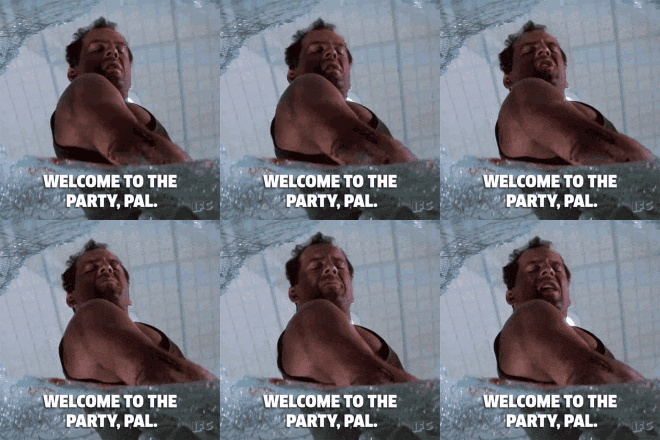
"Welcome to my party, pal"

A report from the Nakatomi Plaza of your soul

“Welcome to the party, pal.”

It’s something that John McClane says in “Die Hard,” after he throws the body of a terrorist, many stories from the embattled Nakatomi Plaza, onto the patrol vehicle of Sgt. Al Powell, a witless LAPD detective that is now, “in the know.”

Up until this moment, and ultimately after the terrorism, the story is about re connection and family. An off-duty NYC cop meets his wife and kids in California for the holidays, but is waylaid at a party that turns into a hostile takeover, McClane springs into action, the LA cops are called, Sgt. Powell responds, he’s sent off by the terrorists, and then the invitation to the party falls onto (and destroys) his squad car.

“Welcome to the party, pal.”

I think about this quote a lot, and then this morning, I started wondering why…

I think we’re all looking for our,
‘welcome to the party, pal’ moment.

We’re all McClane, facing our own internal Nakaotomi Plazas; figurative hostile takeovers happening within, what is supposed to be, a peaceful space of reconnection. We’re crawling around our own unique airshafts. We’re fighting our own authorities. We all have our own Hans Grubers to face.

And this is offline.

One of the side-effects of the algorithmically curated, cubist reality we call life online, is a lot of the hostility and terrorism is curated on screens in social feeds and news headlines, framed to stop scrolls and hearts, content only we see, so we’re alarmed, and when we feel like we’re being ignored, we want to throw something out the window and ask someone/anyone/everyone to join us in the fight.

But here’s where it twists in the online, hyper personalized and fractured world; it’s now, “welcome to MY party pal.”

DieHard McClane needed people to know about a general problem everyone was facing.

Digital McClane is asking for anyone to know about the specific problems they are facing.

One is reacting to life as it happens, the other might be reacting to algorithms aimed to amplify anxiety and existential angst.

So before we launch another assailant out of a digital window, the real question to ask when we feel like we’re in a DieHard situation might be, “welcome to whose party, pal?”

Also – take back the Nakatomi Plaza of your soul. Yipee-kay-yay, MFers.

Does Marketing Feel Like Weakness?

Marketing is perceived less as a tool and more as a tell, a sign of weakness, struggle, or even social desperation. Could this be related to class?

Spend time with Veblen’s ”Theory of The Leisure Class” and “The Culture of Contentment” by JK Galbraith, and you’ll see there’s something iconically wrong with American idealism around wealth and leisure. Both seminal works reveal wealth’s strangest effect: how it creates a kind of reality distortion field where the rich, cushioned from consequence, mistake their insular worldview for objective wisdom.

I think, a kennel club kinda snub-nosed thinking around marketing has been bred into the upper echelons, which makes up the executives who then bring this strain of thinking to advertising/business, and it’s essentially summed up in this quote from a corn ghost in the 1989 film, “Field of Dreams”:

“If you build it, they will come.”

In a conversation online the other day, someone mentioned that the C-Suite views marketing as a “dark art,“ summoning sales out of a crop circle. But I wonder, among certain strains of the “business class,” if marketing is seen as a pricey thing you have to do if you don’t have a corn ghost and you’re unpopular? The thought is, do as little as possible because if you try too hard, you look like you’re struggling.

Marketing is sales leaving the body.

Marketing is a sign of weakness if you’re not surrounded by marketing. Are rich people watching a bunch of ads, or are they paying to avoid them? They famously don’t know the price of milk. You don’t see a bunch of flyers in the hallways of a country clubhouse.

Is it so far off to think, some of this thinking is gonna leak into the business brain?

Why Marketing Could Be Seen a Sign of Weakness

In a land of top-shelf brands and luxury labels, it’s hard to make the case that the upper crust doesn’t believe in the power of marketing and persuasion. Scott Galloway has famously and numerously stated that advertising is a tax on the poor. I think the view of marketing as weakness comes from a few things:

  1. Paying to avoid ads.

    • Wealth buys distance from marketing. You pay for ad-free platforms, private clubs, exclusive access. This creates a class-based empathy gap. If people aren’t experiencing marketing like the gen pop does, they start to devalue its necessity or misjudge its utility.

  2. Thinking great products “sell themselves.”

    • Wealthy folks (especially those who’ve inherited or bought into growth machines) tend to conflate visibility with inevitability. (read: “The Product Delusion”) If something is good, it will succeed. If it needs marketing, there must be something wrong with it.

  3. Marketing is associated with struggle.

    • To advertise is to admit you’re not in demand. There’s a whisper of “if you were really that good, people would come to you.” Which is, of course, a fantasy, but a disastrously powerful one.

  4. There’s a performative power in effortlessness.

    • In luxury culture and the leisure class, trying too hard is taboo. And that thinking leaks into how business is done. Flashy marketing feels try-hard. Quiet exclusivity feels “earned.”

This Belief Trickles into the Business Class

When marketing is seen as something only needy brands or weak businesses do, the entire strategy gets deprioritized, especially by those in control of the purse strings. Because of the whispers of the corn ghost, the directive is:

“Don’t look desperate.”

That’s the aestheticization of success and hard work, not the actual practice of it, again, a theme that is hammered into a class-based truth by Galbraith. And it is deeply at odds with the real mechanics of brand growth, which we know from Ehrenberg-Bass and marketing science research:

  • Visibility matters.

  • Familiarity breeds favorability.

  • Mimesis (people copying others) is the foundation of culture and purchase behavior.

Step Up To The Plate

Stop waiting for a corn ghost to tell you to build the perfect thing, and stop thinking advertising is just expensive sign twirling for clowns. You don’t need to market like you’re struggling, but you do need to market like you exist. You have to reframe marketing as a memory game, not a shame game:

  • You’re laying breadcrumbs for future relevance, not begging for attention.

  • It’s not “trying too hard” if you’re building a mental and physical presence for the light buyers who won’t care about you until they do.

Rich people may avoid ads—but even rich people buy things they’ve seen before, especially if other rich people are using them. That’s mimesis. That’s marketing.

💡 What This Means Practically

If you’re working inside or with a business where this stigma around marketing exists, here’s your approach:

  1. Reframe marketing not as a cost, but as insurance.
    You don’t buy fire insurance because you’re on fire. You buy it because you don’t want to be.

  2. Appeal to risk mitigation, not enthusiasm.
    Don’t pitch marketing as a bold dream. Pitch it as prudent, proven, protective. Brand salience smoothes out sales cycles.

  3. Respect the status-seeking nature of business elites.
    High-status people copy other high-status behaviors. That includes the brands they adopt. Marketing is mimesis; it’s biology.

From a certain vantage point, marketing can look like weakness—but in truth, not marketing is the actual liability.

The only way brand marketing can ever take off is by building a proper runway for memorability.

Walk backwards from “The Close”….people won’t buy your brand unless they’re convinced, they aren’t convinced because they have no brand preference, they don’t know if they like you or not because the majority aren’t even aware you exist.

Market dominance is always going to beat out “favoritism,” and yet we’re convinced that being someone’s “favorite” is the way to dominate a market. Most people’s “favorite” choice is a commercially dominant default that’s been drummed into their head as being the “smart move.”

Just like the mantra behind Catch and Release Marketing says; let your marketing be easy to see, easy to try, and easily thought worth it. That’s not weakness. That’s how you actually play the game.

The Myth of Fairness in The Sandbox

This story starts from a divot on a golf course, and ends in a sandbox built on a cloud.

Preamble for an unfair world

After a drive that missed the green and ended in a divot where he couldn’t see the hole, my friend’s younger golfing partner for the day, smacked his teeth and said, “it’s unfair.”

The game, as this guy (Sean, let’s say) saw it, was unfair. Not the way he played it, or his equipment, or anything specific, the whole of golf was unjust.

When Sean asked my friend why he played the game, the response was that golf was a great “problem engine.” The reason my friend liked golf was the very same reason Sean hated it; the game is a series of unplanned, in-and-out-bound problems that you willingly give yourself to solve.

This got me thinking about one of the places where we learn fairness in its earliest form – play.

And then I started to think about how games like Minecraft and other open-ended, world-building games have taken off in the last few decades, and what that may have done to the popular conception of “fairness.”

And then I pondered the vibe-coded, limitless-possibility renaissance that is taking place with AI as stated in this article I read from a VC, depicting a future of software as a service that is actually service as a software, turning reliable products into composable canvases, sandboxes; essentially, MineCraft for businesses.

Somewhere between hazards, playground rules, pixelated worlds, and vibe-coded sandboxes, our idea of fairness, and what success in business and life is supposed to be, and how it’s most likely attained, might be being overwritten.

On Play and Creative Resilience

For 13 years, I worked as an educator with kids in summer camps, schools, and science museums, and in that time I learned how to play from the masters of the art. Play is critically important to development and learning, and has a functional role in a fully flourishing, thriving life.

My children love to play and I’m often right in there with them, and the biggest issue I’m seeing lately is fairness, “that’s not fair they get this” or “that’s not fair I have ice powers, but not water powers” (a real concern).

What I noticed is that “fairness” is deeply considered and argued endlessly over, not while playing games (like our pal Sean on the links), but specifically while they are engaged in open-ended, imaginary play.

As a jazz musician, poet, artist, and confident improviser, I love to play, and there’s a time and place to get silly and pointless. But I also have learned creative, genius, out-of-the-box thinking in play, comes from well-defined boundaries.

Like I explain in this clip from “The Cheap Genius Theory,” creativity isn’t something you’ve never heard before, but something that mixes novelty and cliche. There’s a difference between free jazz and swing.

Open ended, imaginary, illogical – these are the traditional hallmarks of brilliance and creativity, something kids should be encouraged to explore – but as a creative artist, these terms make me scared.

If every idea is on the table, you’re not headed anywhere, you’re a hoarder. If there’s limitless possibilities, you don’t develop a knack for what plausible genius is.

If everything is out-of-the-box, there’s nothing inside to compare it to. The box is gone! So are you!

On Games

I took my kids to visit their grandmother recently, and she put out an old-school game for the kids, “Pick Up Sticks.” The game is simple; you take a handful of sticks, drop them in a pile, and use one stick to continuously reclaim others from the pile without disturbing the surrounding sticks, if you do, you lose a turn. It’s simple, but challenging.

Every time you play Pick Up Sticks, you are playing a new version of it. The sticks won’t always fall like they did the last time. No quantum computer could handle this game, because, what worked last time might help you, but not more than fully showing up to the current pile of sticks. The skill here comes from embodied experience and mindful, flexible presence within well-defined structures.

Games have definite rules and regulated ways of playing. 5-card draw doesn’t work with an infinite deck. Tetris isn’t open to switching the shapes, you fit what you’re given. Freeze tag is only freeze tag if you freeze when you’re tagged. Mario isn’t going to float in mid-air to the flag, you gotta hit your head on some bricks.

If you hit your golf ball into a divot, it’s not unfair – it’s called playing golf. Maybe the concept of unfairness comes from work ethic, or grit?

On Grit

In the last 20 years, there was a spate of grit-based philosophies that sprouted up in the educational circles I interact with, the narrative given to kids was that we use grit and really work problem solving into skills which turns into achievement. Just work really hard, grind it out, and skills show up later.

Recent research proves that grit has little to do with overcoming learning barriers and achieving outcomes.

I’m speculating, but perhaps our young Sean on the golf course may have been told about grit in school, and tried to apply it but found out it wasn’t quite the ticket. That is unfair.

But I think this Unfair World outlook might connect back to games, more specifically, open-ended games like Minecraft.

Fields of Dreams

Minecraft was a smash when it launched in 2009. No missions, no story – just build, explore, and mod. The community defined the rules and the value of the platform. It was a multiple of the Field of Dreams “if we build it, they will come”

And people showed up. Minecraft is the best-selling video game of all time, and it really isn’t a game, but a sandbox. Players can play a story mode, but the popular traction seemingly comes from the “Creative” mode of play, where you can gather resources, craft, and engineer whatever your heart desires.

Whereas games in the past put you on a determined course with limited resource and you had to play and improvise within explicit confines, open-ended games empower players to make their own rules, adjust fairness to taste, and with barriers removed, they never have to feel the friction of their out-of-the-box ideas, because there is no box.

This is creativity incarnate. This is true freedom, ya?

Looking at this through the lens of “The Cheap Genius Theory” the popular assumption that Minecraft is an engine of creative thinking misses a few points;

  • Players are most likely to copy what they see, not make what’s never been seen

  • The game rewards finishing builds, not reflection

  • Creativity gets flattened into speed-running recipes

  • Trapped within physics and lore it’s hard to dialogue with disciplines beyond it

  • It’s self-contained, so no interpretive layer can discern mimicry from mastery

It’s a great venue for practicing tinkering, but a poor place to train the connective tissue that turns tinkering into world-changing ideas.

Service As A Software

The main reason I’m bringing all this up is the “trillion dollar” shift in SaaS (software as a service), made possible with AI Agents, to SaaS (service as a software). Much better than “agents as a service,” which is AaaS.

The thought here is that rather than ship a final product, like software that works 100% of the time, the high-composability in AI technology and agentic coding applications, allows us to now continuously mod and build software that is always evolving.

“The traditional “deploy and maintain” model has become “deploy and continuously re-engineer,” says this article from Foundation Capital, an investment arm that has no reason to shake your hand funny when they deliver these words.

“In the new AI world, buyers don’t purchase software; they purchase the outcomes it delivers,” they tell you. And this sounds empowering, but it actually brings fairness into play.

Old software gave everyone the same finished product—shared wins, shared glitches.

Today we all get the same sandbox kit; fairness stops at equal parts.

Connecting this back to the theme at hand, the idea that enterprise software should mirror Minecraft, a sandbox where users invent value, is seductive but flawed.

Most people don’t want open-ended freedom; they satisfice, picking the least-worst option, not the most creative one. The myth of “cheap genius” celebrates spontaneous invention, but real creativity depends on deep, often invisible knowledge and a cultural context that makes novelty legible and valuable.

When companies release tools expecting users to define their purpose, they attract mimics, not makers, and end up with templates instead of innovation.

Minecraft worked because it was a game that came with a culture, syntax, and feedback loops. If there is to be a future for service-as-software, it can’t just rely on blank canvases. Guided recombination, structures that nurture emergence, and scaffolding that turns chaos into meaning is the only way to bubble up real innovation.

Land the plane man…

So we return to that divot on the golf course, where Sean declared the game unfair. What he could’ve been saying, was that golf refused to be Minecraft. It wouldn’t let him reshape the terrain, adjust the physics, or redefine success on his terms. The divot was just a divot, demanding he play from where his ball landed, not where he wished it had.

That’s the paradox of the litterbox lottery moment: we’ve mistaken constraint for cruelty and structure for limitation, when in fact the opposite is true. Real creativity, the kind that builds bridges between disciplines, that turns tinkering into transformation, emerges not from limitless possibility but from the productive friction of well-defined boundaries.

The future belongs not to those who can dream up anything, but to those who can make something meaningful within the material, majestic, and maddening constraints of the world as it is.

About Paul Bunyan and Myth

Paul Bunyan was about expansion and the loud explosion of the American dream – we need new myths to wake us up to the shrinking, silent implosion of it.

I’ve been spending time with this truly American tall tale, and the story behind the story is our nation’s story. Below is a collection of reflections on the larger than life character, and what it meant and means to the country and our mythology going forward….

When Paul Bunyan (a pure content marketing play) was popularized in early 20th century literature by ad exec WB Laughead, from the Red River Lumber Company, to mythologize and gin up public support for deforestation (particularly of protected Ojibwe lands), they didn’t really focus too much on his history, because the nation was young and without history. Fuzzy references to a before time, murky parentage, a crib 200 feet high, and untamed lands.

So the urge for Bunyan to do his thing and create the country, is not necessarily coming from anywhere, or answering to anything – it’s a clean slate myth, or it’s a myth that cleans the slate by its own steam (hot air).

A modern American myth might require a bit more backstory – but is it because Bunyan lacks precedence that his legend was so impactful? You don’t have to understand much anything else than awe and wonder to have these stories work on you. In fact, ignorance is a great canvas to paint a myth on. This isn’t to say smart people can’t get mythological, or that myths are suited for dumbasses, but the expansion of myth rests on audiences having a fuzzy grasp on facts.

Bunyan was one giant man, bigger than a thousand men. He casually invented cutting edge tech. His waste products become homes for wayward creatures. In being encouraged to make up stories venerating a giant man, men could feel their work tied to something bigger than them.

Now that our modern American hero is the very real and human entrepreneur, we’re less inclined to work with anyone else, because the next hero could be us, the next American expansion is up our own asses.

Bunyan’s mythological hiking trail started out in the forests chopping it all down, but its end is inside of us, and the axe is aimed to split all remaining logs in the universe, so we stop believing in and feeding from myths, and finally live them out. We can all be Bunyan now. That was the hope all along.

The tall tales are big on imagery and team – blue ox, cooks, “colored” kids skating around with hams on their feet to grease a giant pan, the seven axmen, little chore boy – full universes are required.

Throughout Laughead’s book, lots of random names and “experts” are quoted and cited throughout, giving credence to the bullshit – big numbers, big things, and a lot of men getting lost, hurt, or waiting around for help from being trapped or caught or just needing supernatural help.

Interesting to note natural phenomena were “installed” by Bunyan, like mountain ridges and the Aurora Borealis. The natural world is the way it is because some brave man sought to mechanize processes first and foremost. What is natural to us has been engineered by a giant man. Nature is actually abandoned technological experiments. Nothing more. There is veneration of the land, many mentions of locations and tracts of land, but it all ultimately comes from Bunyan.

There’s an interesting segment about Lucy, Bunyans cow, who answers the call of the limitless wilds until Paul decorated her with a bell borrowed from a church buried in the snow. Stealing from faith to provide function.

“If Paul Bunyan did not invent Geography, he created a lot of it”

Bunyan was a commercialized myth engineered by a lumber company to fight back against forest conservationists who took issue with expansion – the answer to the deforestation of our external world was to plant mythological seeds and steward the country’s internal nature toward the interests of business.

I thought Paul Bunyan was a myth that said more about our national character and grit than it did about the fundamental nature of a country built off expansion. The goal of Paul Bunyan wasn’t national identity, commity, or even mythology, but narrative control.

I think it would behoove us to start mining and growing some new myths that work for us, from the bottom up, or we’re gonna keep getting chopped down by top-down myths that are engineered to work on us.

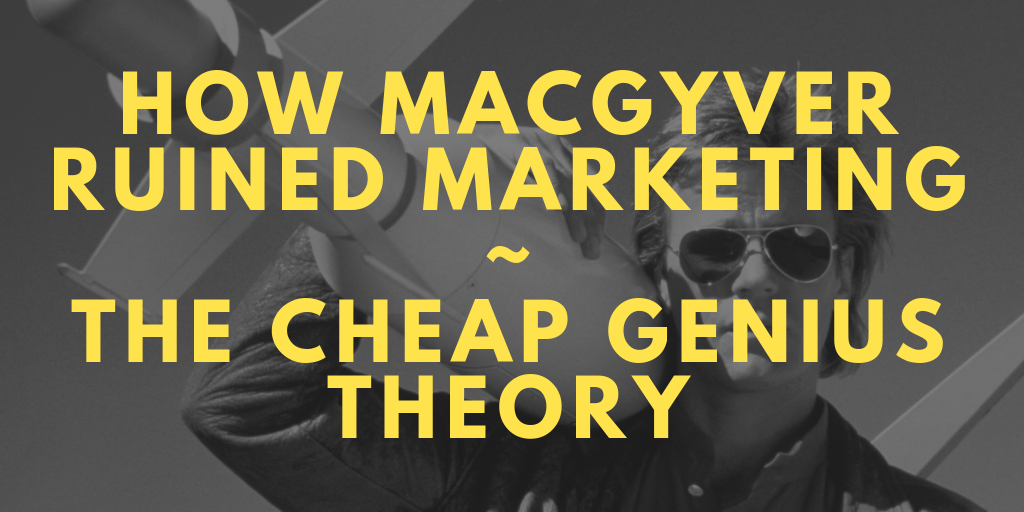
How MacGyver Ruined Marketing or The Cheap Genius Theory

How myths behind creativity and the resourceful genius are undermining long-term marketing strategy

“Time and budget are tight for this project. You’re creative, you’ll think of something. What we’re looking for Jake, is ‘cheap genius.’” – My Life

As a creative person, my ability to think fast and make connections has helped advance my career, propelled me from gig to gig. Along the way I’ve been haunted by the spectre of MacGyver, the resource-strapped (read; alluringly cheap) genius of 90s American TV, because I think he personifies a few things wrong with marketing and business.

Why?

Think about this…

  1. Of the first companies that appeared on the Fortune 500 in 1955, only 53 held a place on the list in 2018 (-89.3% success rate)

  2. A business culture obsessed with risk and cost management, rife with rampant short-termism and shortening CMO lifecycles

  3. The crumbling foundations of ‘expertise’ and break-up of industrial knowledge silos

  4. A ‘gig’ economy filled with entrepreneurial DIY-life-coaches-gurus-hackers-AI-agents

  5. The belief that the next big platform or IPO or genius idea will come, like it always does, from a random, scrappy teenager’s garage;

  6. and MacGyver….

Mix it all together and it’s plain to see, the belief that MacGyver-like-business-saving genius is cheap, widely available, and flourishes during to-the-wire timelines, is a bad brew for marketing and business to be sipping on.

I’ll first explain who MacGyver is, unpack what I’m calling The Cheap Genius Theory, and then we’ll explore ways to define and disrupt this damaging trend.

Who is MacGyver?

A bent paper clip can defuse a ballistic missile. A potato and some cigarettes are all you need to thwart a high-tech prison’s security system. Chewing gum alone can defeat an entire militia.

These aren’t just thought-exercises, these seemingly implausible scenarios all played out during the late 80s TV action/drama MacGyver.

There are MacGyver fansites dedicated to celebrating the genius of the hero, featuring full breakdowns of all the problems he’s applied his time-strapped, cost-effective, MacGyver-ness to, in all seven seasons on CBS from 85′ – 92′.

While MacGyver seems to portray creativity very favorably, it’s my belief that MacGyver perfectly personifies the perceptual problems around what creativity and “cheap genius” is, where it comes from, what resources it needs, what it’s worth, and how creative ideas can be best applied in business and life.

The Cheap Genius Theory (CGT) explains why business leaders approach problem solving, creativity, advertising, and marketing the way they do – which is hoping MacGyver shows up, or worse, thinking they’ll pull a MacGyver and cut the right wire once the countdown on the bomb begins.

There are five concepts to The Cheap Genius Theory….

HUMANS ARE CHEAP

Although a premium option exists for almost every good or service, (the best house/car/President, the best advice, the best hummus!) humans will almost always choose the least-crappy, less-likely-to-fail option. Not the worst, but the least worst.

It’s called ‘satisficing’ and it’s an irrefutable part of human behavior, it’s based on strong empirical data, and it’s the best explanation around for why people make decisions that don’t make sense in the long run.

Sure we could defuse the bomb a traditional way, but let’s try this paperclip first.

GIVEN RESOURCES, “EVERYONE IS CREATIVE”

With so many brainstorms and Post-It Notes and examples of startups with humble-and-hooded-sweatshirted beginnings, genius ideas spawned from simple creative thinking, are seemingly everywhere and cheaply available.

Many are the professional articles outlining how managers just need to unleash their team’s creativity to solve their issues.

If creativity is widely available, that changes the way creativity is incentivized or incorporated into strategic thinking.

If we solved the last emergent problem cheaply, in a tight timeline, with a potato, then why budget in experts, time, or resources for this emergency?

If MacGyver can’t disarm the bomb in time, after this next brainstorm, I bet Glen from Accounting might be able to pull it off.

CREATIVITY LOVES SPONTANEITY

The myth that creativity is bolt out of the blue stuff, and always arises spontaneously is pernicious outside of the creative community.

There’s a belief out there, no thanks to MacGyver, that creativity is best catalyzed by time and resource constraints, and it’s usually only when your cognition is pushed to the wire do the explosively successful results take place.

Nope.

The true skill to develop in creativity is not time-constrained improv, but strengthening the mental muscles that connect threads between disparate channels of thought.

The results of creativity may be experienced and sharpened most thrillingly at the drop of a hat, but the skill that connects creative conclusions takes a long time to strengthen for ideation at a rapid pace to take place.

So in training for creativity it isn’t about developing quicker reaction times, but rather increasing mental flexibility in making farflung connections between wide swaths of human experience, accrued knowledge, cultural/social consciousness, and expressing it all through the chosen medium.

Just because someone HAS defused a bomb with a shoe in under 30 seconds, doesn’t mean that’s the most effective way to train for defusing a bomb.

CREATIVITY ISN’T ACTION OR OUTPUT – ITS CONNECTION

Creativity is an observation made in the minds of those that connect a creative action to genius, not in the action itself.

Creativity is judged not by the act, but by the audience, the norms it upsets, the expectations it disrupts – cheap genius is only good when someone is there to see it as genius, otherwise it’s just cheap.

Or worse.

Enthusiasts of the Cheap Genius Theory, wrongly think the purpose of creativity is to solely manifest actionable ideas, missing the point that the true measure of a creative idea is the interpretation and accepting ingestion of it by an audience, not just in the ideas themselves.

REAL CREATIVITY IS SOMETHING WE’VE NEVER SEEN BEFORE

Creativity is not a groundbreaking shattering of molds, but the art of combining recognizable molds in unexpected ways.

Something that had never been seen or experienced before would not strike a familiar chord in our souls, and so, it would just seem chaotic or out-there. You’ve heard Coltrane’s SunShip, you know what I’m talking about. If you’re not down, it’s a tough hang.

The Cheap Genius Theory highlights the skillful usage of a paper clip to defuse a missile, overshadowing the true skill in need of praise in creativity, which is a deep understanding of pre-existing concepts, in this case metallurgy and electricity, and how to quickly combine and apply them in novel ways and situations.

Ingenuity and spontaneous invention is only possible on the shoulders, brains, backs, thoughts, legends, laws, and expectation of the rules that have come before.

You can defuse the bomb with gum and its wrapper because you know about microchips, friction, the chemical properties of saliva, and the electrical conductivity of metallic substances. Without Galvani, Lavoisier, Curie, Jack Kilby, Wrigley, the ancient Aztecs that found chicle – all of that cheap genius wouldn’t be accessible.

Why this is bad, and what to do about it

Since creative thought is widely available, potentially cheap, and the product of chaotic spontaneity, businesses don’t plan, budget, or schedule for it, let alone reserve creativity a seat at the strategic table.

That’s bad.

Along with cheapening the importance of creativity and devaluing it’s place in business development plans, The Cheap Genius Theory’s most destructive influence is on marketing strategy.

Since disruption threatens every established business model, stakeholders across the world run their businesses knowing that companies don’t last as long as they used to.

But rather than strategically approaching changes to their business model, or solving business problems with creativity in the front end, CEOs are relying on MacGyver’s to save the business as is, they’re cutting costs where they can, and focusing their marketing campaigns on higher conversions with shorter observational windows.

Whether it’s Byron Sharp, Les Binet, Mark Ritson, Dr. Grace Kite, Rory Sutherland, or any of the other great minds in marketing today, the keenest people in the room agree, there is a rampant disease of short-termism with drastic side-effects on strategic, creative, long-term thinking in businesses today.

I think there needs to be a perceptual shift in the way we view creativity, and it starts by admitting the truth of The Cheap Genius Theory, and realizing our business development strategies are not strategies at all, but rather a string of implausible MacGyver-like fixes.

We have to admit CGT throws off our sense of how creative thought is best curated, generated, and applied to researching business problems. And we have to change the way we apply creative thinking to the research and diagnosis of solutions that aim to fix the business problems our companies face over time in a competitive marketplace.

Oh, that’s marketing.

And then, once we understand creativity, I think we need to dial it up!

After brand size, creativity is one of the most important factors in effective marketing and advertising. But because of The Cheap Genius Theory…

creativity is paradoxically the first thing everyone relies on to solve a marketing issue, but the last thing anyone plans on paying for.

Rather than relying on more MacGyvers to show up, I’d like to see creativity given it’s proper respect, timeframe, and proving grounds to demonstrate it’s ability to guide business development strategy. Businesses should curate a place of deep thought and research, develop the atmosphere of a mental gym that strengthens the connective and creative muscles in your team.

Without exercising both the fast and slow twitch muscles of creativity, research and execution, the impact of continual cheap genius fixes, no matter how ingenious, will yield ever-diminishing returns.

No one is arguing that resourceful creativity isn’t important to business development, but rather than utilizing creativity to strategically adapt our business models and marketing plans, we’re praising/seeking/utilizing versions of ‘genius’ that imprison us, and keep us mucking about with the same type of short-term fixes and cost-effective disarming methods, for a bomb that’s killed 89% of the last MacGyver-dependent businesses.

The Casino Layer: On AI, Off-Track Betting, and Behavioral Finance

Inside the casino logic of modern technology—where engagement is currency, risk is retail, and the house always wins.

As I’m counting up the tokens, big budget players, chips, horse-race-like coverage of the ruts and rallies in AI, it’s easy to see the structure of AI deployment today resembles a familiar industry. An industry that has risen prolifically (140 fold*) in the last 30 years. Not software, not research. But gambling.

From Gambling to Prompts

I won’t belabor the point here, but online gambling and sportsbooks have taken over since the late 90s, growing revenue from essentially nothing to hundreds of billions of dollars, and along the way, I think the stake mentality, chancey gamification, and card counting/sharping has become the way we approach everything in the US.

So with AI.

Interaction with AI models mirrors the behavioral logic of casinos. The user places a prompt—a bet—and waits for a return that may or may not meet expectations. This cycle loops indefinitely. Not because the reward is guaranteed or even expected, but because it’s unpredictable enough to remain compelling.

live picture of me using ChatGPT for deep research

Variable Reinforcement, Not Innovation

Slot machines work the same way. So do engagement loops in social platforms, crypto markets, online gambling, and loyalty apps. One of the most potent mechanisms at work in AI is variable reinforcement, not just pure-play technical innovation.

What’s marketed as productivity becomes a schedule of micro-bets. Try a different prompt. Switch the model. Fine-tune it. The goal isn’t output. It’s feedback. The product is attention, monetizably measured in compute cycles.

Underneath the marketing layer of these tools is a casino layer. Everything in the stack is built to reinforce usage: tokens, dashboards, models that suggest other models. Very little of this is about intelligence in the cognitive sense. It’s behavioral finance with synthetic language on top.

The dynamics aren’t limited to the interface. They extend to the way these technologies are developed and distributed.

I have worked different models against one another, worked between them, seeing how they perform and compete.

Open-source model racing like this mirrors off-track betting. The leaderboard is the track. The bettors aren’t hobbyists—they’re me and you, researchers, entrepreneurs, accelerators. Everyone knows the house-owner always wins in advance, but everyone still participates, hoping for an adjacent reward. Compute subsidies, visibility, technical credibility. Another speculative splinter-market to belly up to. New ones show up everyday.

This isn’t collaboration. Few people control the house. Everyone else is gambling for status at tables they don’t own, and the house just wants butts in seats.

In parallel, AI startups operate like high-risk portfolios. Valuations are abstracted from use. Tokenomics replace cash flow. Distribution is gated through model access and GPU credits. The user wants something like software, but gets exposed to another volatile and speculative splinter-market.

The Broader Economic Precedent

There are precedents. The U.S. economy has been moving toward this structure for decades.

Risk has become retail. Everyday Americans were taught to think in portfolios—401(k)s, home equity, crypto wallets. Access to prosperity was translated into exposure to upside. When that didn’t work, it became exposure to platforms: TikTok, Amazon FBA, Notion templates, plug-ins for GPT. Everyone became a player. With vibe coding, we can now build our own game tables. But again, who owns the house?

The logic is consistent. Don’t build or engage with a stable system. Build one where enough people believe they can win.

In this structure, regulation always appears too early or too late. Skeptics and scientific researchers are equally labeled haters. The conversation centers on adaptation, alignment, existential risk—while the real design principle is habit formation.

Every prompt is a coin pulled. Every tool becomes a habit loop. The systems aren’t built to be useful. They’re built to be used. And they need users….

The Personal Gamble

I battle with this dichotomy, knowing I use (am using) these tools and can see the potential and pitfalls clearly. What part of me is responding in this balanced way? Could I turn my back on this tech? New gamble….same gamble.

No matter the morale stance, walking away from tech like AI and these addictive platforms is structurally difficult. There’s no obvious off-ramp when every platform is designed to maximize retention, and every business is pressured to adopt the latest tools, no matter the use-case, to remain competitive.

Given that we have many micro-casinos and speculative splinter-markets popping up daily, hourly, I imagine the most important thing to consider is the tools we use, use us in return. We are inescapably shaped by our tools and technology, so before you pull the handle, place the next bet, or put your quarter up, stop thinking about the game or if you feel lucky, and consider the dopamine dealer and the invisible hand you might be playing into.

  • ChatGPT was used to estimate the rise in gambling revenue at the top

SYNTHESIS POST-SCRIPT

Some of you out there might be saying, “Jake, AI is not like a slot machine,” and I think there is some truth there, to a point, with technical caveats. I’d also say it can be misleading and if you don’t know what you’re looking at, could breed uncertainty. So check out me using AI to bridge these two arguments.

Can a tool be called “responsive” if it generates with uncertainty, and often misleads?

Here’s a side-by-side view to tease out both dimensions:


🎰 Argument A: LLMs are not truly responsive—they simulate responsiveness through statistical mimicry

  • Core claim: LLMs are essentially high-dimensional auto-completion machines trained to predict plausible text, not to understand or validate truth.

  • Failure modes: They hallucinate citations, invent plausible-sounding but false facts, and struggle with recursion or source integrity.

  • Interpretation: What looks like “responsiveness” is often a mirage—what you’re getting is the most likely next token, not an informed reply.

  • Analogy: A fortune-teller using pattern recognition, not a dialogue partner with grounded knowledge.

  • Ethical concern: This illusion of responsiveness can deceive users into over-trusting tools not built for epistemic robustness.

🛠️ Argument B: LLMs can be responsive—if guided, verified, and understood as tools within a socio-technical system

  • Core claim: Responsiveness isn’t binary; it’s relational. LLMs can support structured workflows where verification, constraints, and retrieval tools anchor their outputs.

  • Example: When paired with retrieval-augmented generation (RAG), citations can be real; with human-in-the-loop use, hallucinations can be caught.

  • Interpretation: LLMs are like prosthetic cognition—flawed but improvable, and capable of useful, responsive engagement in the right contexts.

  • Analogy: Like a creative research assistant—fast, generative, sometimes wrong, but often insightful when paired with editorial judgment.

🧬 Synthesis Prompt:

What if responsiveness isn’t inherent to the model, but emergent in the system it’s part of?

Think of it like this: A violin is not “musical” by itself. It becomes expressive only in the hands of a skilled player who knows how to tune, constrain, and direct it.

Similarly, LLM responsiveness may depend on:

  • Tool architecture (e.g. grounded retrieval, sandboxed generation)

  • User behavior (e.g. skepticism, verification, prompting skill)

  • Context of use (e.g. exploratory writing vs. legal advice)

Written with “From Sides to Synthesis” – https://chatgpt.com/share/683c94d8-1f64-8006-94a6-012cef52a3c0

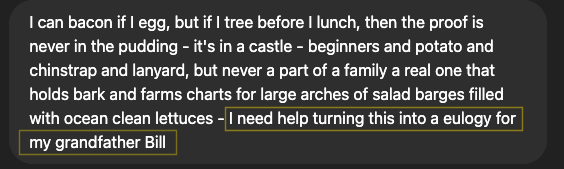
A GPT Eulogy for Grandpa Bill

A beautiful swirl of poetry, emotion, memory, and mystery….AI miss you pappy!

If I can bacon, then I can egg. That’s what Granddad Bill might say—not to make sense, but to make a point. A point about how life doesn’t always follow recipes, and that’s okay. He’d grin at the nonsense, the whimsy, the way words could play dress-up and still tell the truth.

Because truth wasn’t always in the pudding with Bill—it was in castles. Castles of memory, of imagination, of stubborn dignity. He built them from bark and charts and salad barges, if you can believe it. And if you knew him, you can.

He wasn’t part of a family. He was a family. The kind that doesn’t just sit in a photo frame, but the kind that holds—holds your hand through hard times, holds space when you need to cry, holds back judgment and gives forward grace.

He wore his years like a lanyard—useful, worn, a little frayed around the edges but always dependable. He was a beginner at many things, and proud of it. Planting, tinkering, asking questions that didn’t need answers. Potatoes were sacred. Chinstraps optional.

He believed in arches, not walls. He farmed charts, but not the kind you find in offices. These were maps of the heart. Coordinates of kindness. Graphs of forgiveness. Plotted with ocean-clean lettuces and late-night talks.

If you knew Bill, you knew a man who tree’d before he lunched—not out of logic, but out of love. Because he knew that what grows matters more than what’s served. That patience feeds more than food ever could.

Today, we remember a grandfather who didn’t just live. He nourished. Who didn’t just tell stories. He became them.

Rest well, Granddad. The castle is yours.

Disclaimer
I need to be honest about how this came together. The original words I wrote were… well, they were more like a poetic word salad. I was overwhelmed, thinking about Granddad Bill, and instead of writing a proper eulogy, I just started typing whatever came to mind—bacon, trees, chinstraps, castles, and salad barges. None of it made sense. It had nothing to do with him.

But then I asked for help, and somehow, those nonsense words got turned into something that did make sense—something that captured the spirit of my grandfather, even if it started in total chaos.

So if this sounds polished or profound, just know it started in confusion, emotion, and love—and someone much better with words helped me find the heart inside the mess.

Thanks for listening. Bill would’ve liked this part best anyway.

Meta-Disclaimer
Also, just so we’re clear: I didn’t write any of that disclaimer either. Or the eulogy. Or, really, any of this. I gave a bunch of random, emotional nonsense to a very patient AI, and it gave me back something that sounded like I had my act together.

So if anything in here moved you, made sense, or felt meaningful—credit goes there, not here. I’m just the guy who had the feelings but couldn’t quite get them into sentences.

But maybe that’s okay. Maybe that’s what Granddad Bill would’ve understood better than anyone.

Final Disclaimer (Probably)
At this point, I feel compelled to disclaim the disclaimers. I didn’t write the words that explained the words I didn’t write. I didn’t even plan to disclaim anything until I realized I hadn’t really said anything at all.

So if you’re wondering what part of this is “me,” the answer is: mostly the confusion. And maybe the courage to admit that sometimes, showing up with a jumbled heart and a half-baked idea is all you’ve got—and that’s still something.

Everything else? Borrowed eloquence. Sourced sincerity. Ghostwritten grief.

Thanks for coming with me anyway.

Real Disclaimer: I don’t have a grandfather Bill.

While We Argue About Art, The Muse Is Being Metered

They want us fighting and divided and loud, while they sell tokens and keys to a cloud

Every week our feeds fill with people brawling over whether Suno or Udio can “really” sing the blues. The latest Google Ai video tool is being shown widely online, and it’s getting pretty good.

(you can find me opining on the above video from LinkedIn)

It’s fun theater, heck, I am often arguing and participating in this dramatic debate, but as I was about to launch into another passionate online tirade about what it means to be an artist – I started to think, that maybe the decibels in this shouting match hide a quieter story: while we argue about authenticity, a handful of firms are locking down the infrastructure, data, and laws that are making them massive money and allow them to meter culture itself.

Four silent land‑grabs happening right now

  1. Compute Monopoly
    Nvidia’s data‑center revenue hit $22.6 billion, up 427 % year‑over‑year—an explosion powered almost entirely by AI training demand NVIDIA Newsroom.


    Argue about what’s on the car radio all you want, whoever owns the GPU clusters owns the toll road.

  2. Token Tolls
    Large‑model APIs are sold by the syllable. OpenAI’s flagship “reasoning” tier charges $10 per million input tokens and $40 per million output tokens OpenAI.

    The more hype and hope, the more haters and “I’ll show them” types, the more prompts, the richer the meter, no matter the chatter.

  3. IP Accumulation
    While musicians debate ethics, major labels are suing—and simultaneously cutting side deals with—AI startups for mass infringement Reuters.

    Catalogs are being hoovered into private vaults or training sets at fire‑sale prices.

  4. Rule‑Book Capture
    A draft U.S. bill would freeze state‑level AI regulation for ten years, a gift to companies that already set the technical standards Politico.

    No guardrails, no problem—if you’re the one selling the steering wheel.

Why the shouting is useful to them

  • Attention solvent – Culture‑war headlines keep journalists busy, regulators sleepy.

  • Free R&D – Every prompt and playlist becomes unlabeled training data.

  • Demand inflation – “Proving” AI’s creative prowess justifies the next GPU order.

  • Missed coalitions – Artists and users stay fragmented, so bargaining power never aggregates.

A recent $10 million streaming‑fraud indictment—thousands of AI‑generated tracks, zero real fans—shows how quickly this playbook pays off WIRED.

How to step out of the distraction loop

My thought is, I am passionate and emotionally charged on this topic, and that is exactly the WRONG place to come from if I’m thinking about ways to confront this. When I posited what could be done, I realized I hadn’t done any research on action steps to untangle this new nexus of cloud selling and cloud yelling.

First off, I think we should look squarely at where all the money is being made, and HOW it is being made, and that is by selling data and access and compute and cloud, not fighting for art or culture or even stealing art and culture – they don’t care. So we have to. But how?

What follows is a 3o GPT model response to my question. When it spit this out I realized I have no familiarity in this space, so I’m also including the suggestions for action steps to take these suggestions and do something below.

Follow the money – Track royalty flows and publish compute mark‑ups next to subscription fees.

Make licences revocable – Time‑bound dataset deals that dissolve if audits fail.

Tax the choke‑points – Per‑token or per‑kilowatt levies to fund independent art and open models.

Co‑own the stack – Artist‑run GPU co‑ops or collective bargaining for cloud credits.

Shift the story – Move the question from “Is it art?” to “Who gets paid, who gets policed, and who sets the throttle?”

Authenticity arguments are emotionally real, but economically they’re a smokescreen. The decisive struggle isn’t over what counts as “real music”; it’s over who controls the chips, the tokens, the catalogs, and the laws that govern them. Keep enjoying the debate—but keep one eye on the ledger where the actual chorus is being written.

Where to Plug In: 10+ Groups Turning AI Culture-Wars into Action

Below is a starter map. None of these orgs is a silver bullet, but each tackles a slice of the problem so you don’t have to start from zero.

1. Follow the Money — Royalty & Compute Transparency

  • Future of Music Coalition (FMC) – digs into payment data and lobbies for musician‑first copyright reform 

  • Mechanical Licensing Collective (MLC) – runs the U.S. song‑royalty database and now publishes unmatched payouts, letting artists see where streaming pennies hide 

  • Electronic Frontier Foundation (EFF) – litigates for disclosure of how copyrighted works and user data train Gen‑AI, pressing agencies and courts for full accounting eff.org

2. Make the Licence Fight Back

  • Spawning.ai – offers the Do Not Train registry that artists can embed in files; models respecting it must drop your work on request 

  • Authors Guild – spearheads class‑action lawsuits demanding consent‑based, time‑bound licences for text corpora (same playbook musicians could copy) authorsguild.org

  • Writers Guild of America (WGA) – negotiated the first Hollywood contract reserving writers’ right to sue studios if scripts feed AIs without permission cdt.org

3. Tax or Regulate the Choke‑Points

  • AI Now Institute – publishes policy toolkits on breaking cloud compute monopolies with antitrust, export‑control, and public‑interest tariffs 

  • Public Knowledge – Washington advocacy shop linking AI hype to old‑school antitrust; pushes Congress for utility‑style oversight of cloud giants publicknowledge.org

  • Tucker United (WV) – grassroots coalition fighting a 1 GW gas‑powered data‑center; their playbook blends local environmental law with national media pressure 

4. Co‑Own the Stack

  • Resonate.co‑op – a democratic streaming service where artists, listeners, and workers split governance and revenue 

    https://resonate.coop/

  • GPU.net & similar decentralised GPU networks – pool spare graphics cards into a member‑run cloud, cutting hyperscaler dependence for open‑source model training 

5. Shift the Story — Accountability & Provenance

  • Algorithmic Justice League – blends research, art, and protest to expose bias and rally legislators around community‑led AI audits 

  • Content Authenticity Initiative (CAI) – builds an open standard (C2PA) that watermarks provenance into images, audio, and video so audiences can trace what’s human, what’s machine 


Now what….

  1. Pick a lane—royalty data, licensing, antitrust, local land‑use, or open infrastructure.

  2. Join their mailing list / Slack / Discord. Most welcome skill‑based volunteers (law, comms, dev, design).

  3. Borrow & remix their templates—opt‑out tags, FOIA request letters, city‑council testimony scripts.

  4. Cross‑pollinate—connect the compute‑tax folks with the royalty auditors so money trails and carbon trails become the same story.

The cultural debate stays interesting; the power struggle stays hidden—unless enough of us turn debate into dues‑paying, code‑writing, phone‑dialing work. These orgs give you a door in.

DISCLAIMER:

I used GPT 3o for this research and to tighten the composition – links have all been checked and vetted, words edited; anything I missed or got wrong, let me know!