On Fitting Rooms, Fitting In, and Feedback Extinction


Checking the Fit

“It’s not what happens to you, but how you react to it that matters.” – Epictetus

How do you develop an opinion on the clothes you wear? In private, responding to mirrors, magazines, and measurements? Is it in public, or maybe in a group chat? Chances are, it’s a mixture of both, with personal choice being 100% preferred but, due to fashion crazes or “the latest thing,” not always chosen.

What the author is wearing right now….

Unlike an opinion, which you cook up all on your own and might not ever tell anyone, you have to wear your clothes out in public. So while you might select the outfit in private, the perceived & actual public reaction to your clothes is, most likely, a stronger arbiter of judgement.

Fashion is a place where private beliefs and public behaviors eventually collide.

You can believe whatever you want about yourself or your opinions or your clothes. At the end of the day, the behaviors and reactions of others have an outsized influence on an individual’s fashion choices, not because we lack independence but on account of us living as socialized creatures do.
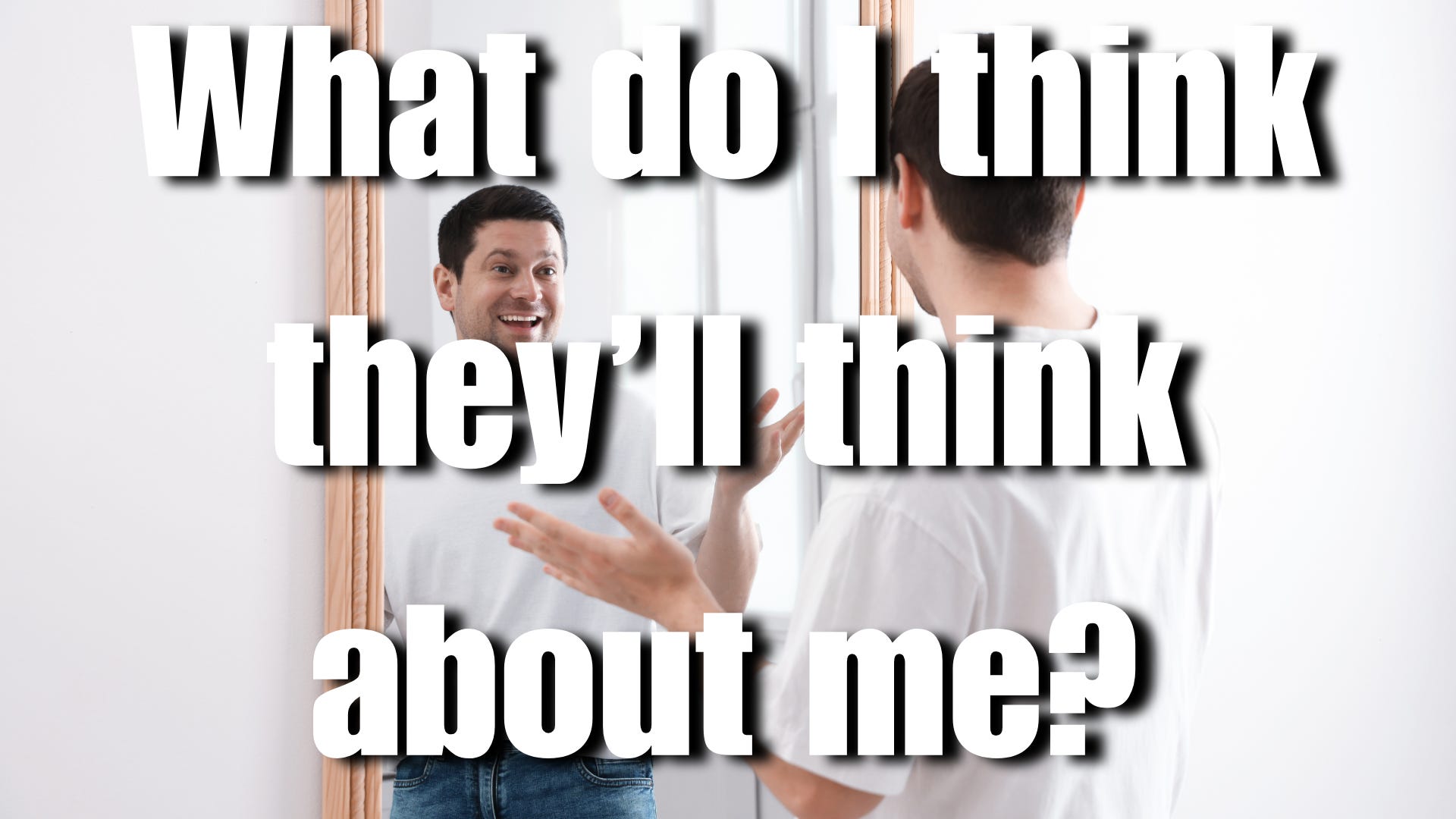
Clothes can operate as a transmission tower between personal belief and socialized behavior.

The way we slip in and out of clothes, and envision ourselves as habituating different personalities, trying different fits out to see if we look like we fit in, is an important allegory for participating in a thriving, socialized, democratic life.

But the option to ‘try something on,’ hasn’t always been a given.

The History of the Fitting Room

Fitting rooms were invented in 1907 at Selfridge’s – back in the day anyone wanting clothes would have to describe what you wanted, and the staff would pull something out. No one could ever try clothes on before purchasing them.

Harry Gordon Selfridge, owner of one of the largest department stores in London (and the world) at the time, had a radical idea: let people try things on before they pay.

Retailers thought he was insane. Letting customers handle the merchandise? They’ll damage it. They’ll waste time. They’ll try and leave without buying.

Instead, after the first fitting rooms were installed, conversion rates at Selfridge’s went through the roof. Returns dropped. Customer satisfaction skyrocketed.
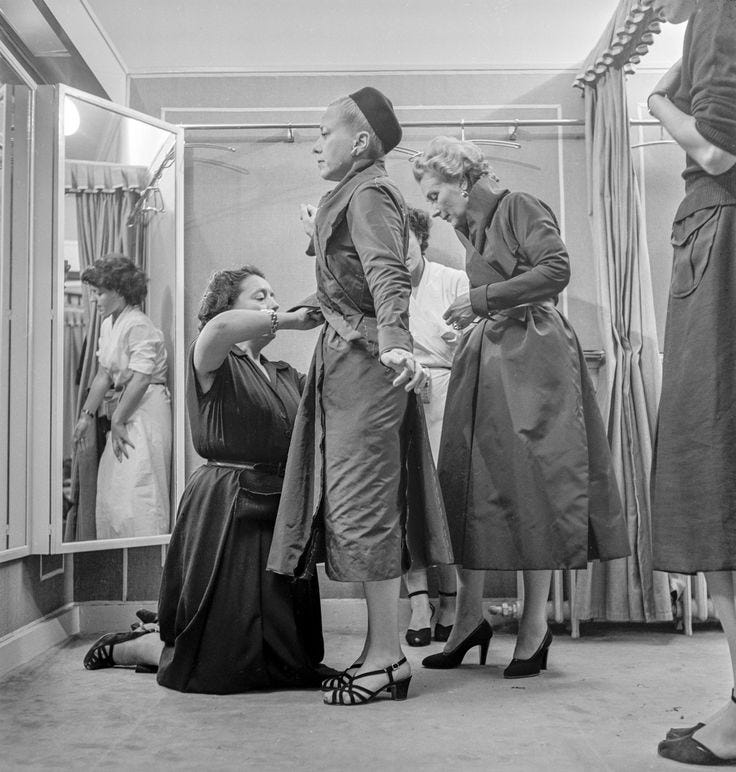
Within a handful of years, every department store in the world had fitting rooms which were important attractors for all day shoppers. The fitting room became a third space to socialize away from society.

“It’s not what happens to you, but how you react to it that matters.”

Within decades, fitting rooms were standard, but some department stores chose another route, maybe to save money, maybe to save space, maybe both – group dressing rooms.

How Group Dressing Rooms Fit In

A month or so ago, I was chilling with my wife and her friends and they got on the subject of old department stores, and two of the ladies mentioned the group dressing rooms at Loehmann’s, both having diverging takes on the experience.

Group. Dressing. Rooms. I tried these words out in my mind, but they made no sense.

What is a group dressing room? Why would that even be a thing?

When I looked up group dressing rooms at Loehmann’s, I was treated with a 2014 HuffPost article from fashion blogger and designer, Mara Menachem, “Everything I Learned, I Learned in the Group Dressing Room at Loehmann’s.”

Writing at the time of the store’s shuttering, Mara fondly remembers the communal fitting rooms of the now-defunct discount retailer as an unlikely place of human connection.

“I realize I’m not the only person eulogizing the loss of our beloved Loehmann’s. This was more than a store and I hope the Loehmann Family realizes the great impact of their famed stores. But before laying my precious Loehmann’s to rest, I must not only memorialize it, but educate the unfortunate individuals who will never experience being stark naked in the group dressing rooms at Loehmann’s”

The scene Mara paints of Loehmann’s group dressing rooms is one where ladies were physically exposed but socially uninhibited.

Women and girls of all ages and body types undressed together, offered unsolicited opinions, helped strangers squeeze into dresses, and learned the unwritten rules of fitting in.

They said things to strangers that most people would hesitate to say in public. They were both positive & policing, candid & encouraging toward one another’s bodies, tastes, and appearances.

The dressing room was simultaneously a place of vulnerability, belonging, and conformity.

In the Loehmann’s group dressing room, you got the answer you were gonna get from the streets, early before you bought the item.

Group dressing rooms made the social negotiation of belonging physical & visible.

“The closing of Loehmann’s is not surprising in the age of quick access and highly educated consumers. But the loss is so great, because what we miss out on when participating in what may seem a shallow activity like shopping, is a real, organic human experience in pure connection.

So maybe Loehmann’s wasn’t a “fancy” store filled with sales people who could tell you where the designer jacket you tried on was made, but what the staff and shoppers at Loehmann’s would teach you, is how to squeeze your hips in a dress too small or what they thought of the President’s speech last night. So yes, I am going to miss this special place and most of all I will miss being naked in the group dressing room at Loehmann’s.”

I’m not advocating for a return to group dressing rooms, there are more positive and negative reviews of them to review online, but I’m wondering, when these experiences went away, did they also close down an important relational vehicle, a third-place we could connect as people?

“It’s not what happens to you, but how you react to it that matters.”

Learning to Fit In

I was a modest teen, and I had my reasons – skinny as a rail, usually with a cold sore, a pigeon chest – so I was not keen on gym class/locker room dynamics, showering with the boys.
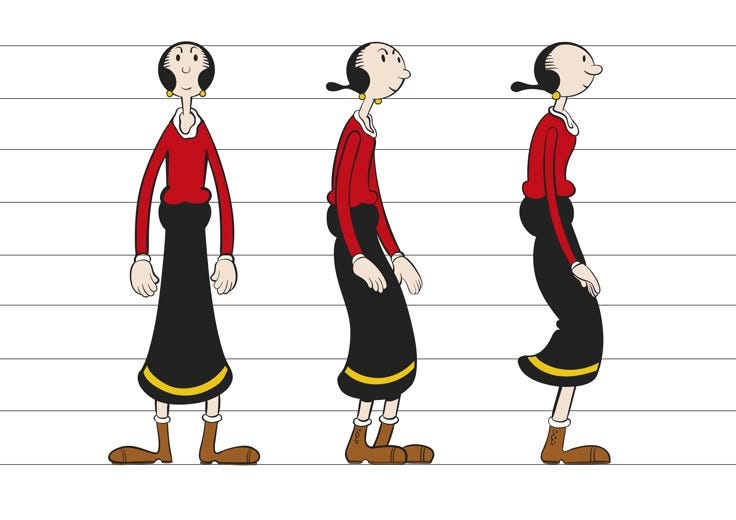
WHAT THE AUTHOR LOOKED LIKE, AGE 12

At that time I was a big fan of Jean Claude van Damme and Schwarzenegger action movies, so I knew what men could look like, and I knew I was nowhere close to that, so whenever possible, I avoided locker rooms like a plague.

Don’t get me started on ‘shirts vs skins’ in gym class…what the actual hell?

All that began to change when my parents took us to see the 1993 adaptation of Shakespeare’s “Much Ado About Nothing.” I remember feeling embarrassed by the opening scene – everyone, young and old, is happy and naked and changing and bathing, without a single shred of embarrassment between their scampering butt cheeks.

The scene is so overjoyous, it got me thinking what changing room confidence I might be missing, or what indifference I might be lacking. The “just-so” nature of the actors gave me an idea that my hesitation about dressing rooms might be a missing acceptance that we are all humans, every shape, and this is what’s underneath the surface.

The poem that opens the movie adds another flavor of nonchalance, and hits on this idea of accessing the raw and real of humanity, something you have to cast off like clothes, to get to the real joy, to get to the nonny nonny.

“Sigh no more, ladies, sigh no more.

Men were deceivers ever,

One foot in sea, and one on shore,

To one thing constant never.

Then sigh not so, but let them go,

And be you blithe and bonny,

Converting all your sounds of woe

Into hey nonny, nonny.

Sing no more ditties, sing no more

Of dumps so dull and heavy.

The fraud of men was ever so

Since summer first was leafy.

Then sigh not so, but let them go,

And be you blithe and bonny,

Converting all your sounds of woe

Into hey, nonny, nonny.”

“It’s not what happens to you, but how you react to it that matters.”

The Dressing Room Gets Binned

Lately, stores are doing away with changing rooms entirely. Brandy Melville, a sizable national brand, recently announced the closure of their fitting rooms in the US and UK.

Although no official reason has been given, according to The Guardian, store staff in several locations (such as Boston and Austin) attributed the removal to chronic vandalism, including a viral TikTok trend where shoppers stuck chewing gum to the dressing room walls and curtains.

With examples of dressing room closures at Sainsbury’s and Tesco in the UK, it’s more than likely there’s an anti-social trend here. But we’re picking up the social scraps with technology.

TikTok has normalized the “Outfit of the Day” (OOTD) ritual. Girls frequently record transition videos or quick mirror selfies as they assemble their clothes in the early AM, sharing them either publicly or on private “spam” accounts for a close circle of friends.

With technology being tied into social rituals, there’s been an emergence of something called Digital Co-Presence. Getting ready for school can feel isolating or mundane. By sending outfit updates, photos of their makeup, or complaining about being tired in the early morning, teenage girls create a sense of “getting ready together” even when they are physically apart.

One fashion blogger, responding to this trend, reflected that these rituals aren’t necessarily about the clothes – it’s about “am I enough?” “will they accept me, do I belong?”

Today, the physical fitting room may be private, or stratified over social or private messages, but the social calculation has gotten mutated online and in many ways, it’s missing entirely offline.

We stand in front of mirrors, or screens, asking what fits. We’re judging the clothes, ourselves, and what we believe to be the expectations of everyone waiting outside.

“It’s not what happens to you, but how you react to it that matters.”

What the rise of techno-dependent social rituals, and the closure of fitting rooms and Loehmann’s group dressing room indicates, is that as opportunities to experience shared, relational, physical space with multigenerational cohorts go away, we loosen our roots to something deep, profoundly social, inherently human.

We forget about the importance of feedback, and at a time when the places/spaces/opportunities for it are at risk of going away.

Feedback Extinction

How do you form a “good” opinion on something? Is it in private isolation, with books, calculators, or facts and figures? Is it in public, with colleagues or friends and family?

It’s probably a hybrid of both, but in an algo-mediated, individualized/personalized, metric-driven, one-way opinion-drenched, social media culture powered by recommendation engines (and no group dressing rooms), I wonder if there’s a current risk of a new information environment crisis – Feedback Extinction.

Not of too much information or too many opinions, but a dismissal & disavowel of them entirely, a total disregard for the raw reality and thoughts of others.

With an ecosystem of tools custom made for narcissism available to everyone, who thinks outside themself? Why would they? What benefit is it to consider someone else’s view, someone else’s body? Why peek over my private fitting room, why acknowledge the others while I’m trying to fit in and “work on myself?”

In many ways we are loathe to admit, the statements – “I don’t need to acknowledge, care, or know about any other opinion than my own” and “I don’t need to see/hear/engage with anyone” could apply to ourselves in certain contexts, just as easily to any garden variety sociopath.

And similarly, maybe we’re filled with unrepentant, mythological longing for a time when all of us would cast of the deceit of men, and be blithe and bonny, trying fits on and wondering how we fit in, together, converting sounds of woe into hey nonny, nonny.

If locations like group dressing rooms are gone from existence, is it so hard to think that the memory of a time where everyone would get naked and talk shit, would slowly turn into a myth?

With no option to be in a dynamic, physical social setting with strangers, how would you be aware that this was an option? Would you know there are others with opinions, would that even matter?

What would facing a feedback extinction feel like?

How would we know we’re feedback endangered?

What if you had to talk and be vulnerable with others to find out? 😳

“It’s not what happens to you, but how you react to it that matters.”

ROI or Die! | Where Terrorism and Marketing Meet

Whether it’s domestic, global, or on your social media feed, it’s hard to ignore the fact that theatrical terrorism and hateful outrage has penetrated into the 21st century ideological marketplace like never before. Why is that?

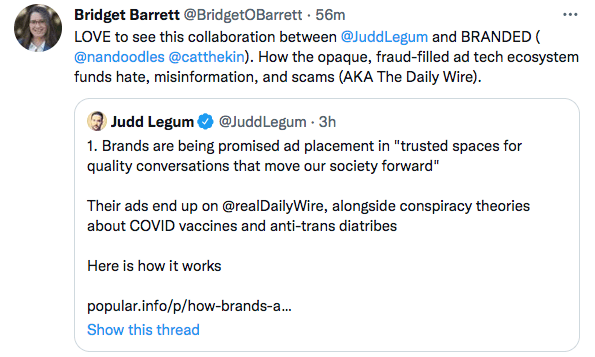
Research shows that along with the traditional terrorism PR playbook, the overly-complicated modern marketing and advertising ecosystem has created perfect, murky conditions for hate to flourish, proliferate, and economically thrive online.

Terrorism is essentially concerned with marketing and promoting violent/hateful political ideologies in ways that minimize resources and maximize attention.

Typically small and state-less entities, terrorists cannot traditionally garner any political recognition on the world stage, so they opt for small, extremely violent acts that focus the world’s attention on their agenda.

Along with traditional media and PR avenues, today’s terrorists have discovered how to troll & manipulate social media, hijack adtech, crypto, and the overly-complicated modern digital marketing ecosystem to create online havens and hatcheries for their piece of shit fanaticism.

Just me being crazy. Nah…

There have been plenty of articles written about this link between terrorism and marketing, (linked at the bottom and above) how ad fraud helps terrorist launder money, how social media and algorithms radicalize people; but there hasn’t been any meaningful attention or action on the part of the marketing industry to curb this or intervene in anyway.

Inspired by the concept of Useful Fiction, which author Peter Singer describes as “working at the intersection of strategic foresight, technology discovery, and narrative…” I asked myself; “who would ever agree to help a terrorist organization with their marketing strategy?”

And so, I’m proud to present; “ROI or Die!” a ‘choose your own adventure’ story about a marketer that is kidnapped by a terrorist organization and forced to handle their marketing strategy.

PLAY IT HERE!

illustration – IAMNEONBROWN

Hopefully, the story gets the marketing and advertising industry thinking about ways to confront and disrupt terrorism, online hate, and prevent dangerous ideological concepts from gaining access to the general market.

Below are links to insightful books, helpful articles, and important organizations working to both combat terrorism and bring attention to the fraudulent and abusive practices hidden in the complex modern ideological marketing ecosystem.

Two important books on how online terrorism & hate marketing is irrevocably impacting the offline world; “LikeWar” by Singer & Brooking and “Messing With The Enemy” by Clint Watts

Research into marketing & terrorism:

Important Resources

Check My Ads – An awesome site run by Nandini Jammi & Claire Atkin, helping marketers understand the modern marketing ecosystem, disrupt ad fraud, and maximize their budgets by working with sites and publishers they trust.

Fou Analytics –  Another amazing site, run by Dr. Augustine Fou, helping educate marketers about better ad buys, stronger strategies, and ways ad fraud is used by criminals to launder money, disrupt society, etc.

UN Office of Counter Terrorism – The United Nations Office of Counter-Terrorism (UNOCT) leads and coordinates an all-of-UN approach to prevent and counter terrorism and violent extremism.

Emotions, Conversions, and the POSMarketer

marketing, advertising, social media marketing, emotional intelligence, POSMarketing Emotional Intelligence, the latest buzzword to fly through marketing’s living room, has all the promising language of a meaningful progress in the march towards moneymaking – and none of the ethical foresight, or foresmell, to realize the manipulative sh*tstorm it unleashes on the world.

The marketer-drones swarmed towards “emotional intelligence” during Advertising Week Europe at the beginning of April, and why not? Who wouldn’t want guaranteed conversions based on an unparalleled understanding of the hidden realms of customer intent? Who wouldn’t want to know how to use emotional channels to drive “user engagement,” sell more products, create desire for services, or to enhance a site’s “stickiness/addictiveness?”

Sensum’s CEO Gawain Morrison believes emotions drive every decision. He believes that brands are headed towards forging relationships with their consumers vs. simply selling a product. Sensum is an “emotions-based software company” that has founded it’s success with huge brands across the world, by measuring, reporting and driving ad campaigns all based on emotional intelligence.
marketing, advertising, social media marketing, emotional intelligence, POSMarketing
Sensum believes that the core of a relationship between a brand and a customer is centered around emotion, so to understand the reasons behind purchase behavior, loyalty and even enjoyment with a brand, that business has to understand it’s consumers on an emotional level.

Imagine a world where immersive and responsive advertisements read your facial features and adapt to your apparent emotional state. Imagine a totally immersive horror movie attuned to your fears, drawing on an experimental emotional response database. Sensum has already been working on these concepts, and their work unlocks deep, impactful marketing insights and applications.

However, any marketing effort that’s based on triggering and gaining response on emotional levels, should be carefully monitored for any ethically questionable use outside of the marketplace. I wonder if Sensum is worried about this…

“The changing shape of the media landscape, from audience participation to the blurring of media lines and boundaries, offers up a wild range of opportunities to people and companies able to experiment in this space.”  – SENSUM640px-Paris_Tuileries_Garden_Facepalm_statueGiven the current state of media manipulation and mistrust, the proliferation of fake news, digital ad-fraud, the government-sanctioned sell-off of private user data by Internet Providers, and the hyper-targeted ability to covertly mine emotional data from social media to use in selective ad campaigns that can influence society and even swing election results – the above quote is a slap in the ethical testicles.
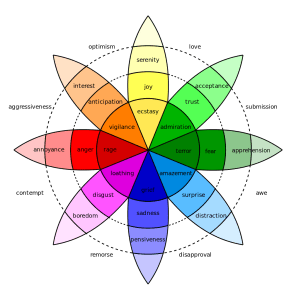
On a personal level – emotional intelligence is an important concept to cultivate. Building a comprehension of emotional signals & responses, and then using this to strengthen connections with another person seems psychologically-sound, empathetic, humane, real. However, we should be clear on one thing. When emotional manipulation is used on a personal level, against someone’s best interests or wishes, it can have extremely negative effects on a relationship and can damage trust irrevocably. Furthermore, emotional manipulation is not only deplorable, it is essentially against Article 22, 26, & 28 of the 1948 Universal Declaration of Human Rights.

marketing, advertising, social media marketing, emotional intelligence, POSMarketing

Our Emotional Wheel of Sales Opportunities

So when a business chooses to collect emotional intelligence from a chosen group (usually covertly), and then analyzes this for patterns, and engineers information and ad campaigns designed to subconsciously effect and slightly nudge someone’s cognitive ability to make decisions in one direction or the other – how is this not viewed as emotional manipulation?  How does the normal marketer, escape the feelings of being a POSMarketer?

I’m not here to throw sweaters on all the strippers inside the nightclubs of the free-marketplace, I’m just here to ask questions –

Can we learn about our customers, but ethically pursue research that isn’t covert and is understood clearly by the participants? Should we pursue ad campaigns that seek to remove emotional vulnerabilities, rather than prey on them? And can the value we provide to our customers or target audience be so abundantly clear, that we pull them in, rather than push ads out?

I’ll close out with some choice words from Tamsin Shaw, in her NYTimes review of a behavioral science book, “The Undoing Project”  – 

We are living in an age in which the behavioral sciences have become inescapable. The findings of social psychology and behavioral economics are being employed to determine the news we read, the products we buy, the cultural and intellectual spheres we inhabit, and the human networks, online and in real life, of which we are a part. Aspects of human societies that were formerly guided by habit and tradition, or spontaneity and whim, are now increasingly the intended or unintended consequences of decisions made on the basis of scientific theories of the human mind and human well-being.

The behavioral techniques that are being employed by governments and private corporations do not appeal to our reason; they do not seek to persuade us consciously with information and argument. Rather, these techniques change behavior by appealing to our nonrational motivations, our emotional triggers and unconscious biases. If psychologists could possess a systematic understanding of these nonrational motivations they would have the power to influence the smallest aspects of our lives and the largest aspects of our societies.

So what kind of marketer are you? An ethical marketer ready to take action on behalf of protecting our marketplace eco-systems – or are you a POS?

Advertising/Marketing Industries Have Civic Responsibility To Fight Fake News

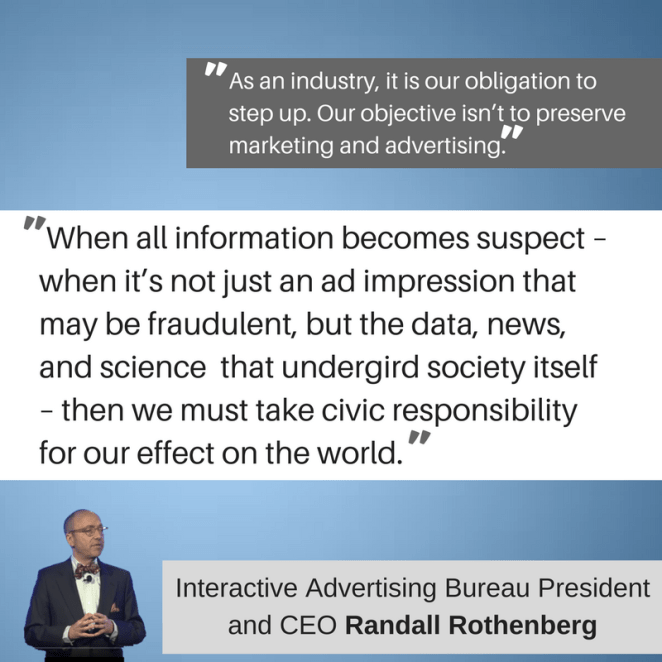
When Interactive Advertising Bureau President & CEO Randall Rothenberg called for an industry-wide commitment to fight “Fake News” at an Annual Leadership Meeting in Hollywood, Florida in January of this year, the response from the audience was mixed.

randall rothenberg marketing blog ad-fraud googleRandall Rothenberg went on in his truly inspiring speech, to elaborate the important role advertisers and marketers now find themselves playing. He outlined the myriad ways algorithms, big-data, and the eco-systems that prop up digital advertising, are ruining the exchange relationships of information online. And he suggests to his audience, CMOS and ad agencies representing some of the top companies in the world, that they need to help bring the change, or suffer the consequences of an eroding trust in the digital landscape.

Looking back now, Rothenberg’s speech takes on a Nostradamic hue of prophecy.

Marketers and advertisers have unwittingly taken public discourse and the connected community of the Internet into a navel-gazing, filter-bubble filled, truth-destroying, civilization-shaking, death spiral. And to pull out of it, we have to realize our place in the cockpit, and understand how we got here.

Entertain me – what’s the worst that could happen?

A group of our marketing and advertising colleagues working with the Data and Marketing Association literally stood up and cheered as they were on hand to witness Congress, then the Senate, then the President, peel back Obama-era protections/regulations, allowing ISPs to access and distribute consumer data, browsing history, in-app messages, and emails, to third-party companies for profit, all without consumer consent?

Getty Images marketing social media

The interested parties have struck a deal – people love relevant ads!

When the vote passed the Senate, on March 23, 2017, we heard this from Emmett O’Keefe, SVP of Advocacy at the Data and Marketing Association:

“Today’s vote in the Senate and expected approval in the House signal that our nation’s top policymakers recognize that our current system of responsible data use works.”

The trust was apparently so overflowing, and the data of the marketplace was handled so responsibly, that the same day, these US companies followed the lead of brands in the UK, and pulled entirely out of Google & Youtube digital display advertising agreements, resulting in a loss of hundreds of millions of dollars for the digital ad giant….

  • AT&T
  • Beam Suntory Inc.
  • Dish Network
  • Enterprise
  • FX Networks
  • General Motors
  • GSK
  • Johnson & Johnson
  • Nestle
  • PepisCo
  • Starbucks
  • Verizon
  • Walmart

These companies, “unknowingly,” were buying programmatic ad-placements that were being paired up with hateful content on Google & YouTube – a Snickers pop-up under an ISIS beheading, or Nazi propaganda brought to you by Mercedes. Truth be told, digital ads have always been placed wherever they can be, and who cares where they go cos they are cheap as dirt! You got the impressions/clicks/views – digital advertising, accomplished. So we spend a few bucks on digital display ads – What’s the worst that could happen?


One of the Managing Directors at Edelman PR, Gavin Coombes, has a quote that sets us up perfectly for the next slippery slope we need to slide down – – –

“As Internet-based communication has become used more often and by more people, we have found ourselves in the paradoxical circumstance of more information arguably leading to less understanding. The “echo chamber” – identified in the latest Edelman Trust Barometer as a major factor in feeding fear and distrust of institutions – is a phenomenon that reached a tipping point in 2016 and with potentially epochal implications. And, seemingly, without warning.”

Edelman Trust Barometer marketing blog, content marketing, advertising, digital marketing, social media marketing

Coombes goes on to explain that social media operates more like tabloid media, vs traditional mass media – using content that entertains or connects emotionally, rather than content that empirically informs. Users prefer, and come to rely on, a steady diet of things that are happy, sad, funny or violent. This diet is typically filled with people like them and based on info they provide freely. So your social media stream is hand-selected by algorithms owned and operated by the social media ecosystems – always designed to keep the most engaging content in front of you, forever regenerating, endlessly attached to advertising revenue, open to marketers of all stripes.

In 2014, it was revealed that Facebook was able to manipulate users emotions depending on what posts a tailored algorithm allowed onto their “Wall.” Positive posts on a user’s wall were shown to illicit more positive posts in return, conversely, exposure to negativity promoted the sharing of negative material . Facebook performed it’s experiment without any user consent, and since the Terms and Conditions covered the unfettered access to user data, it was all above-the-board. Google and Yahoo both follow this same protocol – provide a seemingly “free” product, observe usage, get as much data as possible, get advertising content, and tweak the delivery to get the “relevant” info in front of the right people. 

The reaction to Facebook’s experiment from the marketing and advertising community was shock and hidden joy. Here they had proof of a proper approach to gaming Facebook – emotions spread, and targeted, relevant emotions triggered at the right time can cause action. Proof that information, if properly placed at the right time, could affect change. Facebook’s algorithms keep it’s growing 1.7 billion user base glued to the platform – showing them whatever keeps them engaged, and not too pissed off – and all the while, user data is shared with anyone willing to pay for it.

So what? Marketers and advertisers get to sell soap to people they know like soap. We might use emotional triggers to get people to take action, but it’s with babies and puppies. It’s all good – What could possibly go wrong?

For those unfamiliar with the rising prominence of the newest and least experienced player to step on the field of international diplomacy on behalf of the United States, Jared Kushner – or how the former real-estate mogul turned dad-in-law-Trump’s campaign around by scaling existing marketing technology and “expertly” manipulated the filter-bubbles and emotional triggers of social and search….

For those unfamiliar with the technology he purchased through Cambridge Analytica, and how that company can provide it’s clients, through their OCEAN targeting, info on users political affiliation, race, gender, neuroticism, conscientiousness, openness and other psychological/emotional triggers……

For those unfamiliar with Cambridge Analytica’s parent company, SCL Group, which, since 1993, has made its name providing “psychological operations” for political campaigns around the world, marketing its services to militaries and state security agencies, providing impeccable, highly- targeted, and politically-weaponized disinformation campaigns to such countries as Pakistan, and Great Britain….

For those unaware of the role of mega-hedge-fund-lord Robert Mercer in funding Breitbart, Brexit, his huge investment in Cambridge Analytica both in the UK and US, his not-so-shadow-funding of pro-Trump media blitzes through the new non-profit media company “Making America Great Again,” and his insane amount of influence in the de-globalizing, anti-intellectual, climate-denying, xenophobic, media-exploding, war-mongering shit show we are currently living through…….

You should look into this stuff. What’s the worst that could happen?

This quote from Professor Jonathan Rust, director at Cambridge University’s Psychometric Centre, can help fit the final piece of our puzzle –

“The danger of not having regulation around the sort of data you can get from Facebook and elsewhere is clear. With this, a computer can actually do psychology, it can predict and potentially control human behaviour. It’s what the scientologists try to do but much more powerful. It’s how you brainwash someone. It’s incredibly dangerous.

“It’s no exaggeration to say that minds can be changed. Behaviour can be predicted and controlled. I find it incredibly scary. I really do. Because nobody has really followed through on the possible consequences of all this. People don’t know it’s happening to them. Their attitudes are being changed behind their backs.”

So what should/can marketers and advertisers do about this?

Looking at the above information, the marketer and the advertiser can see several opportunities. Opportunities for more user-generated data, enhanced abilities to track and deliver personalized ads on behalf of brands, nuanced insight into consumer behavior, ways to sneak our messages through emotional pathways, unlimited access to centralized audiences, and access to an ever-expanding marketplace.

Or are the opportunities aligned with a larger civic duty, not just towards our profit margins, but to our society, our fellow humans?

  • Could advertising, done the right way, save the world?
  • Can we open the conversation with our digital marketing companies about ways we can fight ad-fraud together?
  • Can we hold our marketing and advertising associations accountable for their Code of Ethics, and be active, ethical allies for conscientious consumers?
  • Can we work to protect the marketplaces and technology that enable ethically and mutually agreed-upon exchange relationships from “bad actors” or manipulative entities?
  • Can we not sell everyone’s private data up the damned river, just so we can send them “better ads?”

Whatever your stance on ethics and morality and marketplace logic and free-will, we have to realize that while we’ve been engineering the latest and greatest ways to sell stuff in our marketplaces, we’ve also greased the tracks for a whole host of nefarious players to enter into these spaces, use our marketing technology of demand-engineering, targeted behavior modification, and etc., and these sinister forces are inflicting serious harm to the information eco-systems so necessary to our livelihoods and the continuation of modern civilization.

I’ll leave you with a final quote from Rothenberg, and it’s a perfect ending for this rant of an article, because it’s how he ended his speech, mic drop style.

“. . . now I am asking you to reach higher, and deeper into your own better nature. The values we hold dear – diversity, freedom of speech and religion, freedom of enterprise – are under assault, and digital marketing, advertising, media, and technology companies bear some measure of responsibility. The route from self-interested “standards” to fraudulent ads to blind-eyed negligence to the financing of criminal activities to support for hatred is clear, and it is direct.

What we say here – and what we do here – makes a difference. Please leave this conference with this understanding: You have the power to move fast and fix things. You have the ability to repair our credibility. You have the power to rebuild the trust. Thank you.”

So are you a marketer that is willing to stand up and make the world a better, more trusting place? If you rise to the occasion and exhibit the best of what humanity has to offer, at least in a marketer, what’s the worst that could happen?


The Spectroscopy of Content

WARNING – Huge Marketing Metaphor Ahead.

The Spectroscopy of Content is an attempt to find the connective and underlying structures that all marketed messages share. Whether it’s account based marketing, content marketing, mass market advertising, native, guerrilla, paid, earned, owned, taglines, slogans, calls-to-action; marketing is about humans communicating with other humans.

The Spectroscopy of Content provides an understanding of human behavior, it’s shared triggers and environments, and uses this information, preemptively, to increase the relevancy and effectiveness of the marketing we choose to foist upon the world.

"How far that little candle throws his beams! 
So shines a good deed in a weary world."
      
        -William Shakespeare - The Mechant of Venice

First – let’s cover what spectroscopy is;

Spectroscopy is a scientific measurement technique. It measures light that is emitted, absorbed, or scattered by materials and can be used to study, identify and quantify those materials. One thing that you need to remember is that “light” is a lot more than just the colored visible light that we can see. – NASA

This is interesting for two reasons –

  1. What we see as plain, white, visible light, actually contains all the colors of the rainbow, plus a collection of wavelengths that we can’t even sense as humans.
  2. Spectroscopy breaks up a complex, noisy signal, such as light, into discrete, constituent parts, provides a glimpse of once imperceptible structures, and brings meaningful data points out of the chaos.

So far, so good. Now, let’s bring this back to marketing. Below, “Content” refers to any marketed message, in any marketing vertical.

Content starts as this solid concept, a beam of light, ready to illuminate the minds of our target audience. The beam is the message, and the message is the beam. Strong calls to action. Tracking is set up. We’ll know what success means and we’ll be able to point to business goals that Content will help to achieve. We fire the solid beam of light into the blackness of Deep Space/The Internet/America’s Living Room.

Now, let’s briefly return to the science of light.

Light is perceived by it’s reflection off of surfaces, and two different reflections are possible – Diffuse and Specular.

The light rays that allow us to see non-luminous objects such as our hands, the floor and the people around us, are rays that have traveled from a light source and then have reflected off of an object towards our eyes. There are two types of reflection: specular and diffuse. Specular reflection sends discreet beams in specific directions. Diffuse reflection sends many different beams in several directions.

So what about our Content? Once our beam of light is perceived by our audience, will they, via the specular reflection principle, be able to understand specific messages or triggers embedded in the beam? Or will the light spread out into a million different meanings, fade into the background – a diffuse reflection of our loaded beam?

Well, didn’t we think about the audience and the affect our content would have on their Mind Prisms? Did we think to analyze our content’s Impact Spectrum?

We require a few more metaphors.

Just as prisms help to break apart light, the interpretation of your content happens in the audience Mind Prism. The Mind Prism is the only medium through which your lighted message is decoded and understood.

Content is not what you think it is – it’s what your audience thinks it is.

Content is not the beam of light you send, it’s the beam of light that is received. And, further complicating things, each Mind Prism is unique and it’s absorption can change with it’s environment – and no two will absorb information the same way.

So in The Spectroscopy of Content, we’re seeking to consciously pre-fabricate the beam of light, knowing what spectral lines need to be absorbed by the audience, amplifying the strength of those wavelengths, and thoughtfully anticipating the myriad ways our Content may be interpreted, or misinterpreted, by the Mind Prism.

Once the light is considered through the Mind Prism, the Impact Spectrum should be analyzed and considered. To explain this last piece – we return to the light. . .

The spectrum from distant stars contain the signatures of the elements that compose the star. Spectral absorption lines in the wavelength of visible light, correspond with elements, present in the stars chemical makeup. There is a Hydrogen Line, a Sodium Line, Magnesium, etc.

In The Spectroscopy of Content, the “absorption lines” reflect the ideas or concepts that are anticipated to hit the intended Impact Spectrum – and we have several different Spectra of Understanding. Below are three versions I’ve created specifically for this piece – but there is room for thousands more!

Are we soliciting buyer behavior, are we making someone mad, are we talking about cultural values? Is this a curveball with a mysterious trajectory, a fast pitch in an elevator, or a beachball in a stadium? Does this message leave enough room for the recipient’s ego? Does the Content talk about personal things, or relevant ideas in society? Will this make them think of Church, School, the bedroom, the barber shop?

Before we launch any Content, we have to ensure that it’s light will reflect into at least one Impact Spectra, if not multiple. And although it is true that each Mind Prismis unique, certain concepts like the ones briefly covered in the above examples, work on more basic levels. Humans are unique, but human behaviors and reactions tend not to be.

In closing – The Spectroscopy of Content aims to understand the ways information impacts people on this basic level, and use this information to fortify and empower the messages we send in the future. Whether we’re analyzing various Mind Prisms, or their associated Impact Spectrum, one this remains true throughout this “new” marketing metaphor. . . Our success depends not on how much we put ourselves into our marketing, but by how strongly our marketing considers our audience.

Please let me know if you have any questions or would like to learn more about The Spectroscopy of Content.