A socio-political analysis of Pinocchio as a myth of nation-building and disciplined citizenship, contrasted with a modern inversion of that arc, where cutting attachments promises freedom for society but risks producing self-instrumentalized, unmoored puppets.
We focus on the myth of Pinocchio, how his nose grows when he lies and how he became a real boy, but I was thinking the other day, what kind of society created this story?
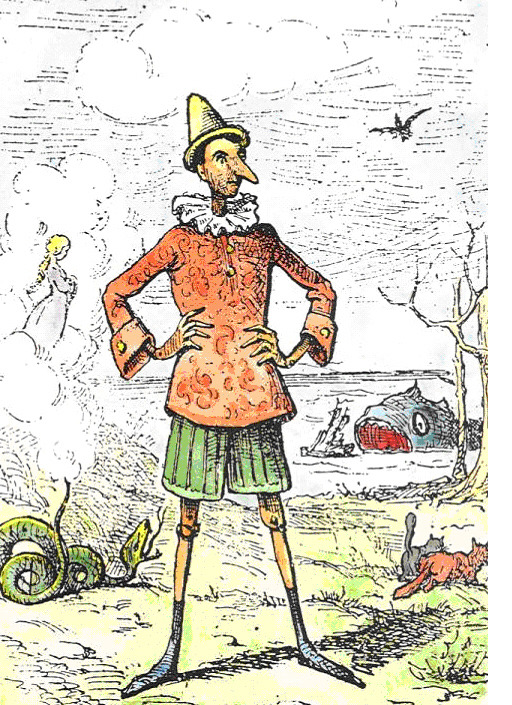
The author, Carlo Collodi (1826–1890), was born into the servant class. He wrote this myth in 1880, in the middle of the industrialization of Italy, and 20 years after the country was unified after hundreds of years of war. He volunteered in the wars of independence in ’48 and ’60. He was passionately political and active early in his career, writing scathing satire, some of which was banned by the Grand Duke of Tuscany.
When the democratic Italy he fought for turned out to be a sham, he became disenchanted with political satire and switched to writing children’s literature, using the medium to express his convictions.
Collodi believed in and fought for a unified Italy that would produce a moral renewal, dignified citizens, elevated people. By the time he begins to write Pinocchio in 1880, this dream is frayed and in tatters.
A newly “united” nation finds itself in political turmoil because a monarchy, mixed with the papacy, has replaced the idealized democracy they fought for, subverting the national identity of a populace facing the beginning edge of an industrial revolution with technology no one has seen before. A citizenry unprepared for the transition to an entirely new way of life, one hastily jerry-rigged to industry.
Seventy percent of the rural population is illiterate, taxes are heavy, and poverty is the baseline. If you weren’t working in a factory, or one of the 300,000 that would emigrate during this time, you farmed for subsistence.
Those that embraced the new way of industrial life had less security. As Italian microhistorian Franco Ramella noted about this time, the rural population “were periodically pushed into precarity by the unstable nature of industrial products and their presence on the market.”
This is industrializing Italy. The modern laboring subjects were rural migrants and peasants, populations the newly formed state could not directly coerce into maturity and factory-readiness.
In the final 1883 version, “The Adventures of Pinocchio” after a series of engagements with many characters from the natural and supernatural world—and the seminal transformation into a donkey in the Land of Toys – Pinocchio becomes real when he internalizes his demands, brings his waywardness and freedom down, and aligns desire with productivity, obedience, and discipline.
Collodi’s characterizations in this myth could be seen as a warning to himself and his generation. It could be an admission from a disappointed liberal reformer: We failed to make a nation that naturally produces citizens.
Now we must manufacture them.
Through The Land of Toys
The Land of Toys, an important allegorical vehicle in the tale, is evidence of Collodi’s attempts to artfully address and emphasize certain aspects of the modernizing society back to itself through the story.
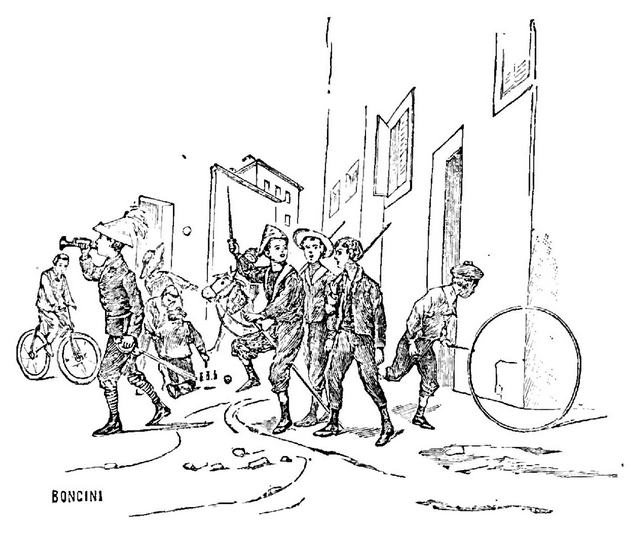
The Land of Toys, originally referred to as a land of Cocagne, later labeled Pleasure Island in the Disney adaptation, is a haven of freedom and anarchy for children who are promised a place where they never have to go to school or work, spending their whole time having fun. In Collodi’s original story it is a mysterious, almost legendary place not present on any maps, unlike in the Disney version where it is an actual location,
Collodi describes in detail how Pinocchio and his wayward companion Candlewick are lured to the Land of Toys by the Coachmen and what they find there.
Along with all the technological chaos and cutting edge pandemonium, there are big tent events advertising the freedoms on offer, canvas theaters crowded by children from morning to evening. The walls of some houses bear messages: “Long live playthings! We will have no more schools! Down with arithmetic!”
Most sentiments are expressed through poor spelling.
Here’s a tighter synopsis from the Wiki to move us along….
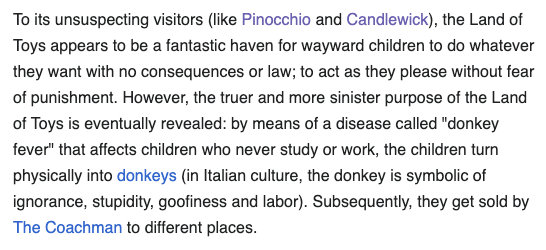
A key detail of the transformation from boy to donkey, from humans into work animals—cited as one of the most shocking in all of children’s literature—is that the children who are fully transformed lose their ability to speak. The speechless donkeys still retain their human minds, able to understand commands, like to strip and get into crates to be sold to hapless farmers.
Another noteworthy aspect of the transition from boy to donkey is that in the Disney version, one can reverse the transformation by correcting bad behavior. In Collodi’s official version, transformation is automatic and irreversible, leading to great toil and pain.
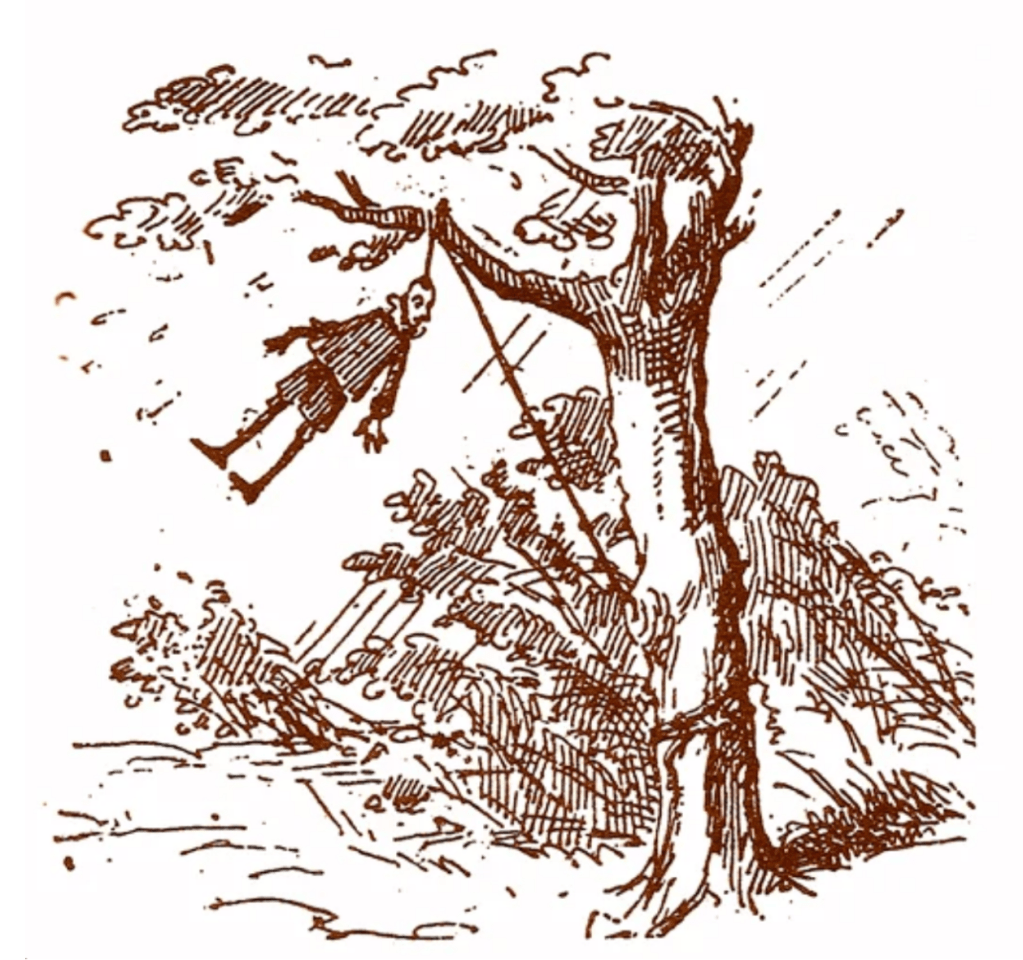
The theme of the cycle of death and rebirth happens many times throughout the story, with Pinocchio encountering many animals that get killed and are reborn, the Blue Fairy is a ghost, kinda, and after transforming in the Land of Toys, Pinocchio stays a donkey for months and only turns back into a puppet when a fish tricks him into a pool and eats the disguise off, essentially killing the donkey version of him, re-emerging as a puppet again.
Taking the socio-political lens of the era in which Collodi wrote this story, the transformative requirement to have the capacity to allegorically die and be reborn, and engage and maintain a harmonious relationship with nature, as opposed to technology and donkey work, hint at two additional morals for this tale that The Land of Toys makes visible.
Untangling The Modern Marionette
It’s been over 100 years since it’s release, and since it’s the third most translated story in the world, there must be a reason Pinocchio continues to unspool truths about our evolving, steady industrializing present.
Through later critical voices from Italy, it could be argued that Collodi’s Pinocchio might not simply be a didactic vehicle about maturity, but also a message of political ambivalence and bittersweet acceptance of the modern times real Italian boys would be inheriting.
In a 2022 article “The Politics of Pinocchio” by Anna Momigliano from The Atlantic, a 1975 analysis of the tale by Alberto Rossa is cited, to explain how one might view this story through yet another lens.
In his seminal 1975 essay, “Le Voci di un’Italia Bambina,” Rosa suggested that Pinocchio’s central political theme was, in fact, the acceptance rather than the rejection of the compromises that go with nation-building: “It’s a universal tale, destined to repeat itself for every person and for every nation. There always comes a moment in which individuals or communities become more adult than they used to be and, looking back, mourn the time when they could be puppets, i.e. do what they pleased.” According to Rosa, Collodi’s greatness lay in his understanding that coming of age, both privately and politically, entails a loss: “Growing up means gaining something but losing something else: A puppet has riches that a boy could never have.”
Taking Rosa’s reasoning a step further..if being a puppet represents uncontrolled rebelliousness, and becoming a real boy means submitting to the social order of a modern nation, with all its hypocrisies and injustices, this would explain the bittersweet, slightly nostalgic tone of the novel’s conclusion: “How funny I was when I was a puppet! And how happy I am now to have become a good little kid!”
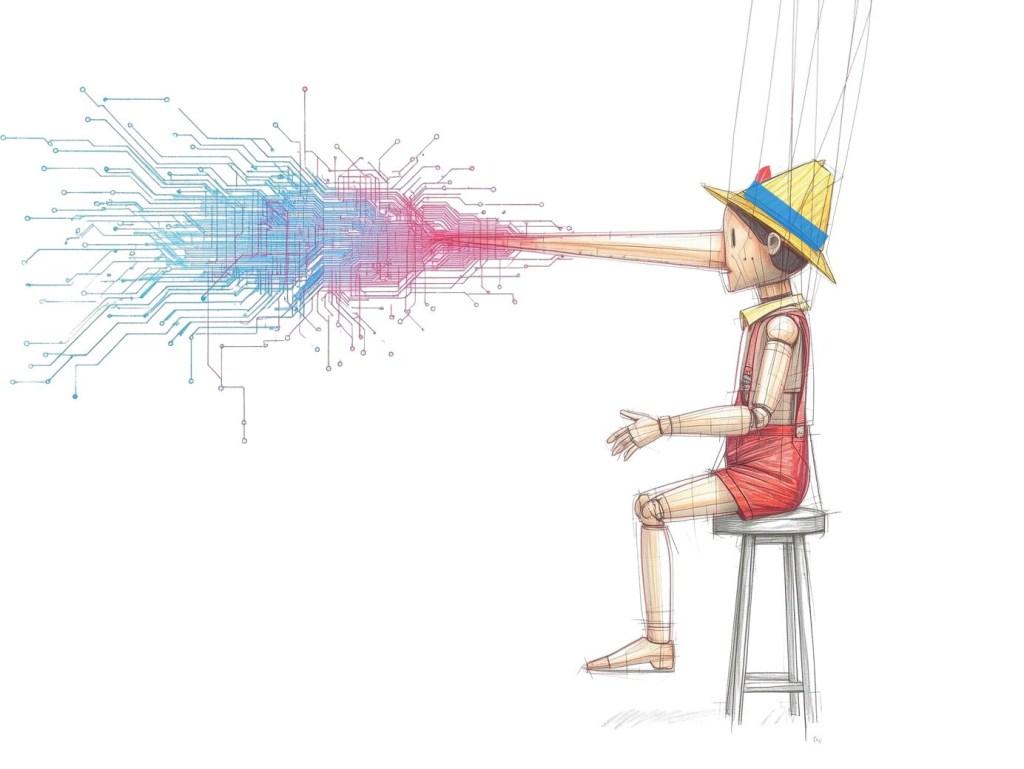
This combined view from Momigliano & Rosa unlocks an interesting angle to study the mindset of the technodeterminist, our modern Pinocchio, who seems to desire the inverse of the original work’s premise; to go from a fake boy to a real life puppet.
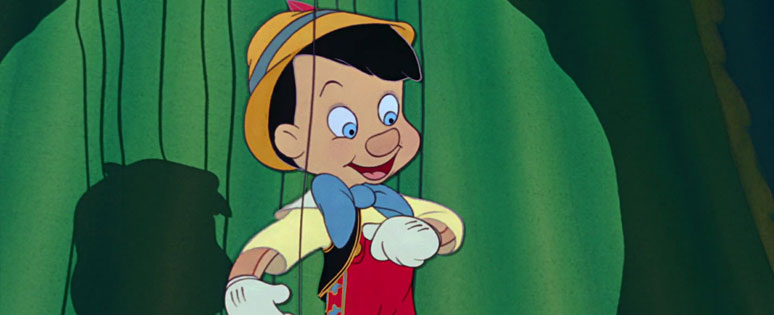
The inversion is artfully illustrated in the lyrics from the 1940 adaptation by Disney –
I’ve got no strings
To hold me down
To make me fret
Or make me frown
I had strings
But now I’m free
There are no strings on me
Hi-ho the me-ri-o
That’s the only way to go
I want the world to know
Nothing ever worries me
I’ve got no strings
So I have fun
I’m not tied up to anyone
They’ve got strings
But you can see
There are no strings on me
– “I’ve Got No Strings” from Disney’s “Pinnochio” 1940
by Leigh Harline / Ned Washington
In the Disney 1940 adaptation of “Pinocchio,” the marionette celebrates having “no strings.” A puppet is held up by strings, yet the song recasts them as holding him down.
Strings function metaphorically here as attachments—vulnerable, caring relationships, obligations, dependencies. What once enabled mobility and orientation is reframed as constraint. Freedom becomes detachment, invulnerability turns into identity.
The theme of comparison is key. The only way to be free is to be a puppet, but not a marionette controlled by relationships and attachments, something real boys might have to contend with.
The outward projection is one of unattached coolness, nothing ever worries me, nothing binds me, nothing holds me down or back.
The inverse moral of Pinocchio for the technodeterminist, might be that the original ending, becoming a real boy, belongs to the past. With the proper tech, Carlo Collodi’s vision for disillusioned peasants, can evolve alongside the machines that overtook the political nature of countries around the world and are going through a hasty rejiggering of industry into technocracy.
The goal might no longer be to become “real boys” based on an outdated (maybe even “fake”) view of politics and citizenry.
The goal is to cut ties to everything and walk as carefree puppets—not to live inside real life with others, but to manipulate your way through it alone.
 POSMarketing