On Fitting Rooms, Fitting In, and Feedback Extinction


Checking the Fit

“It’s not what happens to you, but how you react to it that matters.” – Epictetus
How do you develop an opinion on the clothes you wear? In private, responding to mirrors, magazines, and measurements? Is it in public, or maybe in a group chat? Chances are, it’s a mixture of both, with personal choice being 100% preferred but, due to fashion crazes or “the latest thing,” not always chosen.
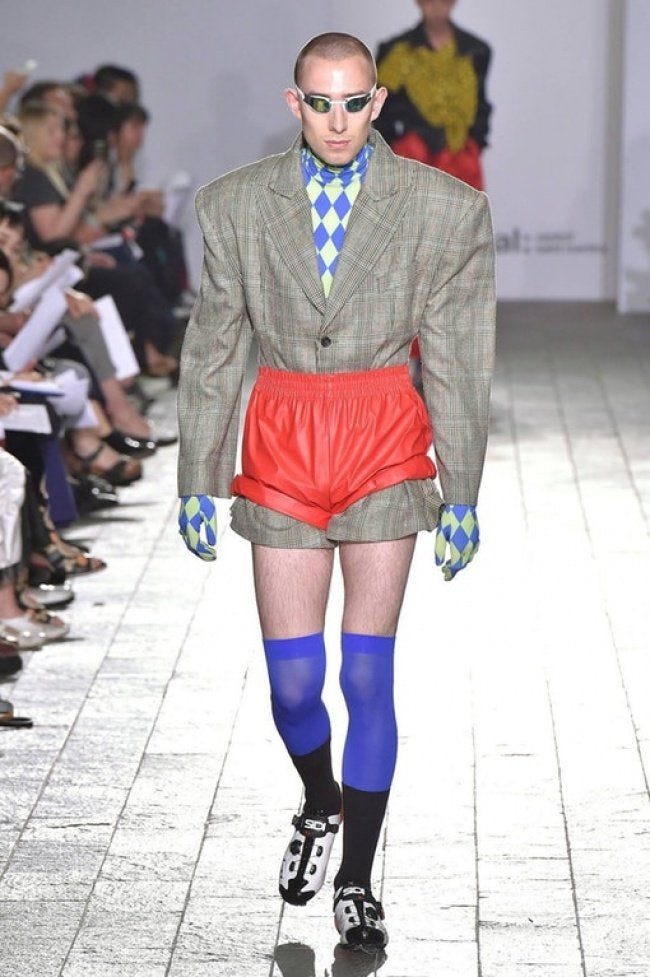
What the author is wearing right now….

Unlike an opinion, which you cook up all on your own and might not ever tell anyone, you have to wear your clothes out in public. So while you might select the outfit in private, the perceived & actual public reaction to your clothes is, most likely, a stronger arbiter of judgement.

Fashion is a place where private beliefs and public behaviors eventually collide.

You can believe whatever you want about yourself or your opinions or your clothes. At the end of the day, the behaviors and reactions of others have an outsized influence on an individual’s fashion choices, not because we lack independence but on account of us living as socialized creatures do.
Clothes can operate as a transmission tower between personal belief and socialized behavior.

The way we slip in and out of clothes, and envision ourselves as habituating different personalities, trying different fits out to see if we look like we fit in, is an important allegory for participating in a thriving, socialized, democratic life.

But the option to ‘try something on,’ hasn’t always been a given.

The History of the Fitting Room

Fitting rooms were invented in 1907 at Selfridge’s – back in the day anyone wanting clothes would have to describe what you wanted, and the staff would pull something out. No one could ever try clothes on before purchasing them.
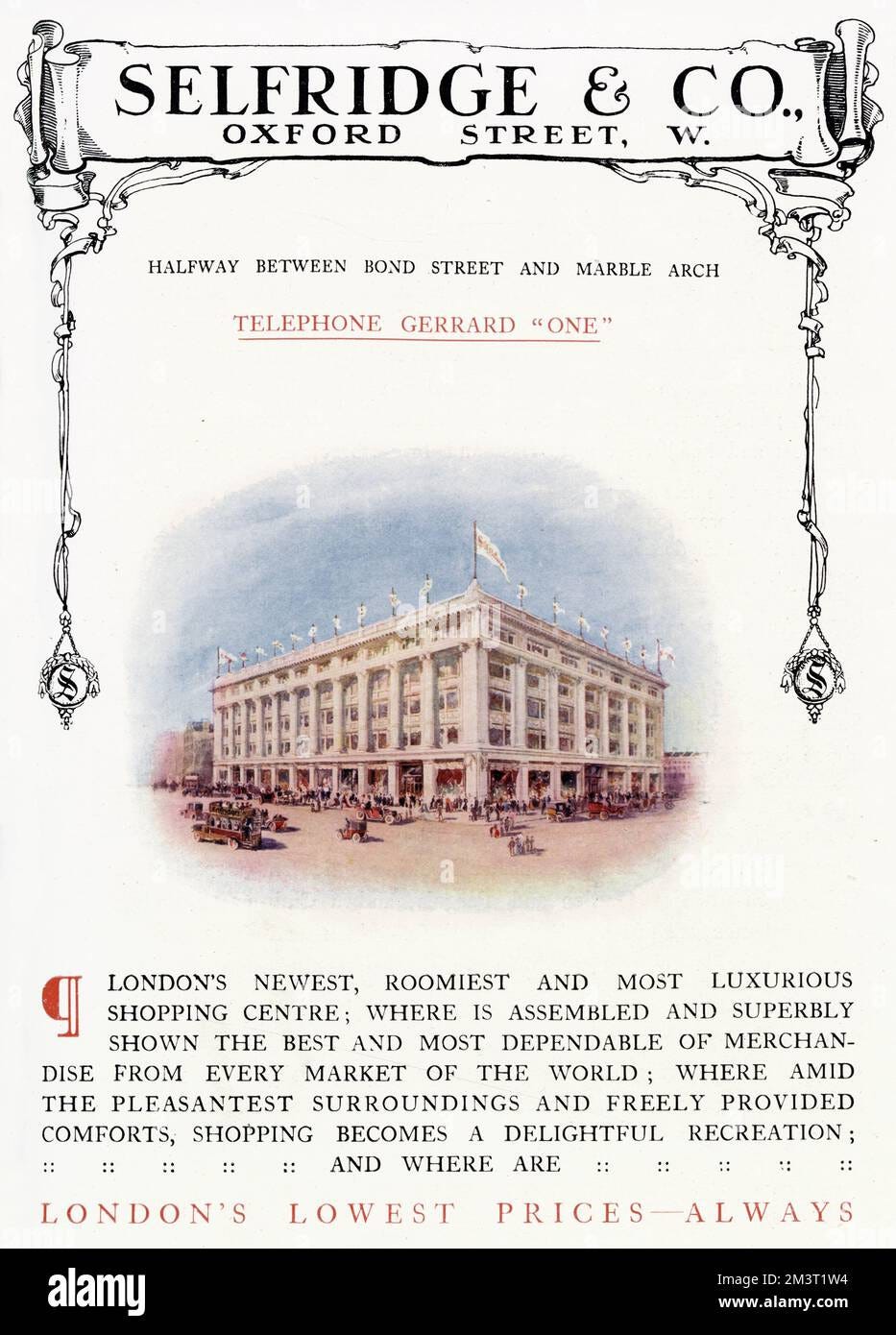
Harry Gordon Selfridge, owner of one of the largest department stores in London (and the world) at the time, had a radical idea: let people try things on before they pay.

Retailers thought he was insane. Letting customers handle the merchandise? They’ll damage it. They’ll waste time. They’ll try and leave without buying.

Instead, after the first fitting rooms were installed, conversion rates at Selfridge’s went through the roof. Returns dropped. Customer satisfaction skyrocketed.
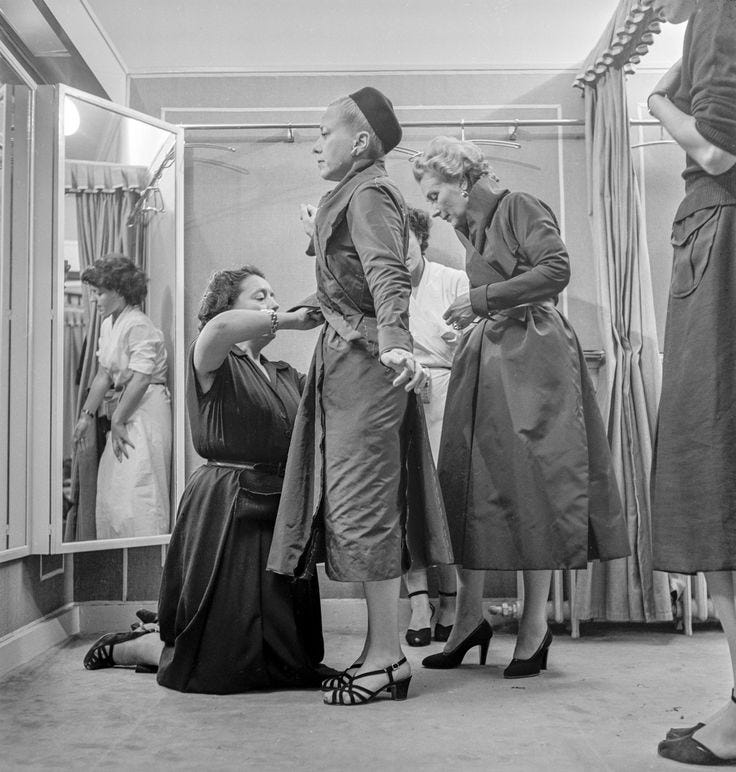
Within a handful of years, every department store in the world had fitting rooms which were important attractors for all day shoppers. The fitting room became a third space to socialize away from society.

“It’s not what happens to you, but how you react to it that matters.”

Within decades, fitting rooms were standard, but some department stores chose another route, maybe to save money, maybe to save space, maybe both – group dressing rooms.

How Group Dressing Rooms Fit In

A month or so ago, I was chilling with my wife and her friends and they got on the subject of old department stores, and two of the ladies mentioned the group dressing rooms at Loehmann’s, both having diverging takes on the experience.

Group. Dressing. Rooms. I tried these words out in my mind, but they made no sense.

What is a group dressing room? Why would that even be a thing?

When I looked up group dressing rooms at Loehmann’s, I was treated with a 2014 HuffPost article from fashion blogger and designer, Mara Menachem, “Everything I Learned, I Learned in the Group Dressing Room at Loehmann’s.”

Writing at the time of the store’s shuttering, Mara fondly remembers the communal fitting rooms of the now-defunct discount retailer as an unlikely place of human connection.

“I realize I’m not the only person eulogizing the loss of our beloved Loehmann’s. This was more than a store and I hope the Loehmann Family realizes the great impact of their famed stores. But before laying my precious Loehmann’s to rest, I must not only memorialize it, but educate the unfortunate individuals who will never experience being stark naked in the group dressing rooms at Loehmann’s”

The scene Mara paints of Loehmann’s group dressing rooms is one where ladies were physically exposed but socially uninhibited.

Women and girls of all ages and body types undressed together, offered unsolicited opinions, helped strangers squeeze into dresses, and learned the unwritten rules of fitting in.

They said things to strangers that most people would hesitate to say in public. They were both positive & policing, candid & encouraging toward one another’s bodies, tastes, and appearances.

The dressing room was simultaneously a place of vulnerability, belonging, and conformity.

In the Loehmann’s group dressing room, you got the answer you were gonna get from the streets, early before you bought the item.

Group dressing rooms made the social negotiation of belonging physical & visible.

“The closing of Loehmann’s is not surprising in the age of quick access and highly educated consumers. But the loss is so great, because what we miss out on when participating in what may seem a shallow activity like shopping, is a real, organic human experience in pure connection.

So maybe Loehmann’s wasn’t a “fancy” store filled with sales people who could tell you where the designer jacket you tried on was made, but what the staff and shoppers at Loehmann’s would teach you, is how to squeeze your hips in a dress too small or what they thought of the President’s speech last night. So yes, I am going to miss this special place and most of all I will miss being naked in the group dressing room at Loehmann’s.”

I’m not advocating for a return to group dressing rooms, there are more positive and negative reviews of them to review online, but I’m wondering, when these experiences went away, did they also close down an important relational vehicle, a third-place we could connect as people?

“It’s not what happens to you, but how you react to it that matters.”

Learning to Fit In

I was a modest teen, and I had my reasons – skinny as a rail, usually with a cold sore, a pigeon chest – so I was not keen on gym class/locker room dynamics, showering with the boys.
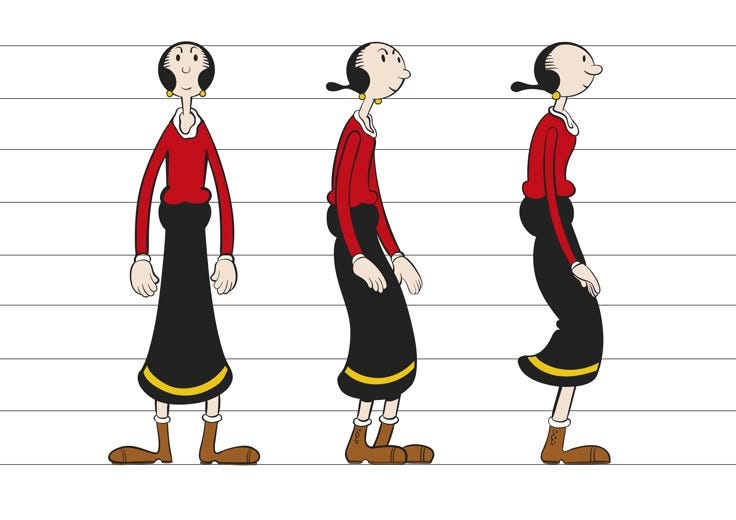
WHAT THE AUTHOR LOOKED LIKE, AGE 12

At that time I was a big fan of Jean Claude van Damme and Schwarzenegger action movies, so I knew what men could look like, and I knew I was nowhere close to that, so whenever possible, I avoided locker rooms like a plague.

Don’t get me started on ‘shirts vs skins’ in gym class…what the actual hell?

All that began to change when my parents took us to see the 1993 adaptation of Shakespeare’s “Much Ado About Nothing.” I remember feeling embarrassed by the opening scene – everyone, young and old, is happy and naked and changing and bathing, without a single shred of embarrassment between their scampering butt cheeks.
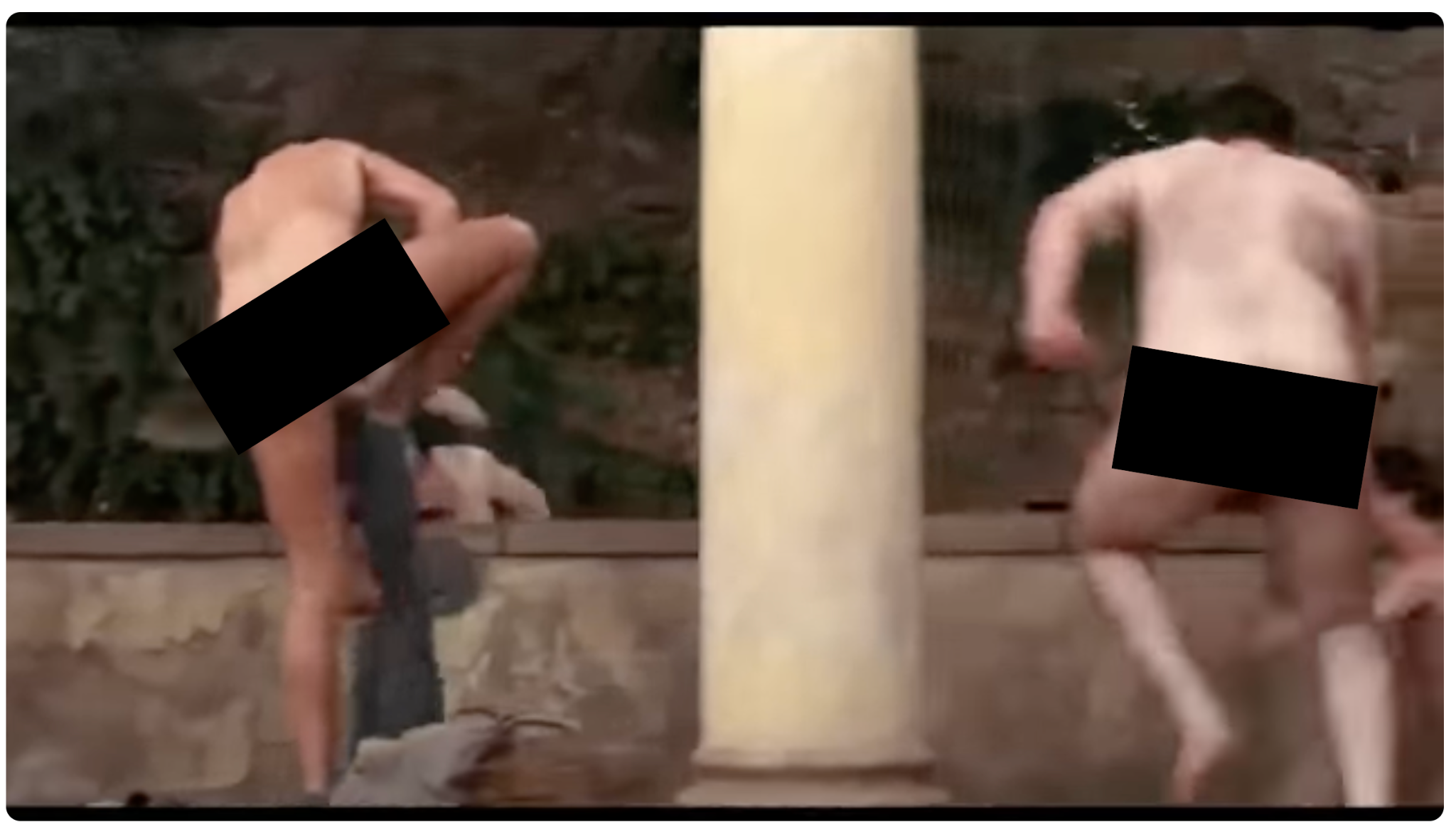
The scene is so overjoyous, it got me thinking what changing room confidence I might be missing, or what indifference I might be lacking. The “just-so” nature of the actors gave me an idea that my hesitation about dressing rooms might be a missing acceptance that we are all humans, every shape, and this is what’s underneath the surface.

The poem that opens the movie adds another flavor of nonchalance, and hits on this idea of accessing the raw and real of humanity, something you have to cast off like clothes, to get to the real joy, to get to the nonny nonny.

“Sigh no more, ladies, sigh no more.

Men were deceivers ever,

One foot in sea, and one on shore,

To one thing constant never.

Then sigh not so, but let them go,

And be you blithe and bonny,

Converting all your sounds of woe

Into hey nonny, nonny.

Sing no more ditties, sing no more

Of dumps so dull and heavy.

The fraud of men was ever so

Since summer first was leafy.

Then sigh not so, but let them go,

And be you blithe and bonny,

Converting all your sounds of woe

Into hey, nonny, nonny.”

“It’s not what happens to you, but how you react to it that matters.”

The Dressing Room Gets Binned

Lately, stores are doing away with changing rooms entirely. Brandy Melville, a sizable national brand, recently announced the closure of their fitting rooms in the US and UK.

Although no official reason has been given, according to The Guardian, store staff in several locations (such as Boston and Austin) attributed the removal to chronic vandalism, including a viral TikTok trend where shoppers stuck chewing gum to the dressing room walls and curtains.

With examples of dressing room closures at Sainsbury’s and Tesco in the UK, it’s more than likely there’s an anti-social trend here. But we’re picking up the social scraps with technology.

TikTok has normalized the “Outfit of the Day” (OOTD) ritual. Girls frequently record transition videos or quick mirror selfies as they assemble their clothes in the early AM, sharing them either publicly or on private “spam” accounts for a close circle of friends.

With technology being tied into social rituals, there’s been an emergence of something called Digital Co-Presence. Getting ready for school can feel isolating or mundane. By sending outfit updates, photos of their makeup, or complaining about being tired in the early morning, teenage girls create a sense of “getting ready together” even when they are physically apart.

One fashion blogger, responding to this trend, reflected that these rituals aren’t necessarily about the clothes – it’s about “am I enough?” “will they accept me, do I belong?”

Today, the physical fitting room may be private, or stratified over social or private messages, but the social calculation has gotten mutated online and in many ways, it’s missing entirely offline.

We stand in front of mirrors, or screens, asking what fits. We’re judging the clothes, ourselves, and what we believe to be the expectations of everyone waiting outside.

“It’s not what happens to you, but how you react to it that matters.”

What the rise of techno-dependent social rituals, and the closure of fitting rooms and Loehmann’s group dressing room indicates, is that as opportunities to experience shared, relational, physical space with multigenerational cohorts go away, we loosen our roots to something deep, profoundly social, inherently human.

We forget about the importance of feedback, and at a time when the places/spaces/opportunities for it are at risk of going away.
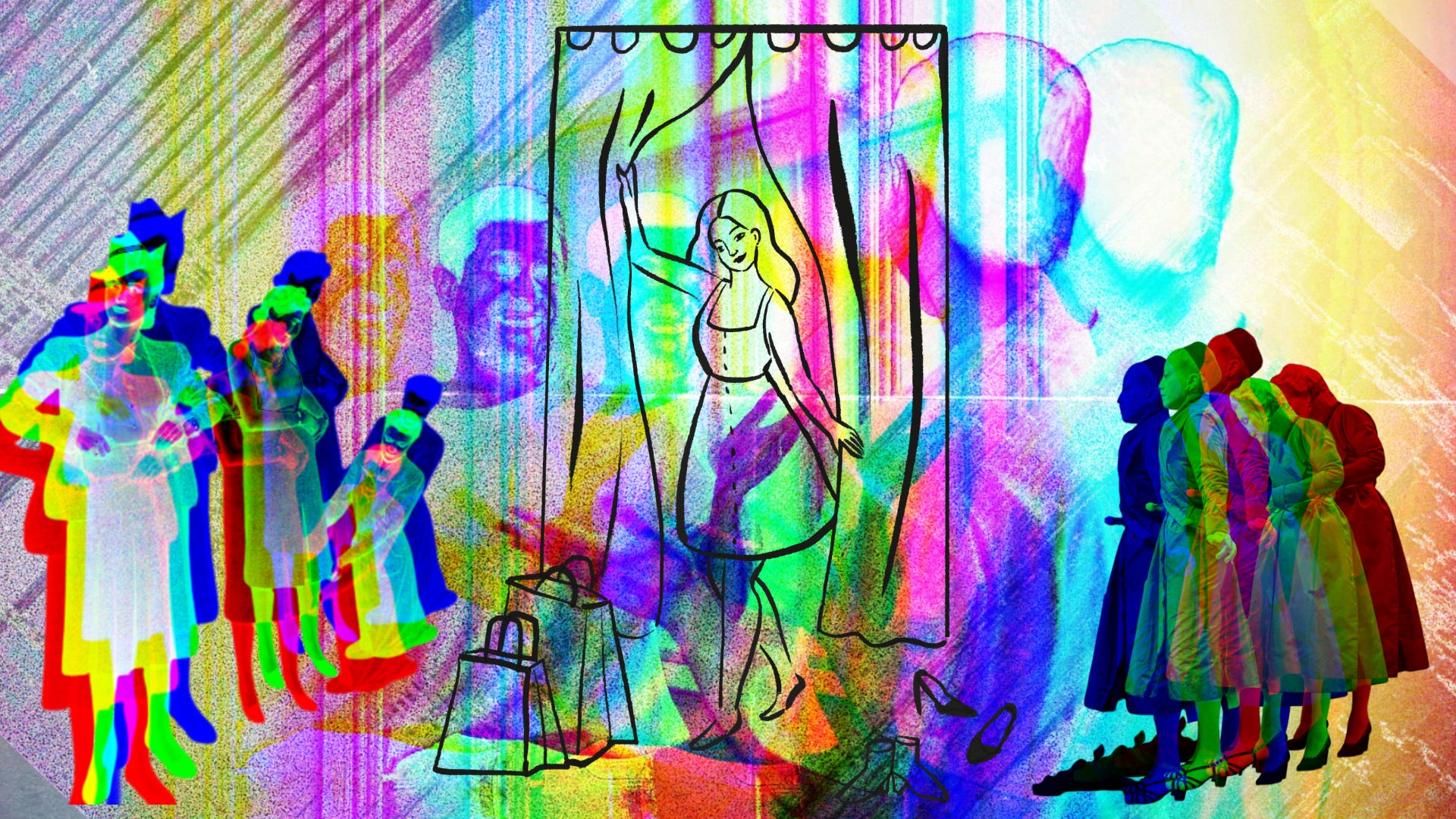
Feedback Extinction

How do you form a “good” opinion on something? Is it in private isolation, with books, calculators, or facts and figures? Is it in public, with colleagues or friends and family?

It’s probably a hybrid of both, but in an algo-mediated, individualized/personalized, metric-driven, one-way opinion-drenched, social media culture powered by recommendation engines (and no group dressing rooms), I wonder if there’s a current risk of a new information environment crisis – Feedback Extinction.

Not of too much information or too many opinions, but a dismissal & disavowel of them entirely, a total disregard for the raw reality and thoughts of others.

With an ecosystem of tools custom made for narcissism available to everyone, who thinks outside themself? Why would they? What benefit is it to consider someone else’s view, someone else’s body? Why peek over my private fitting room, why acknowledge the others while I’m trying to fit in and “work on myself?”

In many ways we are loathe to admit, the statements – “I don’t need to acknowledge, care, or know about any other opinion than my own” and “I don’t need to see/hear/engage with anyone” could apply to ourselves in certain contexts, just as easily to any garden variety sociopath.

And similarly, maybe we’re filled with unrepentant, mythological longing for a time when all of us would cast of the deceit of men, and be blithe and bonny, trying fits on and wondering how we fit in, together, converting sounds of woe into hey nonny, nonny.

If locations like group dressing rooms are gone from existence, is it so hard to think that the memory of a time where everyone would get naked and talk shit, would slowly turn into a myth?

With no option to be in a dynamic, physical social setting with strangers, how would you be aware that this was an option? Would you know there are others with opinions, would that even matter?

What would facing a feedback extinction feel like?

How would we know we’re feedback endangered?

What if you had to talk and be vulnerable with others to find out? 😳

“It’s not what happens to you, but how you react to it that matters.”
Creative Theft and The Modern Marketer

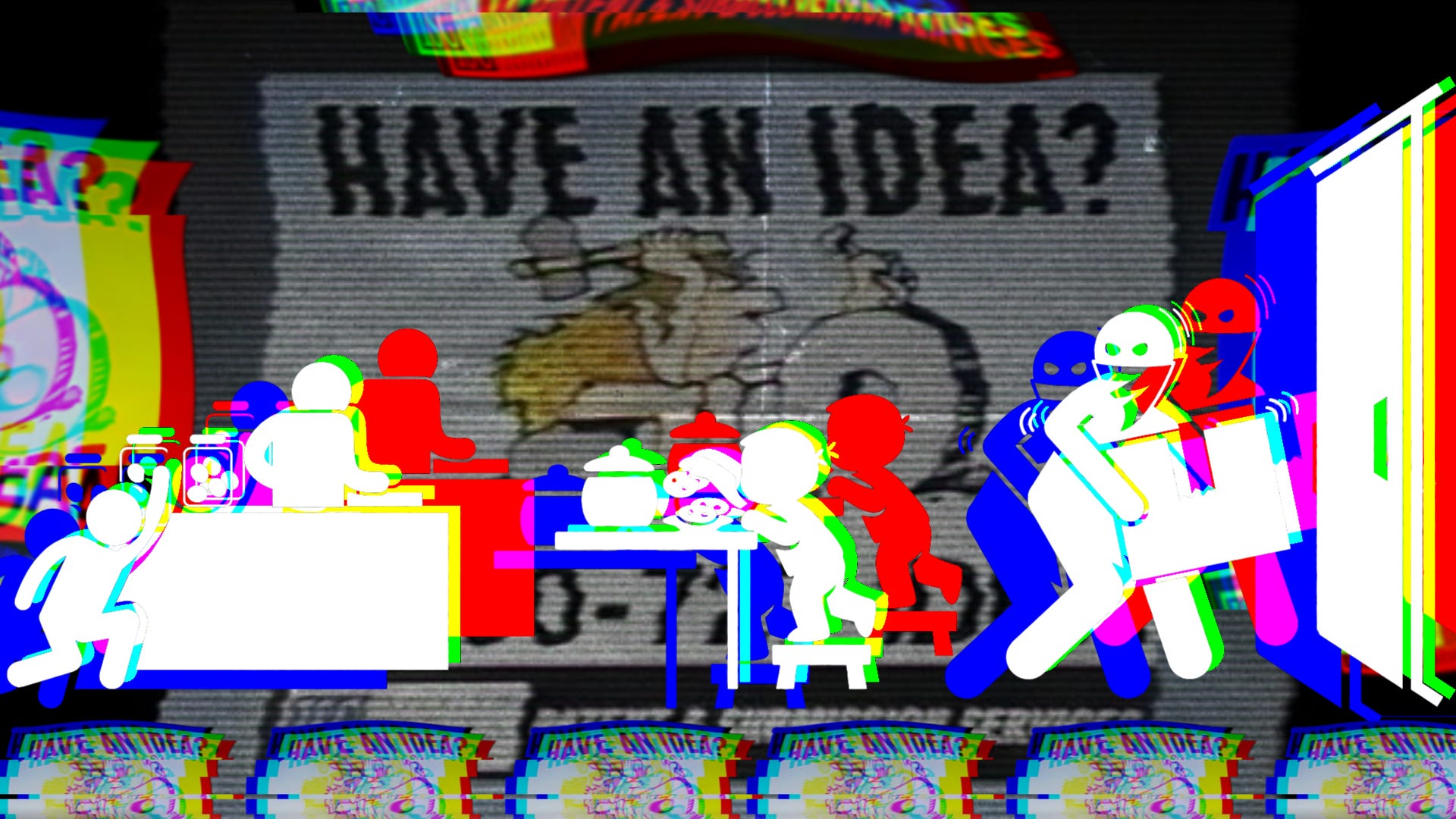
When I was growing up, watching TV that had 4 channels, I sat through a lot of daytime commercials, things for technical colleges, trucking, modeling, art schools, and registering patents.

As a young child watching the adult world as advertised, I remember being keen on the art school and patent commercials. If you could draw well, you might have a future path. If you can invent things, or come up with ideas, you might have a shot in the adult world.

Being inventive with artistic flourish, might be a yellow-brick road to adulthood.

My takeaway was: ideas were valuable to grown ups.

Flash forward to my professional incarnation as an award-winning creative marketer, Grammy-nominated musician/composer, cartoonist, and audio illustrator, it’s safe to say I decided from an early age that applied creativity was a strong bet for a career, and I went all in.

But new technology like GenAI has dramatically damaged the valuation and perception of ‘creativity’ and disrupted the weights and models of the traditional Idea-to-Artistic Execution pipeline.

Not only has AI devastated the job opportunities for the creative class, (the word used in this headline is “eviscerated”) but the technology is decimating creativity itself; the capacity to generate new ideas that don’t seem to fit, the will to stand by ideas that stand out, resilience to craft ideas that are uniquely our own.

The Risk of Having a Point of View

In an era where creativity is fast-ordered & cheaply available, terms and service agreements are skipped over, responsibility is diffuse, production costs and risks of detection are low, AI not only hampers creative muscle building and increases the amount of risque thieving, but this tool-based-service decreases our appetite for actual risk.

Risks that every professional creative, innovative thinker, or stand out brand (the types that others emulate and steal from) already know.

Creativity is risky, art is risky, performance is risky because these things come packed to the gills with perspective and experience and stance, as in you have to take one.

When we outsource the effort to create work, and use technology to rip off other people, we outsource the risk of having a point of view. Period.

But that doesn’t stop the thieving…

Creative Theft and the Limits of Public Shaming

Take this instance of GenAI enabled theft, where Stil Sunscreen had their advertising art and copy robo-jacked by a direct competitor, Body Blendz.

The owner of Stil Sunscreen is featured in the main image on the left, as are all the examples of the original asset, paired with the pirated content to the right. The origin of the fraudulent version is clear, as are the AI enhancements.

What’s clear in reviewing the massive amount of comments under the post, offering support to Stil and deriding the offending brand, is that claims of laziness and shamelessness are at the top of the word cloud.

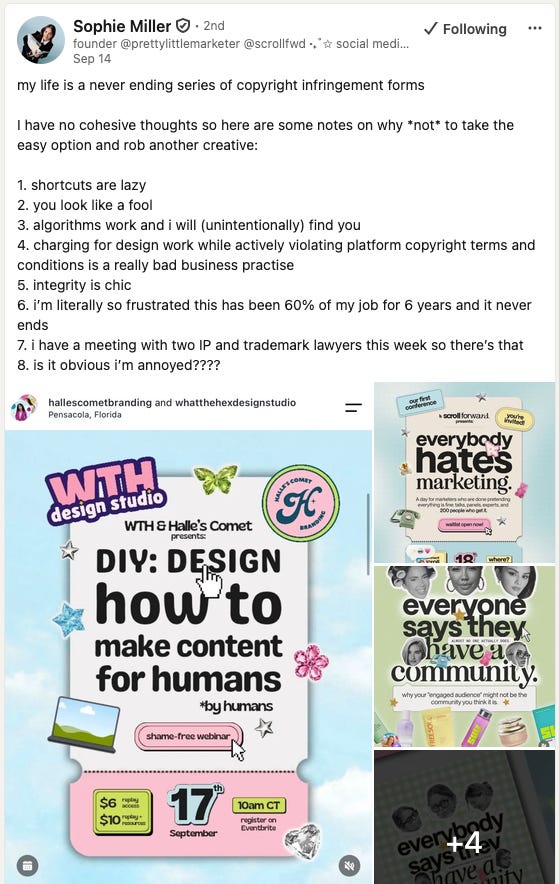
The same can be said for this other instance of tech-enabled theft, where the consulting firm Pretty Little Marketer has been having to fend off copy-cats for YEARS…

It’s important to note the positive and supportive response from the marketing community at large; we love work that is inspired by reference material, has a little wink and nod at things, but we reject straight up stealing ideas.

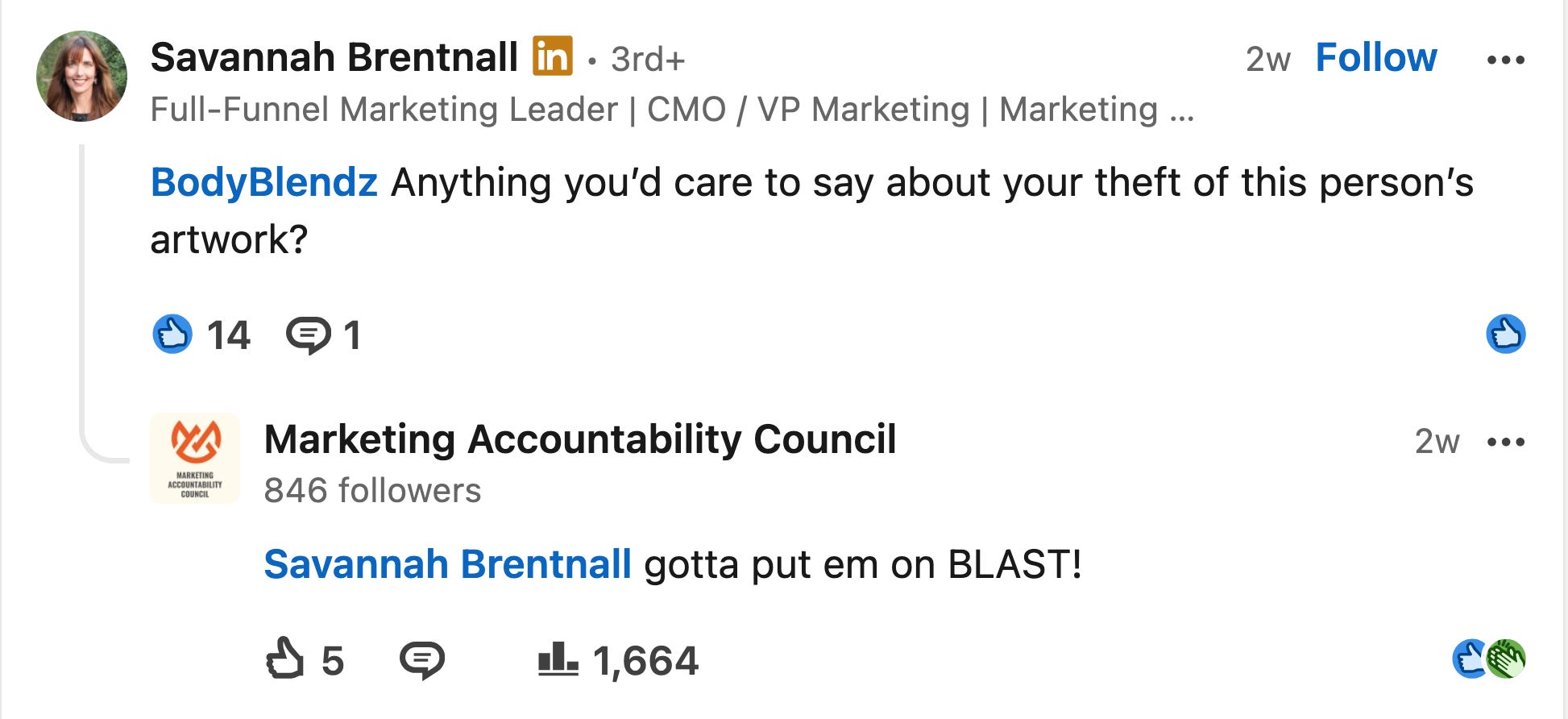
We’ll even call you out…

But I noticed something missing in the responses. The fact that we ratioed these thieves, showed care for the original creators, and shamed the offenders is almost proof that this kind of response doesn’t work. Sophie Miller, founder of Pretty Little Marketer said she’s been fighting this for the entirety of her career.

The crime continues.

Blame and shame on social media is not going to solve it. And maybe that’s because we’re booing the wrong player on the stage.

It’s too easy to steal everything now, so it’s too easy to blame thieving on the traditional ends-vs-means calculations of criminals; laziness, shameless greed, desire.

Maybe theft is so rampant now, not just because AI makes it possible, but because something deeper and more ingrained has been allowed to surface; cowardice.

One of the motivating forces for large scale theft, particularly through GenAI, is individual & institutional cowardice, disguised as creative (read: cost-cutting) efficiency.

Cowardice Is Gas to The Engine of Theft

Here’s an Uncomfortable Sentence for marketers and advertising pros, but mostly brands and the business brains behind them – “I would rather produce something derivative that gets approved than something distinctive for which I might be held responsible.”

Does that feel true? I think so, and I’m Mr. Creativity himself! It’s a big leap from derivative to theft, but again, I’m questioning the compelling reasons to not give a flying fuck and steal some shit.

The incentives for creative theft can look attractive. The work is already validated, internal approvals will be easier, since “everyone is doing it” the risk of getting caught are low, and it doesn’t seem to phase the brands who do get called out.

When marketers steal creative ideas, it isn’t just the look and feel that’s been appropriated.

What fraudulent marketers really steal is someone else’s creative risk.

A distinctive brand requires someone willing to be accountable for a choice before the market has validated it. A pirated brand doesn’t have to sweatily walk that plank. There’s no effort.

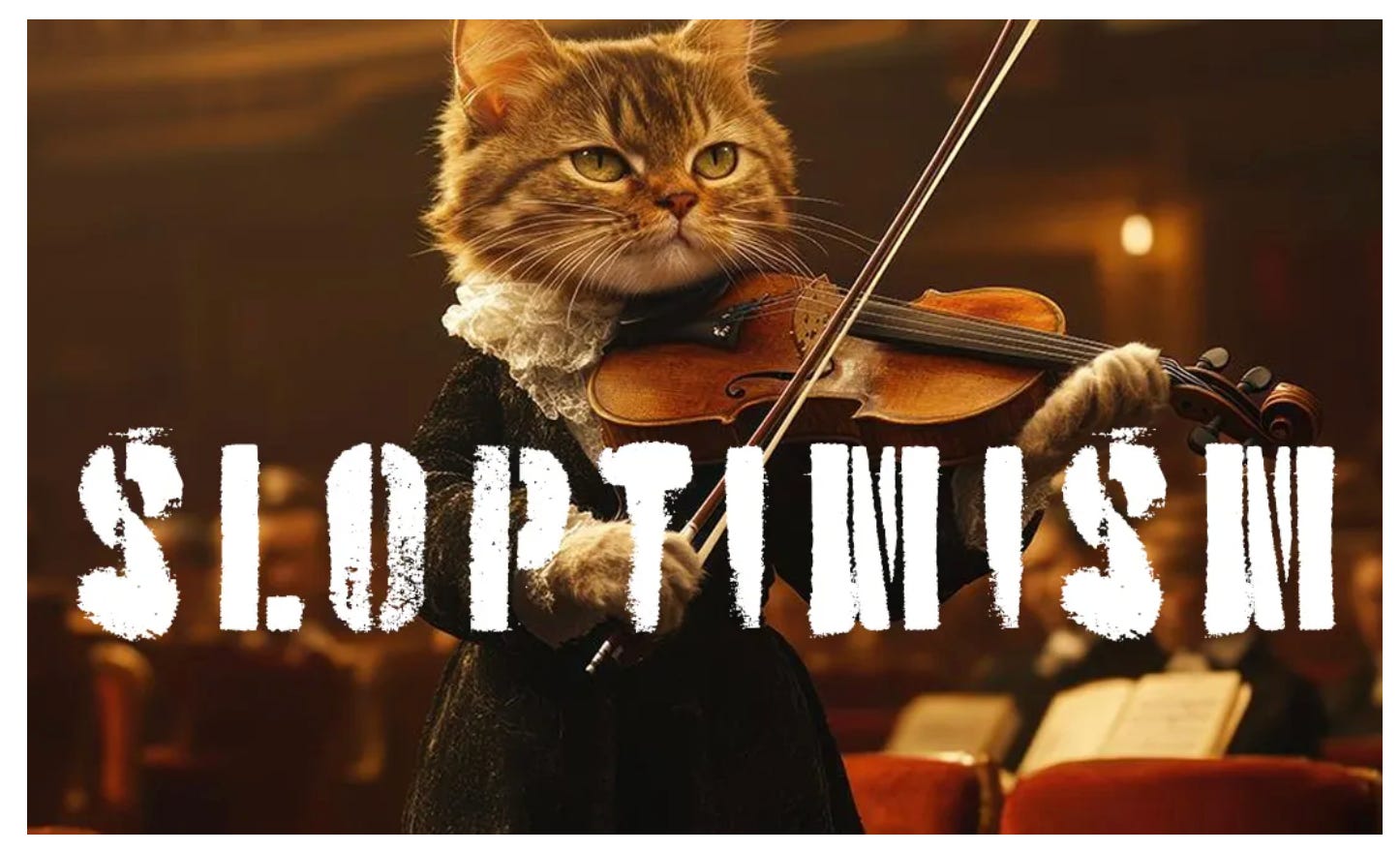
In his latest book “This is Pop; What the Shit Is, and What Isn’t the Shit,” advertising’s punk anthropologist Eaon Pritchard talks about the clash between technology, cultural products, and society. His Substack is similarly focused, and this bit from a recent essay, “Sloptimism” lands right on the target of this one;

“Effortlessness disqualifies something when effortlessness is the point, when the entire cultural act consists in demonstrating that the machine can produce an object without any of the friction that used to make cultural production a form of human risk.

The tech bro who declares his AI image to be Art is not wrong because the image is ugly. He is wrong because the image is safe. And art, even in its most poptimist-friendly forms, has never been totally safe.

Britney Spears making Toxic needed timing, precision, physical discipline, studio craft, and a kind of performative bravery that can’t be generated by a prompt. The AI image of Britney as a Renaissance painting requires none of that.”

Frictionless risk has always been a problem in creative pursuits, and so the most important task in the modern era for marketers isn’t to focus on idea generation, but generating the conditions where ideas can flourish, tending the land, managing the estate.

What’s required is a thirst for friction and sense of stewardship for funky ideas.

Someone Has to Stand Behind the Idea

In a brilliant essay, creative consultant Jane Goldman writes about how good ideas go to die in the frozen middle; that place where a possibly out-there idea needs care and support.

“Good ideas do not need unanimous agreement. They need enough courage, structure, and stewardship to survive the part of the organization where everything gets complicated.”

The creative friction required when/where we sell ideas, is the same friction that gets sanded down by consensus. In a group approval everyone gets a veto and no one defends a choice because no one holds accountability because the buck stops everywhere.

If we ask marketers to take creative risks, but leave them to absorb all the blame when an idea fails, we make borrowed certainty an attractive proposition.

Stealing remains a choice, but the more we feel institutionally pressured to be perfect and the less we’re inclined to deal with friction, creative theft will continue to feel like the least riskiest default option.

Anyone that wants more original work has a responsibility to help ideas survive: give people room to develop them, take risks, defend choices worth keeping, and share responsibility for the outcomes.

Steel Yourself Before You Steal Someone Else’s Courage

I grew up believing ideas were valuable to grown ups, and I still believe that, but I now see the stakes a lot clearer.

Ideas are aplenty, but courage is rare.

Valuing ideas, means that you’re willing to stand behind creativity before you know whether it will work. And not a lot of people are willing to do that. But the ones who do, are the ones everyone emulates, the creatives that catalyze culture.

Someone has to keep taking those risks, and if culture eats strategy for breakfast, then someone definitely will. Will it be you, risking it all on an original idea, or will it be your copy-paste team, taking the risk of being caught stealing someone else’s risk?

It’s all risky business, but we can make a difference. Will we lazily accept a culture that steals spotlights, or one that earns electricity and builds lightbulbs.

Will we continue to participate in a thieving culture, or will we try to find honorable work?

Do you want to be dope, or do you want to deal it?

I Heard It Through The Fakevine

“People say, “Believe half of what you see
Son, and none of what you hear”

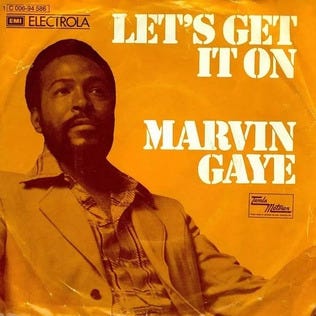
– “I Heard It Through The Grapevine” – Marvin Gaye, 1969

From Marvin To Modems

When I was growing up, I had an obsession with Marvin Gaye. I was captivated by his music and voice, the grooves, the Marvin-only overdub harmonies. The first song that brought Marvin into my world was his 1969 smash hit, “I Heard It Through The Grapevine.”

From the very first sizzling slap of the tambourine and the alluring intro vamp of the keys, to the french horn swell shoving us into the verse, the song threw me into a narrative universe and held me tight in a master storyteller’s tractor beam.

However, the iconic groove wasn’t the most captivating part; I remember really freaking out about this ‘grapevine’ thing.

If the grapevine wrecked this guy’s world, it seemed devastating and urgent to me to figure it out.

How did people know things about other people? How does that knowledge become reality?

Was there some kind of information network that can tell you what’s true before someone else knows about it? Is it gossip, is it rumor, is it actually (hopefully) grape flavored?

I remember thinking, if the grapevine is real – how the hell does it work!?

Just a few years after being introduced to “the grapevine,” we got online, and our home computer, and Prodigy, became the center of attention.

This was well before socialized internet and iMessaging. Prodigy was not for socializing yet but for…something, at that point we hadn’t quite cracked the purpose.

As ubiquitous internet continued its rise in the 90s, there was one grapevine-flavored caveat that kept popping up – “don’t believe everything you see online” – which was now paired with another principle of technocratic faith, “this is the future.”

Don’t believe everything you see online + Online is the future

And indeed it was the future. Almost three decades later I’m interminably online and working in digital marketing (a role not possible without computers), so its safe to say the once and former, well rumored, and not to be believed future of the internet is here.

And yet, I’m wondering about the online future you can’t believe, especially if you read about it online.

I’m still wondering about the online grapevines, which haven’t gone away but have grown larger, and more tangled, and more complicated.

I’m wondering how much of the vine has actual grapes?

From Being Online to Betting On It All

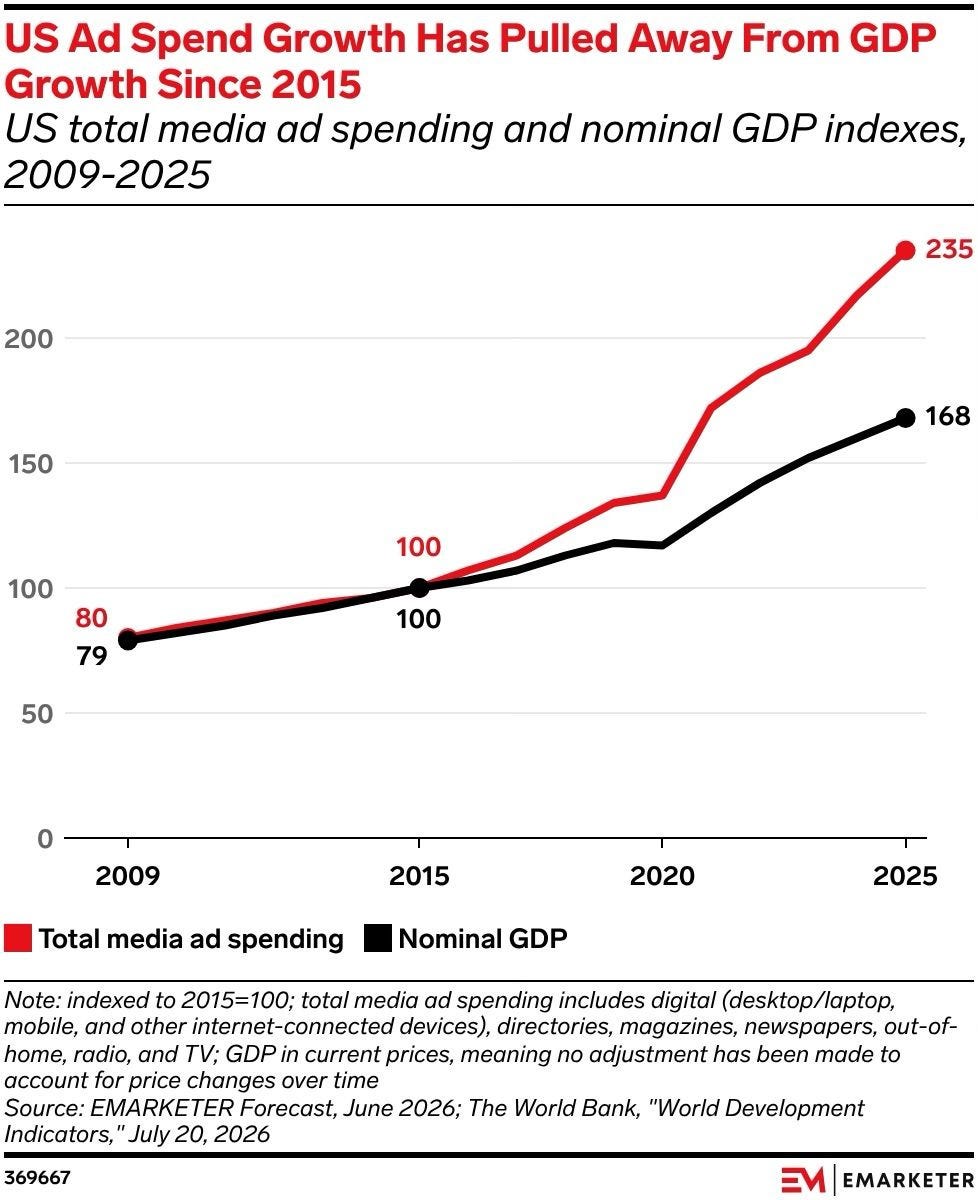
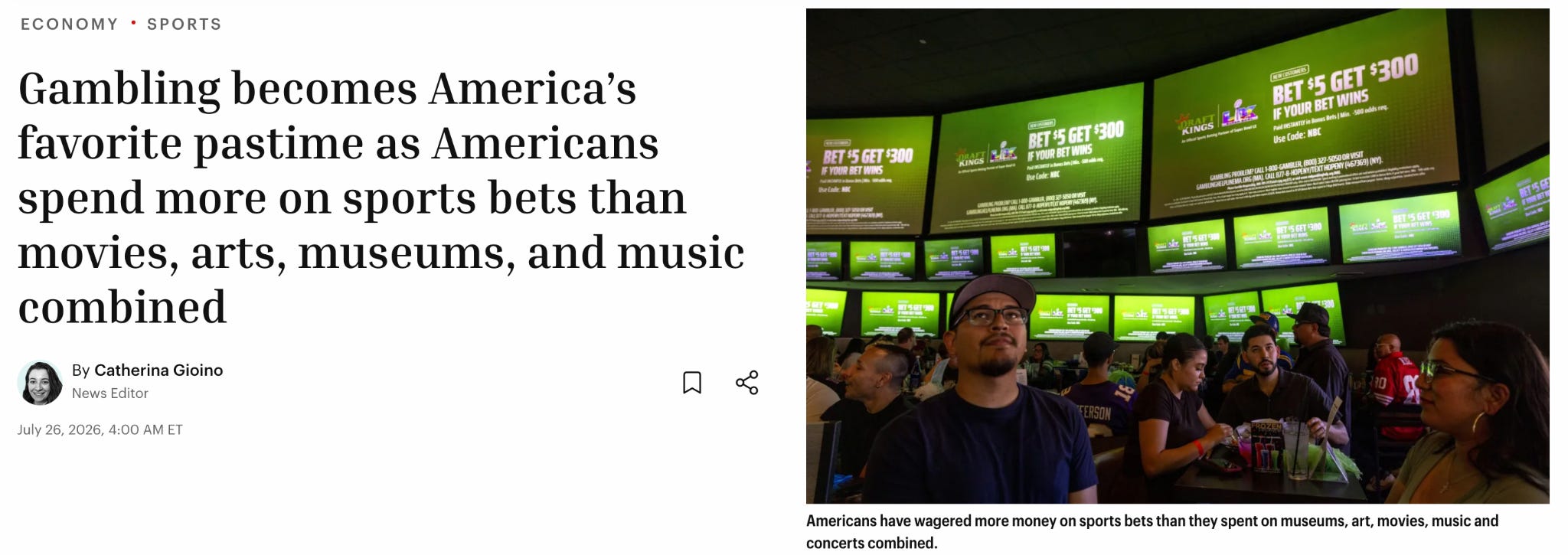
After I read that ad spend in the US is 2x GDP and media spend wildly diverges from time spent on certain advertising mediums, and learned how Americans are spending more time gambling than going to movies, music, art, or museums combined, I had to take a pause, drink my juice box, and collect my thoughts.

My initial take on the GDP chart seems simple but I think profound, “ad spending is growing faster than the economy.” Which is exciting and defended by people in marketing who make and spend that cash, but the prospect should cause some concern; we’re advertising goods & services past the point where the wealth/finances available in the marketplace can meet the obligation. Period.

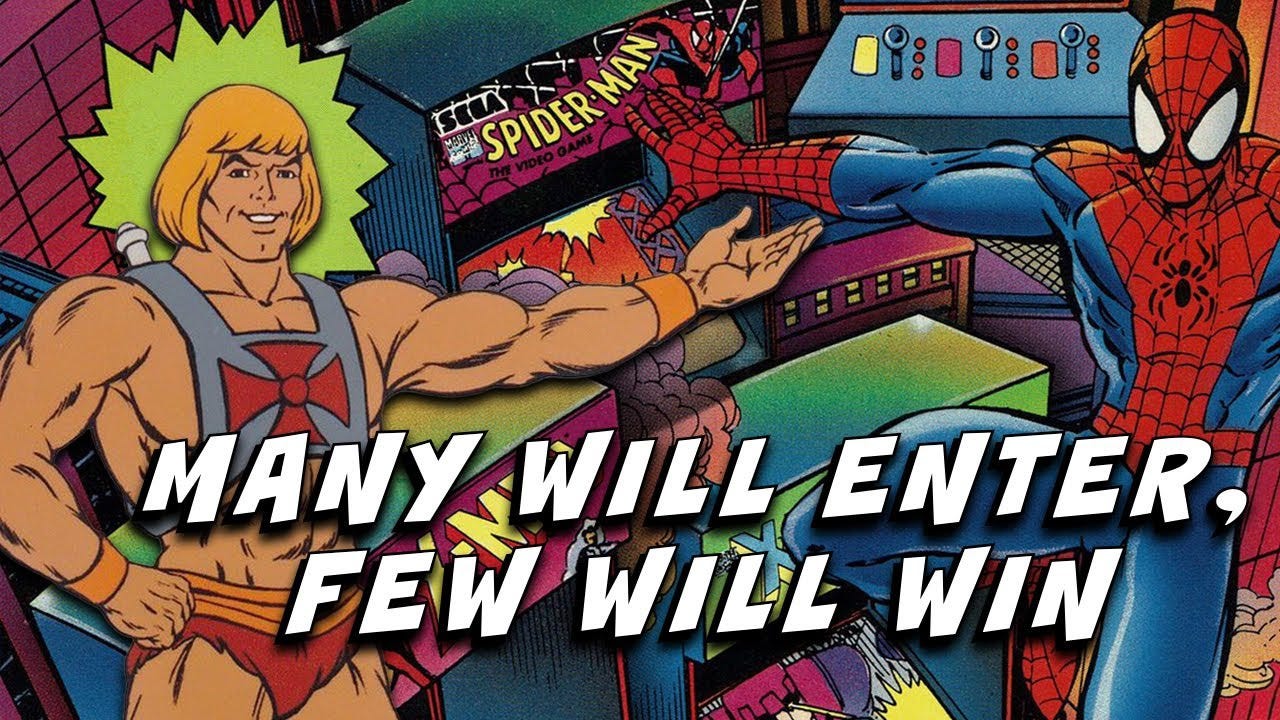
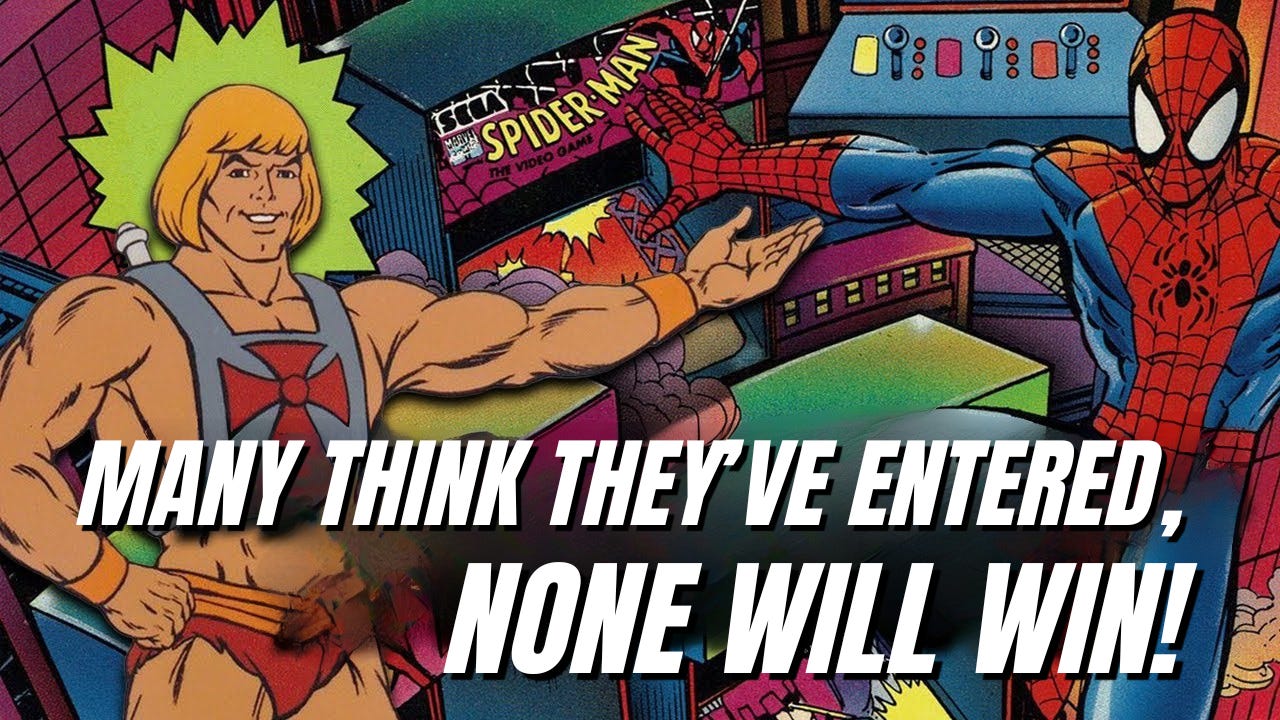
Reminds me of all the sweepstakes and contests in the 80s & 90s, where you would hear the legally required phrase – “many will enter, few will win”

If the supply can’t meet the demand, are we at least advertising to the best of our data-driven abilities? Well, let’s review the next chart…

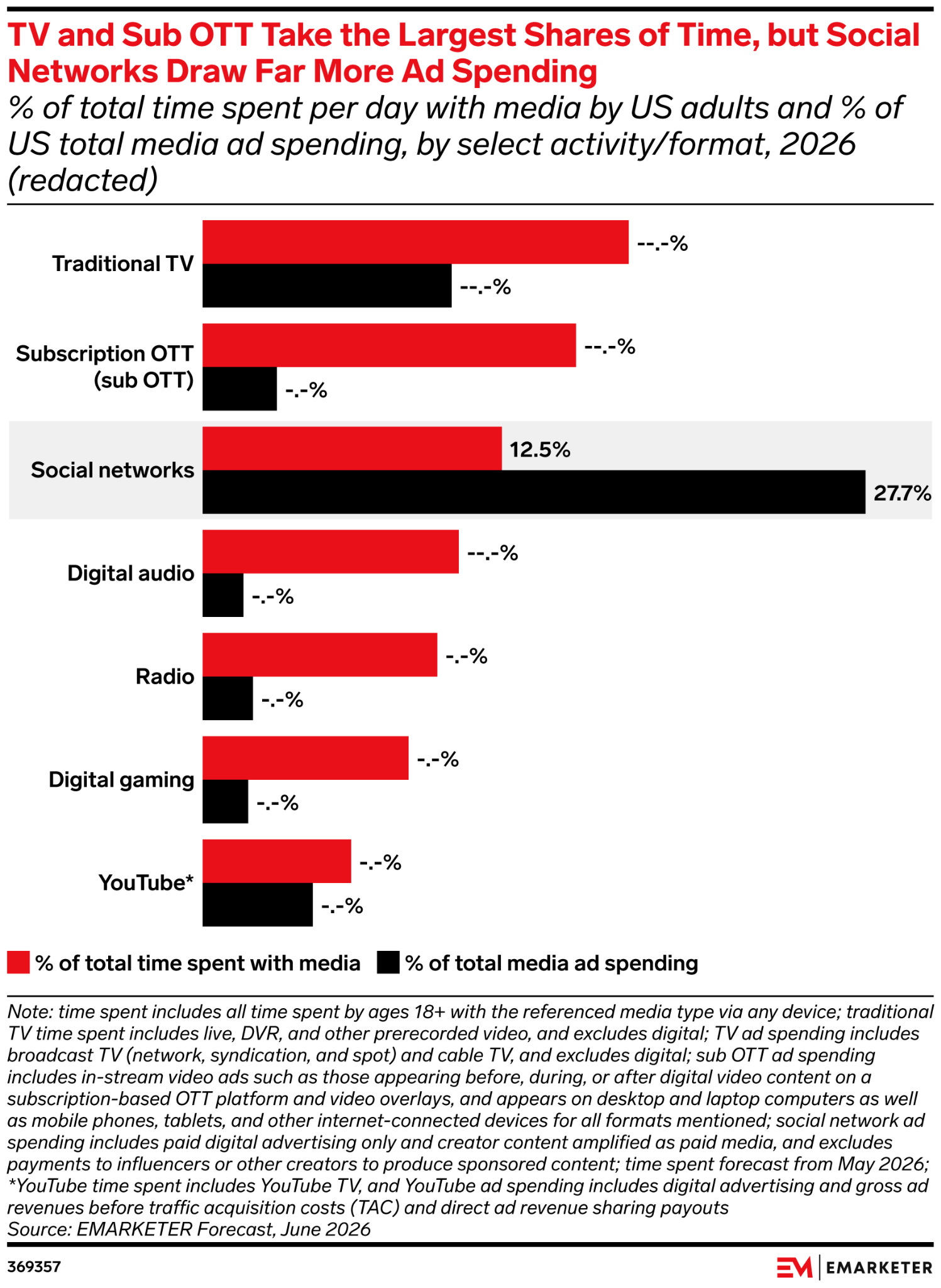
The evidence from eMarketer here shows that ad budgets are not even closely aligned with the mediums where people are spending time, with a massive, data-ignorant overinvestment into social media.

Taking these two charts into consideration, it’s evident that more money is going into advertising than will EVER come out, and a lot of that ad money is being misused and backing bad odds and the wrong horses, entirely.

Which connects to the “gambling is the new American pastime” article. If we’re spending more money on gambling than culture itself, then we’re pretty firmly in a gambling culture, which means gambling is a part of business culture.

Now I don’t mean to complain about the free drinks and good parking, but does it bother anyone else that markets seem to operate like casinos, and that most of the action seems to be extracted from statistically ignorant gamblers, eg. me & you & everyone?

Maybe I’m wrong. Maybe it’s easier to place bets instead of making hard choices or dealing with bad luck? Maybe we want to take it all to a casino?

Maybe our desire to feel like we’re the rare few who might win, cognitively prevents us from realizing we’re almost always going to be just one of the many who entered?

Or maybe I’m just a loser who hates winners and I’ve got a tiny axe to grind?

Could be, but if you’ve done the research I have, or just click through and read all these citations coming at you, I seriously doubt that take holds…

From Playing The Game to Gaming The System

I’ve written about how digital advertising is a casino pretending to be a supermarket, I’ve compared horseracing metaphors to marketing, detailed how fraud has become the foundation for digital marketing, talked about malicious compliance and ethical drift, and provided insight into behavioral finance, AI, and the casino logic of modern technology—where engagement is currency, risk is retail, and guess what…the house always wins.

But increasingly, a growing stack of settlements, cases, and legal records is starting to look like a volcanic mountain of supporting evidence for serious losses amidst the house’s take.

Google has been found to have illegally monopolized key parts of the ad-tech auction system; Meta has faced litigation and paid $40m in settlements over inflated (+80%) reach and video metrics; LinkedIn settled claims ($6.6m) over inaccurate advertising metrics; Lane’s Gifts exposed click fraud and secured a $90m settlement from Google; Uber’s litigation exposed fraudulent attribution; and most recently Phia, co-founded by Bill Gates’s daughter Phoebe Gates, has faced allegations of cookie stuffing—claiming credit for sales it didn’t generate.

The gambling logic extends beyond advertising into behavioral engineering: a 2026 jury found Meta negligent over addictive product design that harmed a young user, while 29 states are pursuing $200b in damages from Meta over already proven allegations that it deliberately engineered Facebook and Instagram to addict children.

A bunch of different cases, same gambly pattern & odds-based architecture: the house controls the market, establishes an unrealizable floor and an infinite ceiling, measures the outcomes, claims the wins and pays off losses, intentionally designs the machine to keep players playing, and before anyone finds out the deck is stacked (and even after settling in court), the house has already taken its cut.

And the casino parking lots remain full of agencies, brands, and sure, scam artists, but it’s all good when information/data/news of “big winners” is constantly flowing through the gaming floor.

Back in December, I asked this question, “What would it take to convince any fence sitters, that the majority of the digital advertising eco-system operates behind a casino-like veil where advertisers see flashing dashboards while criminals and platforms quietly harvest the proceeds?

What could be said to get us to snap out of the fever-dream fantasy that we’re in a rational marketplace, when the reality is we’re gambling CLIENT MONEY at tables where the house dictates the real winners, the metrics and cards we’re dealt are fuzzy, and more than half the other players aren’t even human?

And I think I’m closer to an answer, or at least better questions.

The problem isn’t necessarily the casino or the gamblers, but where we source our conception of the stakes and odds, the information layer underneath it all.

It’s the grapevines, stupid.

From The Grapevine to The Fakevine

The grapevine is another term for the rumor mill. Through gossip, chatter, and hearsay, information gets passed from one source to another and after a while there is a general, consensus based truth-like juice that socially drips from the network.

So the gambler’s paradox of the grapevine is that it is not to be trusted, but there is truth to it.

Many data points have gone in, but only a few bits of information ever make it out.

The real manipulative art of the grapevine doesn’t really concern the grapes or vines but manufacturing the appearance of grapevines. Which kinda describes the internet.

Don’t believe everything you see on the internet + The internet is the future

As I was working up this essay, I saw two additional headlines that secure this gambling grapevine connection with the ad industry stories above;

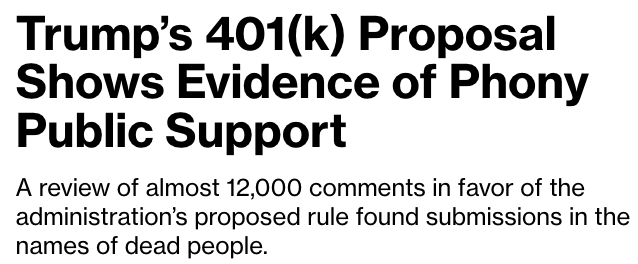
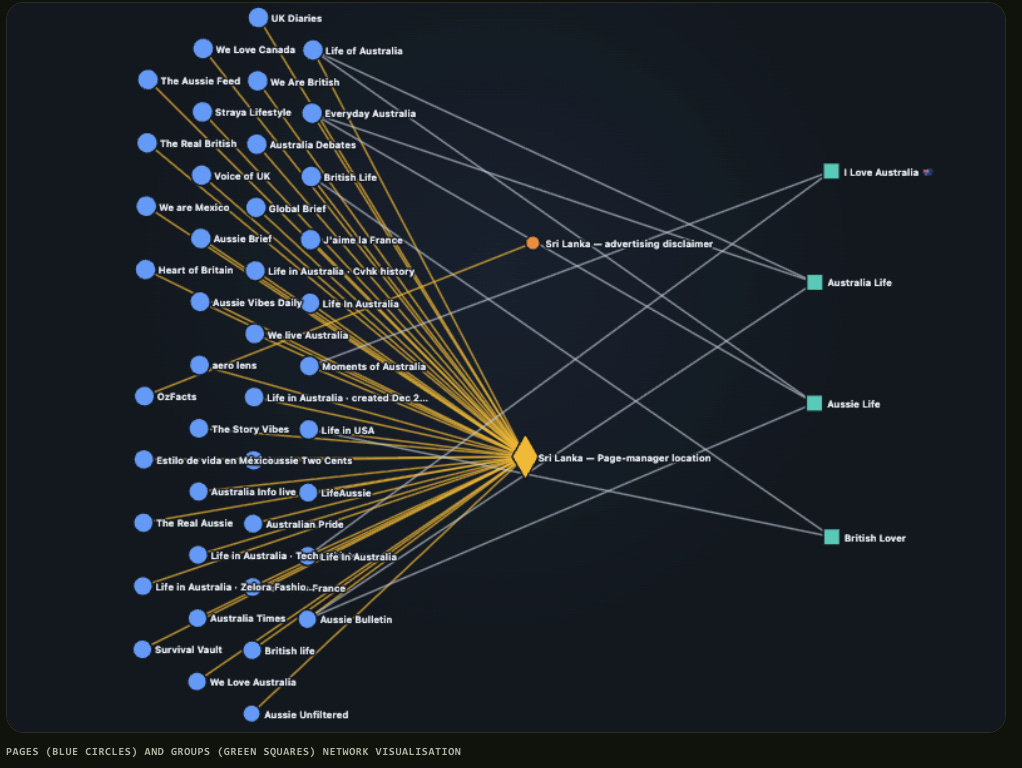
Trump admin faking social support for their policies (even using dead Americans), and the journalistic exposure of a social media network of +800k local political Facebook groups in the UK, US, and Aus taking millions in ad revenue, all deeply involved in divisive politics and…operated out of Sri Lanka.

I won’t go into the Cambridge Analytica scandal, that Ad fraud is on track to make somewhere between $50-140billion this year, potentially peaking to $172b in 2028, and is the second highest source of criminal income after drug trafficking, the Dead Internet Theory, the wallets on Polymarket International trading on inside U.S. military information, the rampant digital ad impression fraud, Meta consistently lying about DAU/MAU numbers that overblow stats past census data since 2012, or the many, many, many lawsuits for inflated user bases and astorturfed reviews.

The only reason I’d do that, is to point out that all of these increasing concerns are not about exceptions taking place, but proof that intangible rules are being adhered to.

One of those rules is – control the narrative. Manage the grapevine, or grow it.

From Grapes to Grape Flavored

Grapevine perception management has seemingly become one of the most important “skills” to control in marketing of all ilks. The ability to fake it, is now rewarded in the marketplace as having made it. Manipulating the grapevine is so essential to modern digital marketing success and has become so frothy, that it’s even caught the attention of the Feds.

The FTC has effectively recognized the grapevine problem in regulation. Its Consumer Reviews and Testimonials Rule, effective October 2024, makes it unlawful to buy or sell fake reviews and, critically, to buy or sell fake indicators of social-media influence—such as followers, views, likes, subscribers, shares, or other engagement generated by bots or accounts that do not represent real individuals—when used to misrepresent commercial influence.

We’ve built an economy willing to pay for the appearance of human activity (which is against the law), whether or not there are actual humans (which is fraud, also illegal), or actual value (which isn’t economically viable), underneath it (we can’t check under any algorithmic hood).

Once evidence of human activity becomes the thing we reward, people discover ways of producing the evidence without producing the underlying reality.

An impression worth money creates an incentive for fake impressions. A follower worth money creates an incentive for fake followers. A stream worth money creates an incentive for fake streams. A comment worth political influence creates an incentive for fake comments.

In a very real way, all of this is built off grapevines, off hearsay, off “doing the research.” Online sleuthing (like I’ve done right here) allows us an easy way into the vines, but not a clear path out.

In a shameful admission, I think what I’ve provided here could be perceived as MORE GRAPEVINES.

Which makes me think, maybe the grapevines aren’t “out there” but we live amongst them and create them from our own soil. There isn’t one grapevine but many, and some are 100% fake, most are definitely imagined, but they have real value and leave tangible effects.

The dead internet theory means there’s a grapevine strangling online society. We know there’s a grapevine of adfraud. We pay to access the supposed grapevine of influencers. We wager money on the grapevines of Polymarket or Kalshi. There’s a grapevine of financial information and economic theory that underpins our markets.

And if the grapevine is a commodity-based business model, that means we need more grapes plucked earlier, so there can be no institutional, vintage, legacy vines anymore for the public but only for the very private few, which is too many sour grapes to consider at once. [Read Eaon Pritchard’s “Chairman of The Bored” for a dive into this concept]

Layers of vines, tangles of grapes, barrels of hooch, orchards of horsehit.

There’s no grapevines kids; it’s a vineyard, and we’re here to work whatever into wine.

So get to stomping!

From The Gift Horse’s Mouth to Confronting Sour Grapes

Back to Marvin.

The ultimate point of “I Heard It Through The Grapevine” is not an expose on the rumor mill, like I thought in my 8-year old mind, but the unmet desire for confirmation of reality from a singular, trusted source.

People say believe half of what you see
Son, and none of what you hear
But I can’t help being confused
If it’s true, please tell me, dear

[Pre-Chorus]

Do you plan to let me go?
For the other guy you loved before?

Marvin is trying to verify reality, he’s not aiming to mistake the grapevine for reality, but without confirmation, without hearing it from the horse’s mouth as it were, instead he hears it through the grapevine.

The real missing piece in the grapevine dumpster fire is confrontation. And the accelerant is both the avoidance of looking in a gift horse’s mouth, and the acceptance of the sour grapes it’s chewing on.

People who accept that we live in a post-truth multiverse, where each person is a captain of their own reality, have given themselves up to the soured grapevine.

And if you really grokked everything I shared above, it’s easy to see why.

But we’re not done just yet…

From Helpless to Hopeful

I’m writing about this stuff because it’s something marketers actually can fix, and we don’t need a huge revolution to do it. What we need is a spirit for conflict & confrontation.

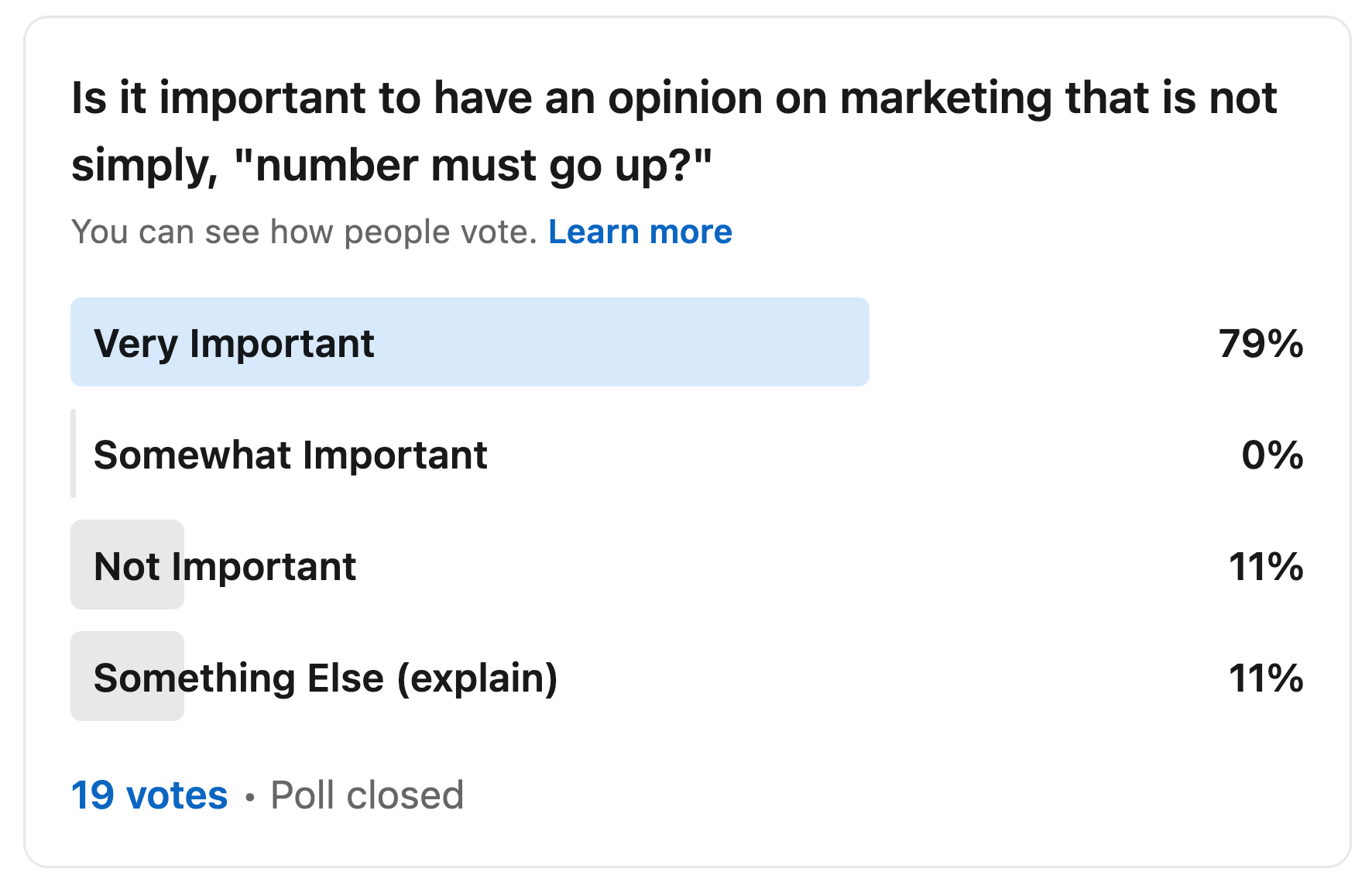
Not confrontation or conflict in a combative sense, but in the spirit of sensemaking: turning toward something and facing it. Asking the person. Rubbing up against reality. Checking the source. Looking under the hood. Questioning the KPI or metric. Having someone explain how they know what they say they know. Checking to see if you know what you say you know. Being open to being wrong. Being curious about what’s true. Developing an opinion on marketing that isn’t “make the number go up.”

A MAC poll on LinkedIn

In short, the on-going mission is confronting the grapevines.

With confrontation comes the soft-skilled friction between information and opinions, and with that accountability, and then individuals have the confidence to speak up before things get twisted into grape jelly, and then culture gets a hold of information, then knowledge, then wisdom.

So what does this look like in practice? Here are seven things you can do right now:

Measure the gap.

The Marketing Accountability Council built TrustGap to help people examine the distance between what companies say and what the evidence supports. That basic exercise can be applied almost anywhere in marketing: put the claim on one side, the available evidence on the other, and look directly at the space between them.

Trace metrics back to something real.

When a dashboard says performance improved (or didn’t), keep asking questions. What improved? According to whom? Based on what measurement? Did customers buy more, stay longer, recommend you, remember you, or behave differently? The closer you can get to an observable outcome or a real meaty question, the fewer vines you have to swing through.

Triangulate instead of accumulate.

Ten sources repeating the same claim might not be an insight. Find genuinely independent ways of parsing signal from noise and weave them together: quantitative and qualitative research, customer conversations and behavioral data, platform metrics and financial outcomes. More information doesn’t necessarily provide more confirmation.

Follow the incentive.

Ask who benefits from the metric, methodology or conclusion being true. Should the platform selling impressions be the authority on whether those impressions worked? Is there a hidden incentive in one department that isn’t known but guides attribution decisions? If the attribution model hasn’t changed in years, don’t follow it, but ask why?

Humans are the loop.

Talk to customers on the phone. Talk to sales. Talk to the people doing the work. Look at complaints. Read the weird comments. Ask somebody what happened before asking a machine to summarize what happened. Ask someone to review what a machine summarized. The messiness of human testimony isn’t a flaw, but the required friction that reveals what clean datasets can conceal.

Write down what you don’t know.

A healthy marketing organization should be able to distinguish we know, we think, the data suggests, and we have no f***ing idea. Those are four very different states of knowledge, and pretending otherwise is how another grapevine gets planted.

Stop the blame and shame.

The grapevine distorts accountability as well as information. Blame and shame collect wherever marketers and businesses cling to the illusion of control, treating probabilistic systems as predictable and then holding people responsible when reality fails to match what the grapevine promised. The work gets better when the blame-and-shame train stops and grounded sensemaking replaces senseless flagellation.

None of these suggestions require us burning down digital marketing, abandoning data, smashing the dashboards, or waiting for regulators to save the day. This advice requires something considerably less dramatic but more taxing – refusing to outsource judgment.

The internet will remain a grapevine, marketing too, and AI is already growing some spectacular new vines of its own.

Our job isn’t to tend to the vineyards.

Our task is to hone the ability to realize when we’re strangled and tangled, find out where the vine meets the wine, separate the squeeze from the juice, the proof from the truth, and have the spine to admit when we’re backing into a reality of rumors, and the temerity to push through and confront reality.

Revisiting Pinocchio: Nation-Building and Modern Freedom

A socio-political analysis of Pinocchio as a myth of nation-building and disciplined citizenship, contrasted with a modern inversion of that arc, where cutting attachments promises freedom for society but risks producing self-instrumentalized, unmoored puppets.

We focus on the myth of Pinocchio, how his nose grows when he lies and how he became a real boy, but I was thinking the other day, what kind of society created this story?

The author, Carlo Collodi (1826–1890), was born into the servant class. He wrote this myth in 1880, in the middle of the industrialization of Italy, and 20 years after the country was unified after hundreds of years of war. He volunteered in the wars of independence in ’48 and ’60. He was passionately political and active early in his career, writing scathing satire, some of which was banned by the Grand Duke of Tuscany. 

When the democratic Italy he fought for turned out to be a sham, he became disenchanted with political satire and switched to writing children’s literature, using the medium to express his convictions.

Collodi believed in and fought for a unified Italy that would produce a moral renewal, dignified citizens, elevated people. By the time he begins to write Pinocchio in 1880, this dream is frayed and in tatters.

A newly “united” nation finds itself in political turmoil because a monarchy, mixed with the papacy, has replaced the idealized democracy they fought for, subverting the national identity of a populace facing the beginning edge of an industrial revolution with technology no one has seen before. A citizenry unprepared for the transition to an entirely new way of life, one hastily jerry-rigged to industry.

Seventy percent of the rural population is illiterate, taxes are heavy, and poverty is the baseline. If you weren’t working in a factory, or one of the 300,000 that would emigrate during this time, you farmed for subsistence. 

Those that embraced the new way of industrial life had less security. As Italian microhistorian Franco Ramella noted about this time, the rural population “were periodically pushed into precarity by the unstable nature of industrial products and their presence on the market.”

This is industrializing Italy. The modern laboring subjects were rural migrants and peasants, populations the newly formed state could not directly coerce into maturity and factory-readiness.

In the final 1883 version, “The Adventures of Pinocchio” after a series of engagements with many characters from the natural and supernatural world—and the seminal transformation into a donkey in the Land of Toys – Pinocchio becomes real when he internalizes his demands, brings his waywardness and freedom down, and aligns desire with productivity, obedience, and discipline.

Collodi’s characterizations in this myth could be seen as a warning to himself and his generation. It could be an admission from a disappointed liberal reformer: We failed to make a nation that naturally produces citizens.

Now we must manufacture them.


Through The Land of Toys

The Land of Toys, an important allegorical vehicle in the tale, is evidence of Collodi’s attempts to artfully address and emphasize certain aspects of the modernizing society back to itself through the story.

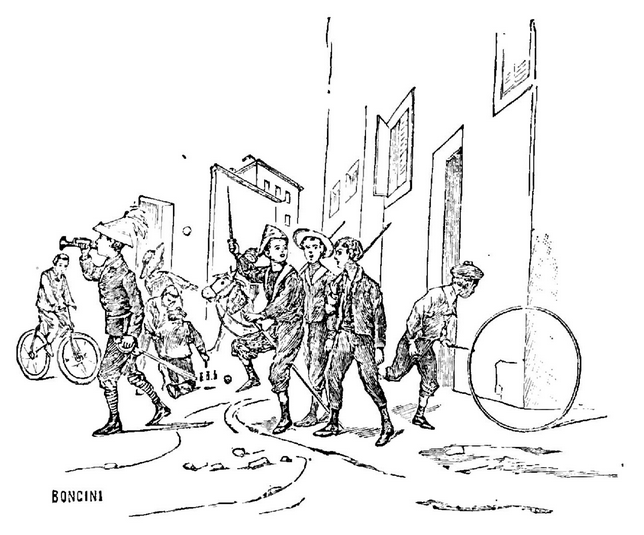
The Land of Toys, originally referred to as a land of Cocagne, later labeled Pleasure Island in the Disney adaptation, is a haven of freedom and anarchy for children who are promised a place where they never have to go to school or work, spending their whole time having fun. In Collodi’s original story it is a mysterious, almost legendary place not present on any maps, unlike in the Disney version where it is an actual location,

Collodi describes in detail how Pinocchio and his wayward companion Candlewick are lured to the Land of Toys by the Coachmen and what they find there.

Along with all the technological chaos and cutting edge pandemonium, there are big tent events advertising the freedoms on offer, canvas theaters crowded by children from morning to evening. The walls of some houses bear messages: “Long live playthings! We will have no more schools! Down with arithmetic!” 

Most sentiments are expressed through poor spelling.

Here’s a tighter synopsis from the Wiki to move us along….

A key detail of the transformation from boy to donkey, from humans into work animals—cited as one of the most shocking in all of children’s literature—is that the children who are fully transformed lose their ability to speak. The speechless donkeys still retain their human minds, able to understand commands, like to strip and get into crates to be sold to hapless farmers.

Another noteworthy aspect of the transition from boy to donkey is that in the Disney version, one can reverse the transformation by correcting bad behavior. In Collodi’s official version, transformation is automatic and irreversible, leading to great toil and pain.

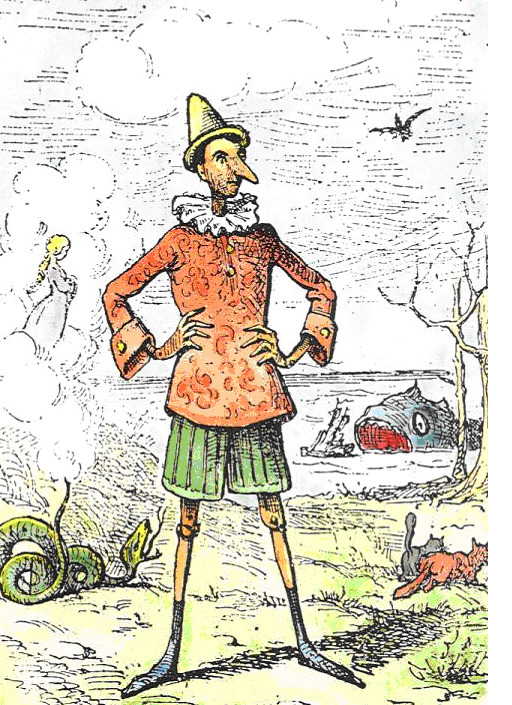
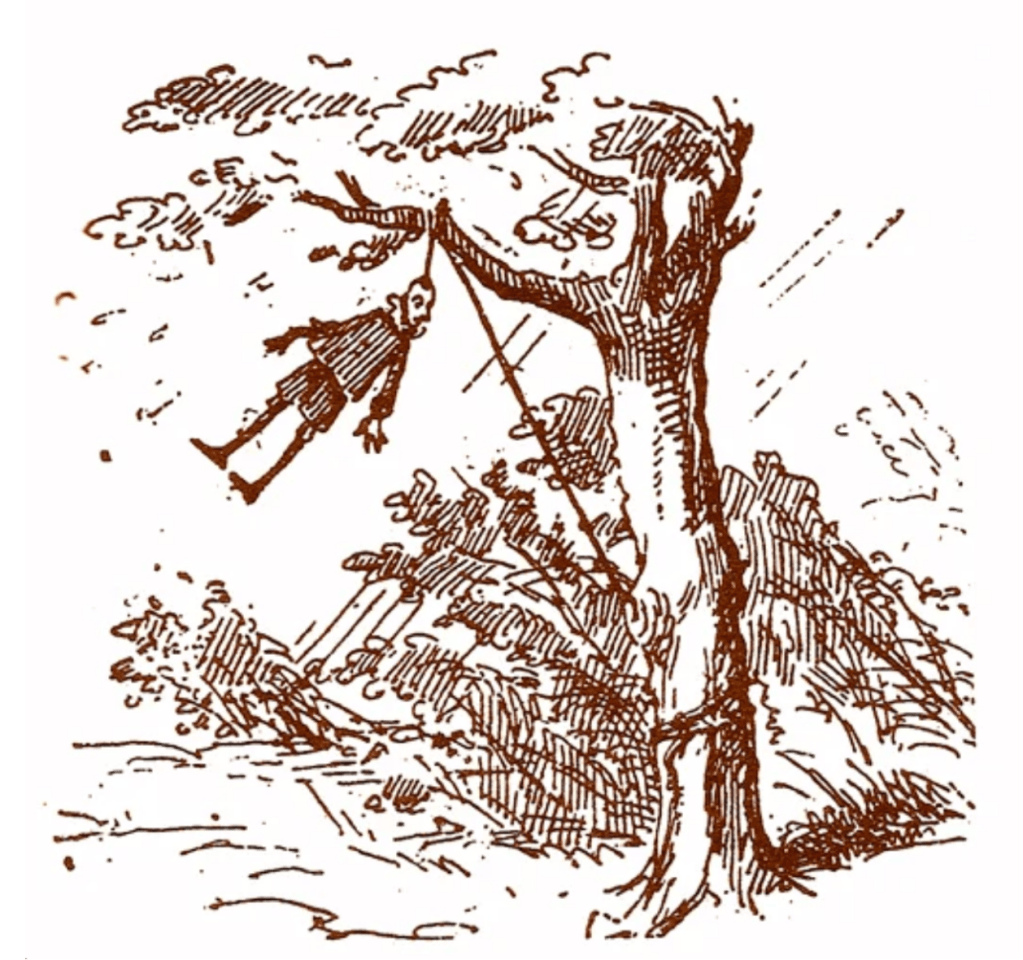
artwork from the 1883 version, where Pinocchio is hung up to die by the Fox and Cat.

The theme of the cycle of death and rebirth happens many times throughout the story, with Pinocchio encountering many animals that get killed and are reborn, the Blue Fairy is a ghost, kinda, and after transforming in the Land of Toys, Pinocchio stays a donkey for months and only turns back into a puppet when a fish tricks him into a pool and eats the disguise off, essentially killing the donkey version of him, re-emerging as a puppet again. 

Taking the socio-political lens of the era in which Collodi wrote this story, the transformative requirement to have the capacity to allegorically die and be reborn, and engage and maintain a harmonious relationship with nature, as opposed to technology and donkey work, hint at two additional morals for this tale that The Land of Toys makes visible.


Untangling The Modern Marionette

It’s been over 100 years since it’s release, and since it’s the third most translated story in the world, there must be a reason Pinocchio continues to unspool truths about our evolving, steady industrializing present. 

Through later critical voices from Italy, it could be argued that Collodi’s Pinocchio might not simply be a didactic vehicle about maturity, but also a message of political ambivalence and bittersweet acceptance of the modern times real Italian boys would be inheriting.

In a 2022 article “The Politics of Pinocchio” by Anna Momigliano from The Atlantic, a 1975 analysis of the tale by Alberto Rossa is cited, to explain how one might view this story through yet another lens.

In his seminal 1975 essay, “Le Voci di un’Italia Bambina,” Rosa suggested that Pinocchio’s central political theme was, in fact, the acceptance rather than the rejection of the compromises that go with nation-building: “It’s a universal tale, destined to repeat itself for every person and for every nation. There always comes a moment in which individuals or communities become more adult than they used to be and, looking back, mourn the time when they could be puppets, i.e. do what they pleased.” According to Rosa, Collodi’s greatness lay in his understanding that coming of age, both privately and politically, entails a loss: “Growing up means gaining something but losing something else: A puppet has riches that a boy could never have.”

Taking Rosa’s reasoning a step further..if being a puppet represents uncontrolled rebelliousness, and becoming a real boy means submitting to the social order of a modern nation, with all its hypocrisies and injustices, this would explain the bittersweet, slightly nostalgic tone of the novel’s conclusion: “How funny I was when I was a puppet! And how happy I am now to have become a good little kid!”

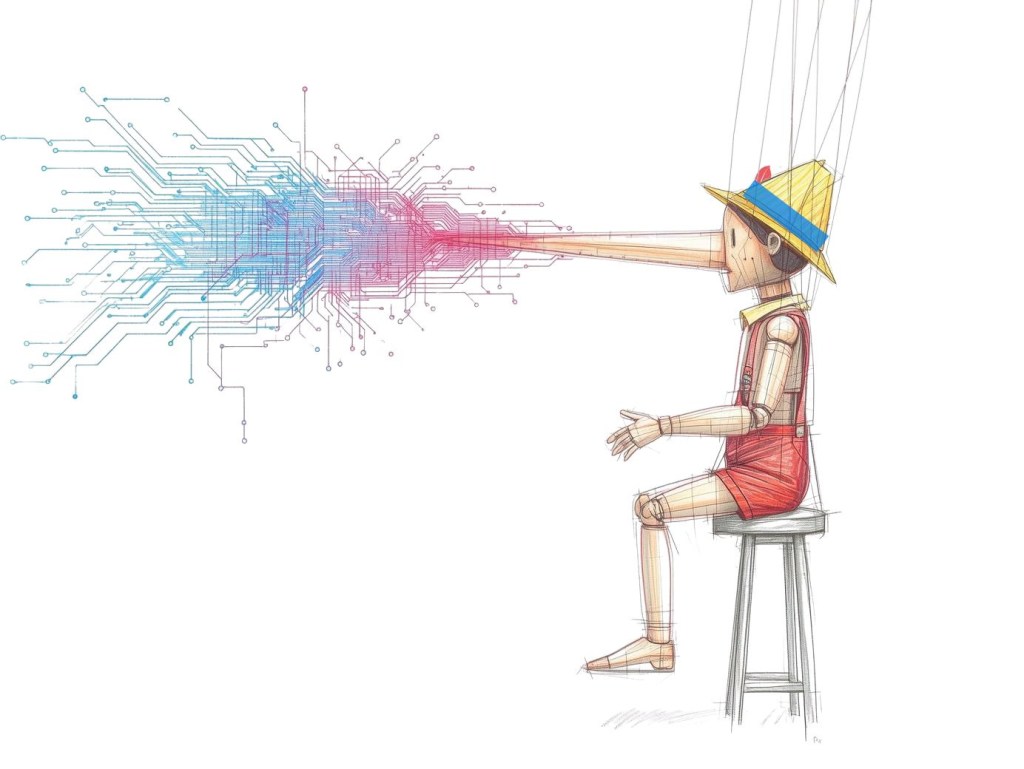
This combined view from Momigliano & Rosa unlocks an interesting angle to study the mindset of the technodeterminist, our modern Pinocchio, who seems to desire the inverse of the original work’s premise; to go from a fake boy to a real life puppet.

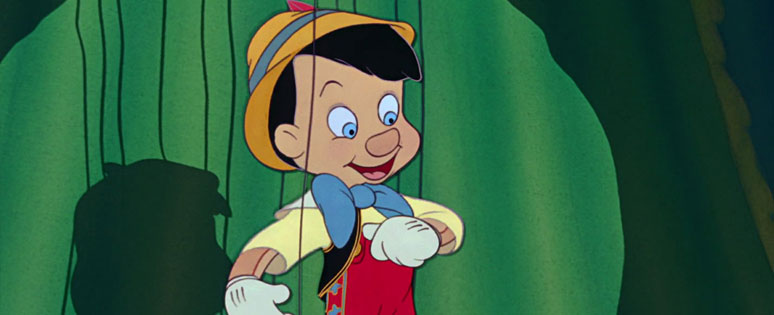
The inversion is artfully illustrated in the lyrics from the 1940 adaptation by Disney – 

I’ve got no strings

To hold me down

To make me fret

Or make me frown

I had strings

But now I’m free

There are no strings on me

Hi-ho the me-ri-o

That’s the only way to go

I want the world to know

Nothing ever worries me

I’ve got no strings

So I have fun

I’m not tied up to anyone

They’ve got strings

But you can see

There are no strings on me

– “I’ve Got No Strings” from Disney’s “Pinnochio” 1940
by Leigh Harline / Ned Washington

In the Disney 1940 adaptation of “Pinocchio,” the marionette celebrates having “no strings.” A puppet is held up by strings, yet the song recasts them as holding him down. 

Strings function metaphorically here as attachments—vulnerable, caring relationships, obligations, dependencies. What once enabled mobility and orientation is reframed as constraint. Freedom becomes detachment, invulnerability turns into identity. 

The theme of comparison is key. The only way to be free is to be a puppet, but not a marionette controlled by relationships and attachments, something real boys might have to contend with.

The outward projection is one of unattached coolness, nothing ever worries me, nothing binds me, nothing holds me down or back. 

The inverse moral of Pinocchio for the technodeterminist, might be that the original ending, becoming a real boy, belongs to the past. With the proper tech, Carlo Collodi’s vision for disillusioned peasants, can evolve alongside the machines that overtook the political nature of countries around the world and are going through a hasty rejiggering of industry into technocracy. 

The goal might no longer be to become “real boys” based on an outdated (maybe even “fake”) view of politics and citizenry. 

The goal is to cut ties to everything and walk as carefree puppets—not to live inside real life with others, but to manipulate your way through it alone.